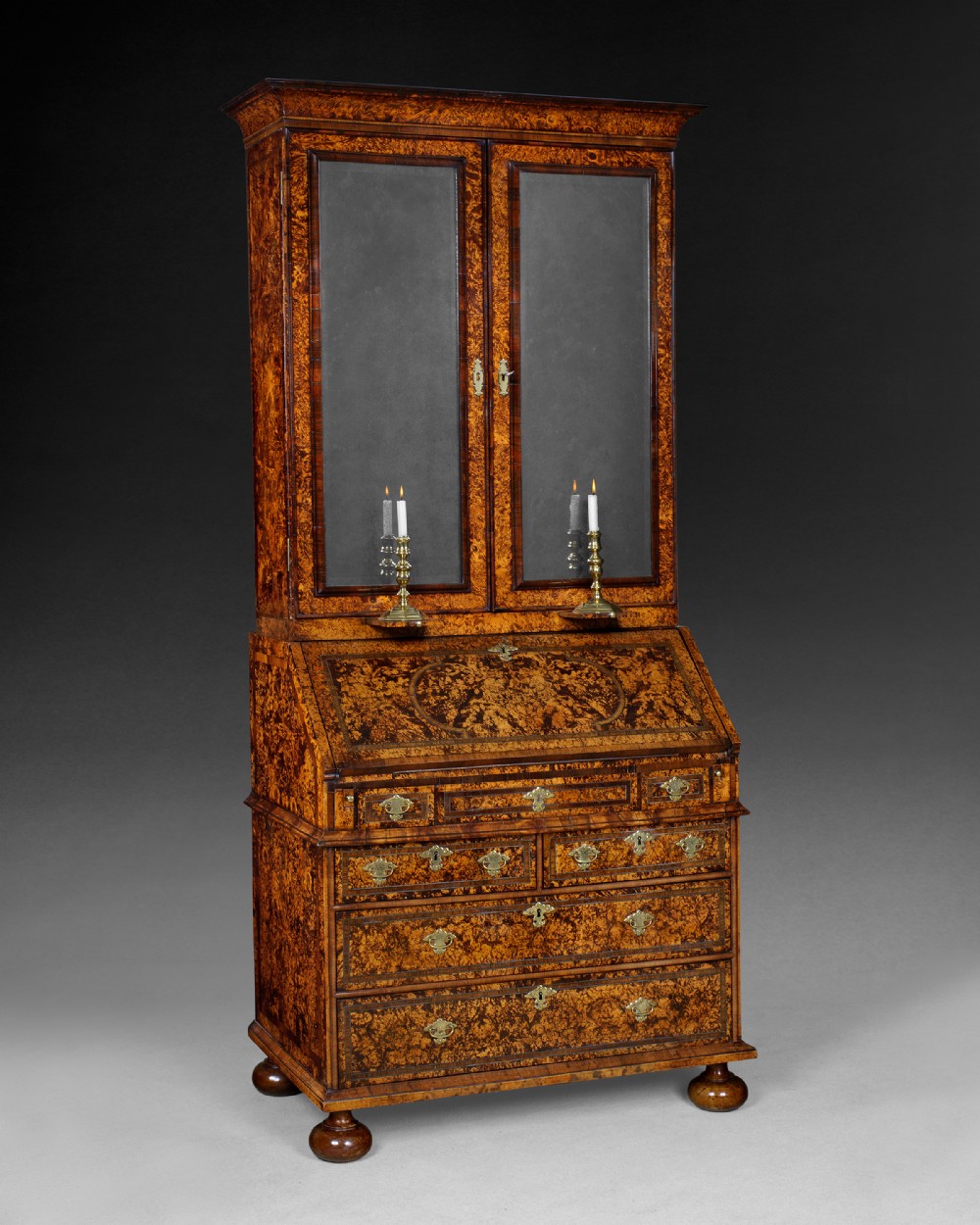
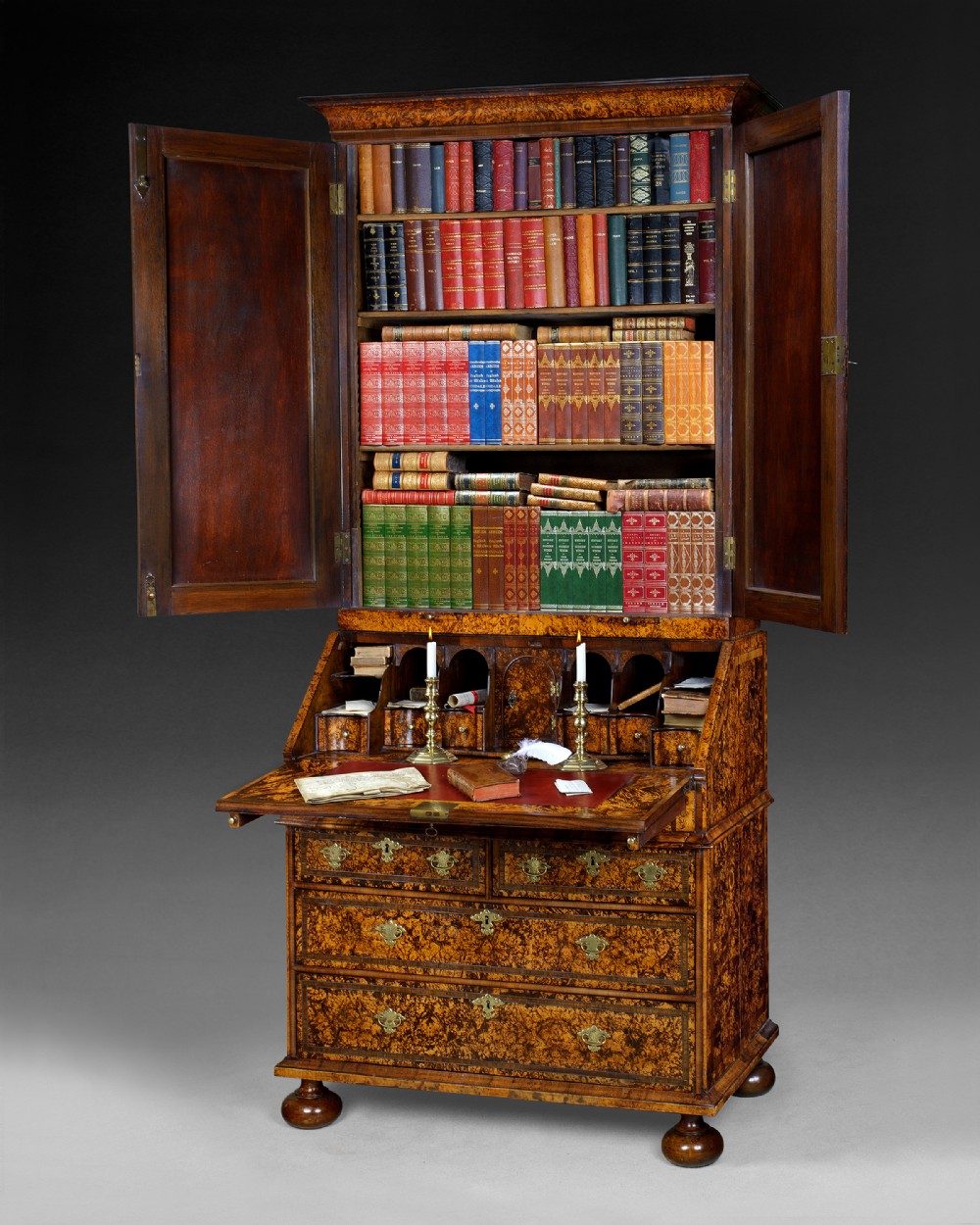
An extremely fine and rare Queen Anne period "Burr Mulberry" bureau bookcase attributed to John Coxed with rosewood cross bandings and mouldings as well as pewter stringing. The deep cavetto cornice above 2 mirrored doors to the upper part enclosing adjustable shelves and having pull out candle slides to the frieze above the bureau flap. This opens to reveal an arrangement of pigeon holes and small concave fronted drawers around a central arched door behind a locking well slide. On the outside the well is flanked by a small drawer to each side above two half width and two full width drawers and the whole is raised on flat bun feet.
H: 88", 224 cms, W: 41.25", 105 cms, D: 23", 58.5 cms.
Attribution: From Ca. 1711 to Ca. 1797 the White Swan workshop on the south side of St. Paul’s Churchyard in London was continuously occupied by successive generations of cabinet-makers who identified their works with paper labels. Several examples by John Coxed and Coxed & Woster are recorded and this helps in the attribution of this example. There are a number of quirks to their known works which in combination make this attribution valid. These are the use of what is commonly called Burr Mulberry with Rosewood Mouldings, Crossbanding and lines of pewter inlay. It has more recently been identified that these Mulberry Veneers are in fact stained Maple or Sycamore and indeed in Stalker and Parker's treatise on japanning a section is given over to producing a tortoiseshell type effect using nitric acid, metal filings and lampblack mixes with linseed oil. As there is a body of labelled pieces by John Coxed (Fl.1711-1718) or indeed his widow Grace Coxed and Thomas Woster (Coxed & Woster Fl. 1719-1735) we have comparisons.
Coxed's early works have the applied mouldings to retain the mirror plates as in this example and the lack of a surbase moulding to the top of the base complies exactly with his labelled oeuvre. Interestingly, the sliding wooden locks mechanism to secure the well slide as described by Adam Bowett (See below) is featured in this example as well.
Literature: Furniture History, The Journal of The Furniture History Society, Vol. XXXIX, 2013 "Labelled furniture from the White Swan workshop" Adam Bowett & Laurie Lindey pp 71-98.
"English Furniture 1660 - 1714 From Charles II to Queen Anne", Adam Bowett, pp 224-226
"The London Furniture Makers, Sir Ambrose Heal", pp 40-43, Illustrations: pages 31 & 229-231
"Marked London Furniture 1700-1840" Christopher Gilbert, pp 153-162, illustrations 232-253
Country Life October 2nd. 1969 “The myth of the Mulberry Burr veneer, Edward H Pinto.