33,150  PAGES BROWSED TODAY PAGES TODAY 88 ANTIQUES UPLOADED TODAYNEW ARRIVALS
88 ITEMS ADDED TODAY
Sort Order
Items Per Page
Browse Categories
Sort order
Items per page
ID #SA1141877
SOLD
Email
Save
Franz De Paula Ferg (Attributed), Figures of the Commedia Dell'arte Performing in a Busy Village Square - Antique Oil Painting
Brave Fine Art
sold SA1141877
Sorry, but this item has been sold.
Brave Fine Art

Brave Fine Art

Sellingantiques Verified Since Nov 2018
View Dealers Stock Page
  • About Us
    Exquisite antique paintings that capture the imagination.
Id #SA1141877
PDF SHARE
SAVE

Franz De Paula Ferg (Attributed), Figures of the Commedia Dell'arte Performing in a Busy Village Square - Antique Oil Painting

18th century
Description

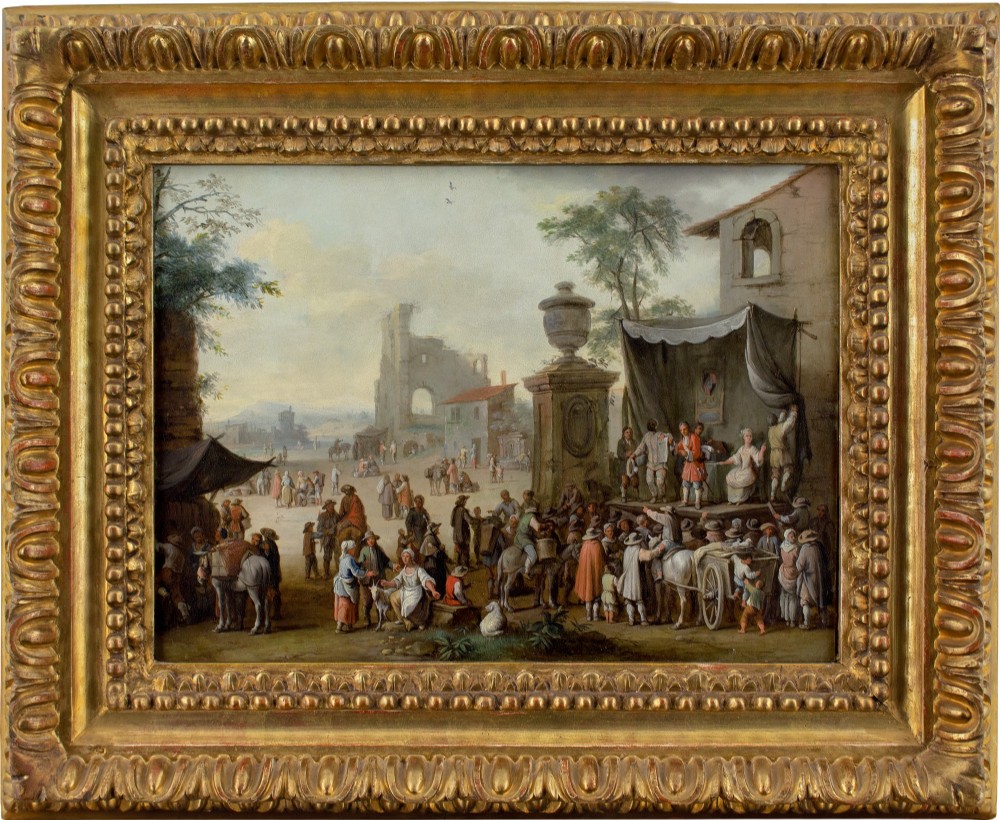
This early 18th-century oil painting attributed to Austrian artist, Franz de Paula Ferg (1689-1740), depicts the Commedia dell’Arte performing in a busy Italian village square. Ferg was a distinguished painter, draughtsman and printmaker of multi-figure genre scenes and landscapes.

Amid the hurly-burly of a crowded market, citizens mingle to discuss various wares. In the foreground, a woman appears to plead with another during a goat-based debate. A behatted chap in a green coat gesticulates, perhaps bartering or explaining “we might be back later”.

By the stage, a rider atop a white horse is delayed by the crowds, as two sprightly ne'er-do-wells extract fresh eggs from his cart. Their mother stands ahead of them, awaiting the spoils. In every direction, there’s a tale unfolding. Who are these characters? What are their respective roles? Who can be trusted? From our elevated position, they appear akin to curious ‘Lilliputians’ obliviously conducting their everyday activities within a quaint miniature environment.

We’re reminded, while pondering on these intriguing questions, of the travelling actors conspicuously treading the boards on the right. The ‘Commedia dell'Arte’ was a partially improvised show based around several standard character types. Popular between the 16th and 18th centuries, actors would assume a role, such as a mischievous masked harlequin, or a self-assured ‘Il Capitano’, then proceed to amuse the audience with a string of witty shenanigans.
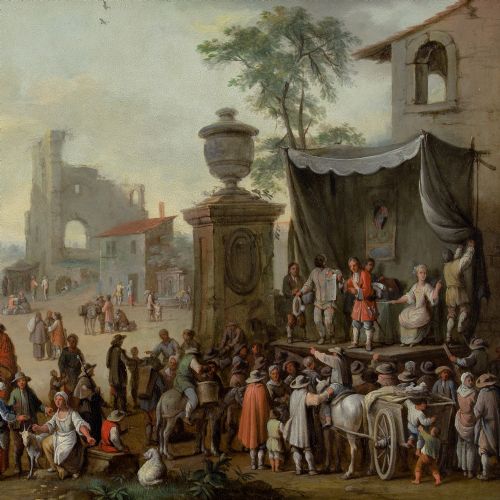
By including a theatre, Ferg is narrating a rather ironic story of his own, whereby the audience is providing the ‘real’ entertainment. Why do we need to concoct an imaginary story when the villagers have such stimulating tales?

“Jesters do oft prove prophets”. King Lear. William Shakespeare.

Produced during the early part of his career, the figures, colouring and overall composition are comparable with two of his signed works at the National Gallery in Prague - ‘Small Town with a Church’ and ‘Landscape with Dancing Peasants’. Also with his ‘Village on a Canal’, which is in the Lichtenstein Princely Collections. All of these stem primarily from Ferg’s tuition with Johann (Hans) Graf (1653-1710) and were probably undertaken prior to 1720.

Born in Vienna, at a time of significant change, Franz de Paula Ferg, also known by his anglicised name of Francis Paul Ferg, was a master of genre painting. He was trained initially by his father, the history painter, Adam Pankraz Ferg (1651-1729), before working first under ‘Baschueber’ and then Graf. During the early part of his career, he was particularly inspired by the latter, and developed a similar style, both in terms of brushwork and colouring. Often we see a blueish-green landscape with figures rendered consistently in ochre, tinted vermillion, and light blue. Most of his works were on small sheets of copper.

Next, Ferg lived with the landscape painter, Josef Orient (1677-1747), presumably working in his studio. Apprentices, in general, were known to assist the master with specific elements, such as adding figures (also known as ‘staffage’) into a view. Indeed, when looking across Orient’s oeuvre, it would appear that Ferg was more accomplished at rendering believable forms. There was probably a similar arrangement in place when he travelled to Dresden and worked alongside Johann Alexander Thiele (1685-1752).

It was in Dresden that Ferg established himself as an artist of considerable merit, producing numerous works for patrons. His attention to minutiae, coupled with his advanced skill as a colourist, formed the basis of a growing reputation. He soon taught himself to etch, thus enabling him to offer prints alongside his works in oil.

In his ‘Figures of the Commedia dell'Arte Performing a Quack Doctor Scene in a Village Square’, which sold at Christie’s in 2013, there’s a sense of realism, whic

Physical Dimensions
Height
37cm (14.57")
Width
44cm (17.32")
Depth
5cm (1.97")
Declaration

Brave Fine Art has dated this piece to the 18th Century.

Reference Numbers
Sellingantiques Reference
SA1141877
Description
This early 18th-century oil painting attributed to Austrian artist, Franz de Paula Ferg (1689-1740), depicts the Commedia dell’Arte performing in a busy Italian village square.
Ferg was a distinguished painter, draughtsman and printmaker of multi-figure genre scenes and landscapes.
Brave Fine Art
fig 1. Franz De Paula Ferg (Attributed), Figures Of The Commedia dell'Arte Performing In A Busy Village Square - Antique Oil Painting
fig 1. Franz De Paula Ferg (Attributed), Figures of the Commedia Dell'arte Performing in a Busy Village Square - Antique Oil Painting

Amid the hurly-burly of a crowded market, citizens mingle to discuss various wares. In the foreground, a woman appears to plead with another during a goat-based debate. A behatted chap in a green coat gesticulates, perhaps bartering or explaining “we might be back later”.

fig 2. Franz De Paula Ferg (Attributed), Figures Of The Commedia dell'Arte Performing In A Busy Village Square - Antique Oil Painting
fig 2. Franz De Paula Ferg (Attributed), Figures of the Commedia Dell'arte Performing in a Busy Village Square - Antique Oil Painting

By the stage, a rider atop a white horse is delayed by the crowds, as two sprightly ne'er-do-wells extract fresh eggs from his cart. Their mother stands ahead of them, awaiting the spoils. In every direction, there’s a tale unfolding. Who are these characters? What are their respective roles? Who can be trusted? From our elevated position, they appear akin to curious ‘Lilliputians’ obliviously conducting their everyday activities within a quaint miniature environment.

fig 3. Franz De Paula Ferg (Attributed), Figures Of The Commedia dell'Arte Performing In A Busy Village Square - Antique Oil Painting
fig 3. Franz De Paula Ferg (Attributed), Figures of the Commedia Dell'arte Performing in a Busy Village Square - Antique Oil Painting

We’re reminded, while pondering on these intriguing questions, of the travelling actors conspicuously treading the boards on the right. The ‘Commedia dell'Arte’ was a partially improvised show based around several standard character types. Popular between the 16th and 18th centuries, actors would assume a role, such as a mischievous masked harlequin, or a self-assured ‘Il Capitano’, then proceed to amuse the audience with a string of witty shenanigans.

fig 4. Franz De Paula Ferg (Attributed), Figures Of The Commedia dell'Arte Performing In A Busy Village Square - Antique Oil Painting
fig 4. Franz De Paula Ferg (Attributed), Figures of the Commedia Dell'arte Performing in a Busy Village Square - Antique Oil Painting

By including a theatre, Ferg is narrating a rather ironic story of his own, whereby the audience is providing the ‘real’ entertainment. Why do we need to concoct an imaginary story when the villagers have such stimulating tales?

fig 5. Franz De Paula Ferg (Attributed), Figures Of The Commedia dell'Arte Performing In A Busy Village Square - Antique Oil Painting
fig 5. Franz De Paula Ferg (Attributed), Figures of the Commedia Dell'arte Performing in a Busy Village Square - Antique Oil Painting

“Jesters do oft prove prophets”. King Lear. William Shakespeare.

Produced during the early part of his career, the figures, colouring and overall composition are comparable with two of his signed works at the National Gallery in Prague - ‘Small Town with a Church’ and ‘Landscape with Dancing Peasants’. Also with his ‘Village on a Canal’, which is in the Lichtenstein Princely Collections. All of these stem primarily from Ferg’s tuition with Johann (Hans) Graf (1653-1710) and were probably undertaken prior to 1720.

fig 6. Franz De Paula Ferg (Attributed), Figures Of The Commedia dell'Arte Performing In A Busy Village Square - Antique Oil Painting
fig 6. Franz De Paula Ferg (Attributed), Figures of the Commedia Dell'arte Performing in a Busy Village Square - Antique Oil Painting

Born in Vienna, at a time of significant change, Franz de Paula Ferg, also known by his anglicised name of Francis Paul Ferg, was a master of genre painting. He was trained initially by his father, the history painter, Adam Pankraz Ferg (1651-1729), before working first under ‘Baschueber’ and then Graf. During the early part of his career, he was particularly inspired by the latter, and developed a similar style, both in terms of brushwork and colouring. Often we see a blueish-green landscape with figures rendered consistently in ochre, tinted vermillion, and light blue. Most of his works were on small sheets of copper.

fig 7. Franz De Paula Ferg (Attributed), Figures Of The Commedia dell'Arte Performing In A Busy Village Square - Antique Oil Painting
fig 7. Franz De Paula Ferg (Attributed), Figures of the Commedia Dell'arte Performing in a Busy Village Square - Antique Oil Painting

Next, Ferg lived with the landscape painter, Josef Orient (1677-1747), presumably working in his studio. Apprentices, in general, were known to assist the master with specific elements, such as adding figures (also known as ‘staffage’) into a view. Indeed, when looking across Orient’s oeuvre, it would appear that Ferg was more accomplished at rendering believable forms. There was probably a similar arrangement in place when he travelled to Dresden and worked alongside Johann Alexander Thiele (1685-1752).

It was in Dresden that Ferg established himself as an artist of considerable merit, producing numerous works for patrons. His attention to minutiae, coupled with his advanced skill as a colourist, formed the basis of a growing reputation. He soon taught himself to etch, thus enabling him to offer prints alongside his works in oil.

In his ‘Figures of the Commedia dell'Arte Performing a Quack Doctor Scene in a Village Square’, which sold at Christie’s in 2013, there’s a sense of realism, whic

Height
37cm (14.57")
Width
44cm (17.32")
Depth
5cm (1.97")
Date of Manufacture

Brave Fine Art has dated this piece to the 18th Century.

Reference Numbers
Sellingantiques Ref
SA1141877
Brave Fine Art
Brave Fine Art
Sellingantiques verified Since Nov 2018

Exquisite antique paintings that capture the imagination.

Dealer Profile

You can view the stock and full dealer information on the Brave Fine Art Profile Page
PDF SHARE
SAVE
Franz De Paula Ferg (Attributed), Figures Of The Commedia dell'Arte Performing In A Busy Village Square - Antique Oil Painting
1 / 8
Archive I Franz De Paula Ferg (Attributed), Figures Of The Commedia dell'Arte Performing In A Busy Village Square - Antique Oil Painting

Franz De Paula Ferg (Attributed), Figures of the Commedia Dell'arte Performing in a Busy Village Square - Antique Oil Painting

Archive II Franz De Paula Ferg (Attributed), Figures Of The Commedia dell'Arte Performing In A Busy Village Square - Antique Oil Painting  View II
Archive III Franz De Paula Ferg (Attributed), Figures Of The Commedia dell'Arte Performing In A Busy Village Square - Antique Oil Painting  View III
Archive IV Franz De Paula Ferg (Attributed), Figures Of The Commedia dell'Arte Performing In A Busy Village Square - Antique Oil Painting  View IV
Archive V Franz De Paula Ferg (Attributed), Figures Of The Commedia dell'Arte Performing In A Busy Village Square - Antique Oil Painting  View V
Archive VI Franz De Paula Ferg (Attributed), Figures Of The Commedia dell'Arte Performing In A Busy Village Square - Antique Oil Painting  View VI
Archive VII Franz De Paula Ferg (Attributed), Figures Of The Commedia dell'Arte Performing In A Busy Village Square - Antique Oil Painting  View VII
Archive VIII Franz De Paula Ferg (Attributed), Figures Of The Commedia dell'Arte Performing In A Busy Village Square - Antique Oil Painting  View VIII
Enlarged Archival View
Telephone 01684 215986
Location
21 Enterprise Way
Arle Road
Cheltenham
Cotswolds
GL51 8LZ
United Kingdom

Under appointment only.
Verified Since Nov 2018
Items For Sale 66
Items Sold 1,841
Brave Fine Art
Brave Fine Art
Verified Since Nov 2018
View Dealer Info
Location: 21 Enterprise Way, Arle Road, Cheltenham, Cotswolds, GL51 8LZ, United Kingdom, , Under appointment only.
Verified
Nov 2018
For Sale
66
Sold
1,841
Franz De Paula Ferg (Attributed), Figures Of The Commedia dell'Arte Performing In A Busy Village Square - Antique Oil Painting
Ref: SA1141877
Franz De Paula Ferg (Attributed), Figures Of The Commedia dell'Arte Performing In A Busy Village Square - Antique Oil Painting
Detail View 2
Detail View 3
Detail View 4
Detail View 5
Detail View 6
Detail View 7
Detail View 8
Archival Detail
Every single antique dealer on our platform is individually approved by our internal team. We verify their professional trade history, ethical standards, and photographic quality to ensure a secure, high-standard buying environment. Upon joining, every dealer agrees to a strict 9-point code of conduct. While issues can occasionally arise, our dealers typically resolve them swiftly and directly with the buyer. In fact, since our founding in 2002, Sellingantiques has only had to step in to help resolve an issue on roughly five occasions—a true testament to the quality of our dealers and their dedication to your happiness.
Our dealers are highly experienced in packing and shipping fragile, high-value antiques. Because you are in direct contact with the dealer, you will be able to easily go through all available shipping and insurance options together to ensure your item arrives safely.
Antiques are the ultimate green purchase. By choosing historical pieces over newly manufactured goods, you completely eliminate the carbon footprint of modern mass production while preserving exceptional, timeless craftsmanship.
items
Add keywords to the filter
Price
£100
£250000
Era
Movements
Material
Origin
Stock Location
Freshness
Online Payments
Categories