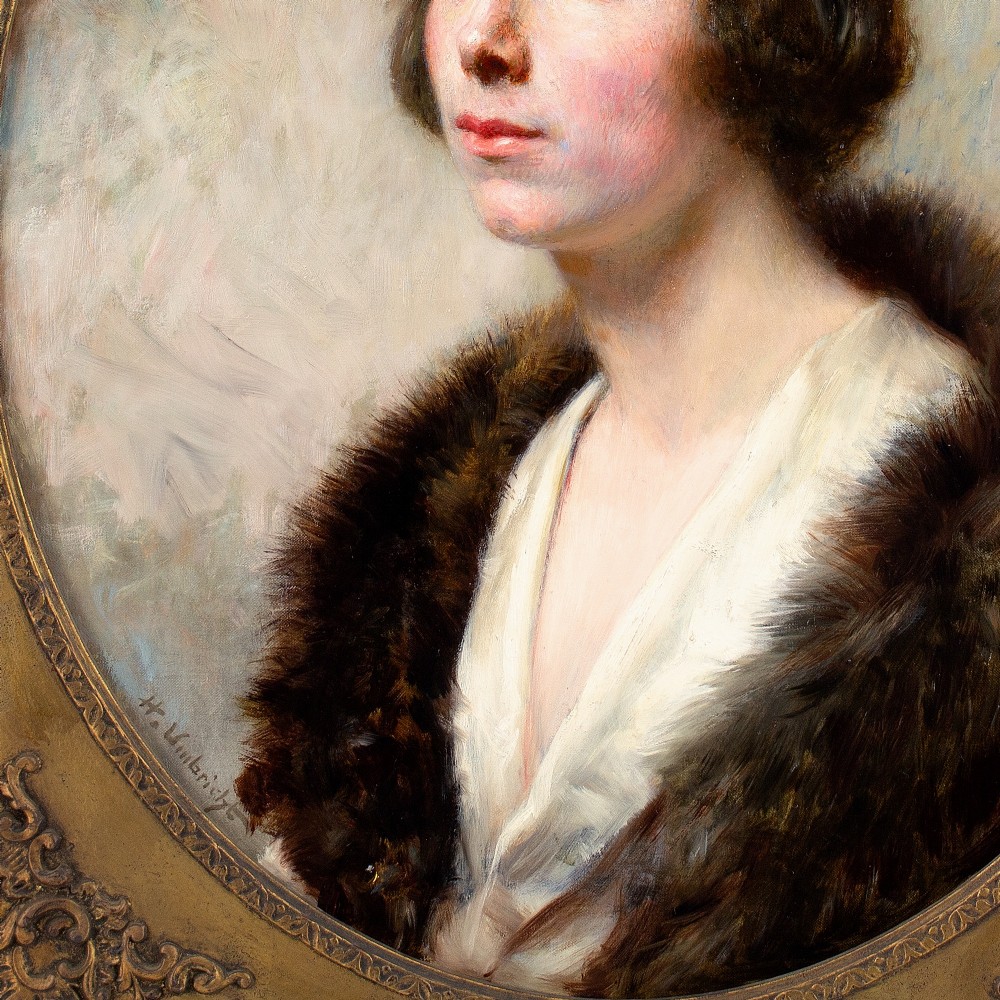
Brave Fine Art has dated this piece to the 1920s.
Umbricht was a distinguished painter of genre scenes, landscapes, stills and portraits.
Distant mountains, picturesque valleys, the sparkling Ehn River, and sprawling rural plains - a veritable smorgasbord of views.
He honed his draughtsmanship under the tuition of his uncle, ‘Hess’, and was soon offered a scholarship by the German government to study in Munich. He refused, however, and headed for Paris to train under the highly-regarded Léon Bonnat (1833-1922).

Bonnat’s studio was synonymous with success and he encouraged his students to paint freely and with expression. His own portraits were influenced by the Spanish masters, such as Diego Velázquez (1599-1660), and he extolled the virtues of this style. Umbricht was in fine company as Bonnat also trained John Singer Sargent, P. S. Krøyer, Erik Werenskiold, Henri de Toulouse-Lautrec and Gustave Caillebotte among others.

Following his training, the Paris Salon beckoned and the young Umbricht’s debut came in 1880. By 1884, he’d been awarded his first medal and several more would follow including at the Chicago and London Exhibition and the prestigious Exposition Universelle (1900). He was subsequently knighted with the Cross of the Order of Leopold.

Midway through his career, the critics were alive with praise describing his portraits as “full of mastery” and with “very true and harmonious” colouring. In 1911, the newspaper ‘Le Rappel’ described him as “earning a place among our best portraitists”. His adroit handling of colour was often the highlight of press reviews, rarely dull, he preferred to tantalise the eyes with a lively, yet harmonious palette.

From the 1920s onwards, his career seems to have plateaued, perhaps due to the rise of the avant-garde in Paris. Interest waned in classically inspired works in favour of the emerging modernists. During this later period, he produced numerous portraits for local dignitaries, as we see here. These were full of guile, energy and his trademark effervescence. Each underpinned by his education with Bonnat - the spirit of Velázquez firmly front of mind.

Today, the achievements of Honoré Louis Umbricht are consigned to the archives and rarely do his works surface. He was a traditionalist usurped by new Parisian ideologies. His daughter, Marie-Thérèse Umbricht, also became a painter. He’s represented at various museums including in Nancy and Strasbourg.

The sitter, Marguerite Grosjean, was born in Erstein, Bas-Rhin, Grand Est, France. She was around 30 for this sitting.
Signed in the lower left and held within its original gilt frame.
Learn more about Honoré Louis Umbricht in our directory.

Medium: Oil on canvas
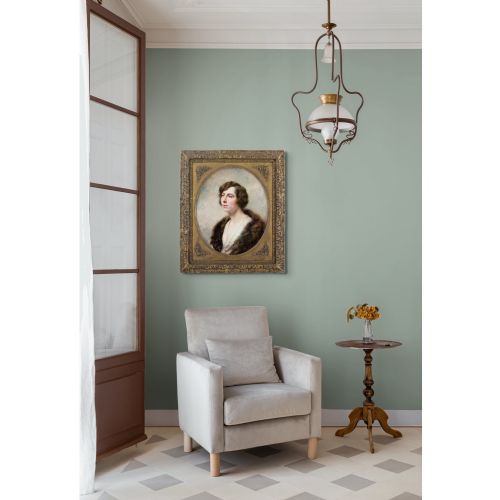
Overall size: 30” x 35” / 76cm x 89cm
Year of creation: c. 1925
Labels & Inscriptions: Inscribed on the reverse with a reference to the sitter.
Provenance: Private collection, France.
Condition: Assessed and approved by our conservator. Cleaned. Revarnished. Faint stretcher marks. Frame restored.
Artist’s auction maximum: £18,200
Our reference: BRV1767
Brave Fine Art has dated this piece to the 1920s.
Exquisite antique paintings that capture the imagination.
You can view the stock and full dealer information on the Brave Fine Art Profile Page

Honoré Louis Umbricht, Portrait of Marguerite Grosjean - Antique Oil Painting