
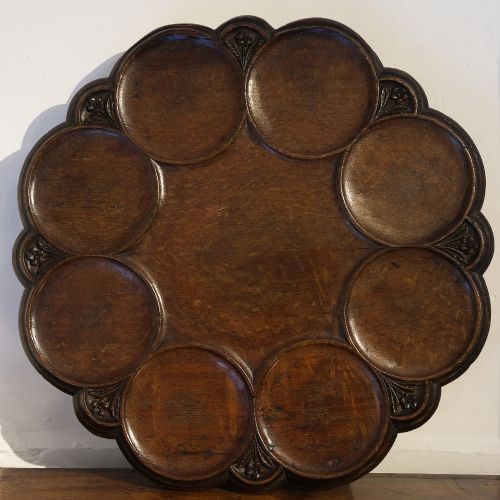


Wooden Lazy Susan
A wooden lazy susan is a revolving table top serving tray designed to pass food smoothly around the table during communal dining.
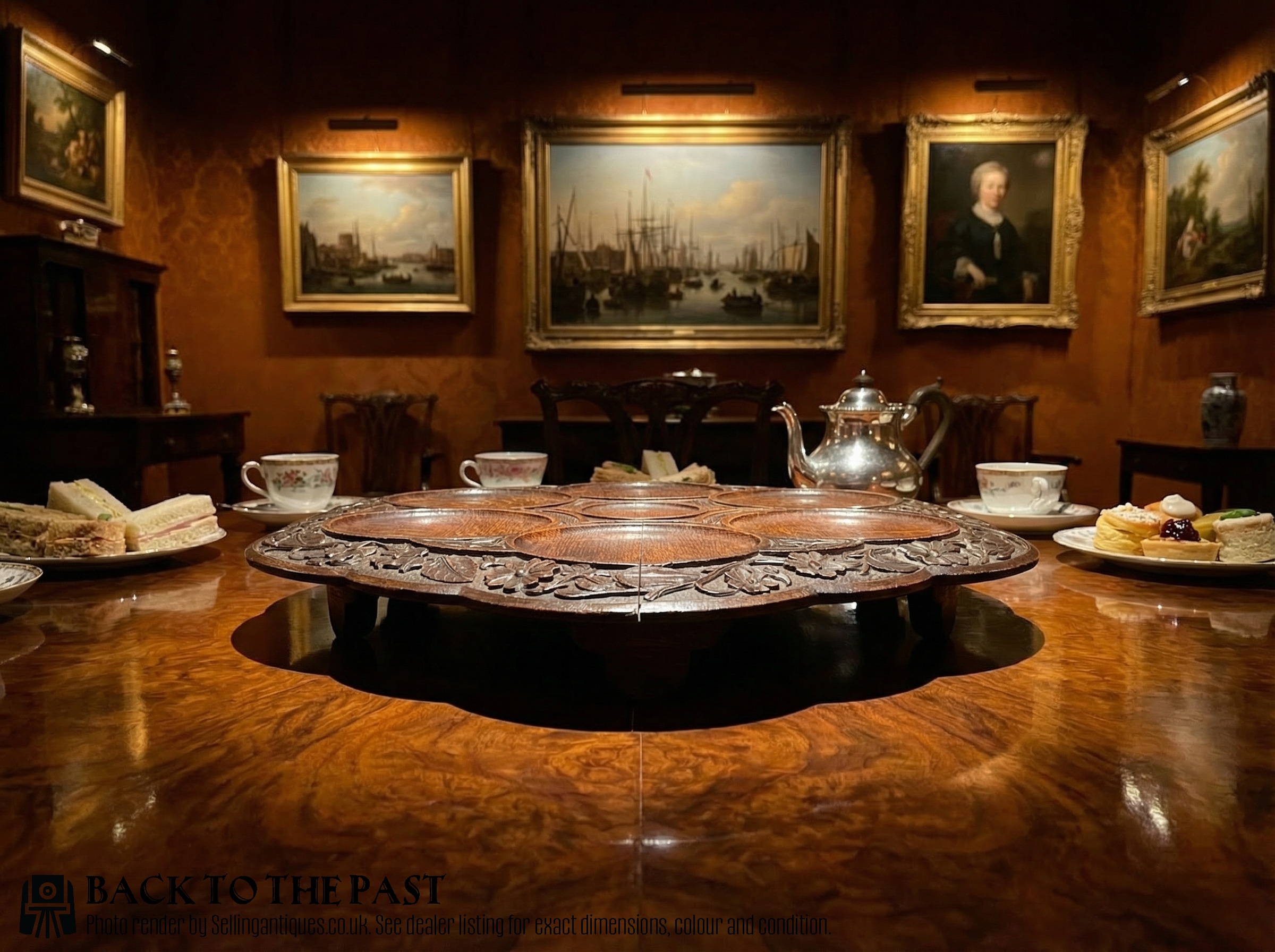
Wooden Lazy Susan
When you search for a wooden lazy susan, you encounter revolving trays and table top stands spanning the eighteenth century through to the Edwardian period and the Art Deco era. The examples on this page include simple round stands, carved rotating trays, two tier revolving servers, and table top accessories.
The pieces originate across English country and formal dining traditions, taking the form of traditional lazy susans, serving trays, and rotating tazzas. Mahogany and oak dominate the selection, often shaped as circular dining accessories intended to sit centrally on the table.
How they were made
Maker construction relies heavily on solid timber boards of mahogany and oak, frequently turned on a lathe and joined with central rotating mechanisms. Cabinet makers also applied decorative touches such as satinwood inlay and cross banding to enhance the circular surface.
The listings span the eighteenth, nineteenth, and early twentieth centuries, featuring oak, mahogany, and satinwood inlay.
What varies in quality
Quality rests in the precision of the timber selection and the smoothness of the revolving mechanism. Dense mahogany figures with cross banding or subtle satinwood inlay demonstrate a higher level of cabinet making than plain utility boards.
The weight and balance of the central stand dictate how steadily the tray turns under a heavy load of dishes. Superior examples maintain a level spin without wobble, reflecting careful proportioning by the maker.
The Wooden Lazy Susan Glossary
- Lazy Susan
- A revolving tray placed on a table to assist in moving food easily from person to person. These rotating accessories date back centuries in English dining rooms.
- Cross banded
- A border technique where thin strips of veneer are laid across the grain of the main timber. This decorative framing appears on polished mahogany table tops.
- Tazza
- A small pedestal plate or shallow bowl raised on a foot. In wooden serveware, this refers to an elevated revolving display stand.
- Satinwood inlay
- Contrasting pale timber inserted into a darker wood surface to form geometric patterns. Cabinet makers used this detail to ornament dining furniture.
- Revolving
- The property of turning on an axis or central pivot. This motion defines the entire category of table top serving accessories.
Wooden Lazy Susan: Frequently Asked Questions
What is a wooden lazy susan used for?
These revolving trays were placed in the centre of dining tables to share dishes, condiments, and canapés among guests without passing bowls manually.
They allowed diners to rotate food towards themselves with ease during formal meals and party gatherings.
How do I date a wooden lazy susan?
Dating relies on identifying the timber species, construction methods, and decorative styles such as Georgian cross banding or Edwardian turning.
Earlier examples from the eighteenth and early nineteenth centuries typically feature heavier solid mahogany boards and hand turned components.
Are these pieces stable on the table?
Most antique serving turntables are built with a wide circular base or low pedestal to support weight evenly as dishes rotate.
Properly maintained rotating pivots allow the top to spin smoothly without tipping when food is placed near the edge.
Can I use an antique lazy susan today?
These wooden items function well for modern serving purposes, provided the central turning mechanism is handled with care.
Regular polishing helps protect the antique timber surfaces from moisture and daily wear during contemporary dining use.