
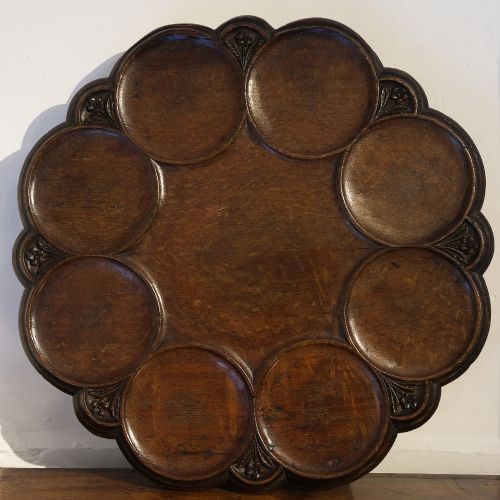


Antique Rotating Tray
An antique rotating tray brings the practical charm of the dining table into focus, offering effortless access to food and drink across Georgian, Victorian, and Edwardian homes.
Antique Rotating Tray
An antique rotating tray spans forms such as the lazy Susan, the dumb waiter, and the tazza, designed to revolve on a central pivot for ease at the table. These pieces emerge across the Georgian, Victorian, and Edwardian eras, serving as functional dining aids for condiments, courses, and drinks.
The versions most commonly met on this page include mahogany and oak lazy Susans, alongside multi-tiered dumb waiters and occasional party turntables. They range from simple timber discs to carved or two-tiered constructions originating in English workshops.
How they were made
Cabinet makers utilised dense hardwoods like mahogany, Cuban mahogany, and oak to build these rotating trays, ensuring a stable and heavy base that turns smoothly. Selected pieces incorporate carved decorative borders and contrasting glass or metal elements such as aluminium and chrome.
Joinery techniques focused on balancing the revolving top plate securely upon a concealed pivot mechanism. Timber surfaces were planed, polished, and sometimes carved by hand to display the natural grain of the wood.
What varies in quality
The distinction between a standard rotating tray and a superior example lies in the stability and smoothness of the revolving mechanism. Finely balanced movement without wobble separates better workshops from everyday production.
Material selection and surface treatment further define the hierarchy, where deeply figured Cuban mahogany or crisp hand-carving elevate the piece. The integrity of the timber and the weight of the base dictate how well the object ages through decades of use.
The Antique Rotating Tray Glossary
- Lazy Susan
- A revolving tray placed on a table to assist in moving food easily between diners. This form appears frequently in mahogany and oak across various centuries.
- Dumb waiter
- A freestanding piece of furniture with revolving tiers designed to hold dishes near the dining table without servant attendance. Georgian examples often feature graduated circular trays on a central column.
- Tazza
- A shallow cup or tray raised on a pedestal foot, occasionally adapted into a revolving format during the Art Deco period. It functions as a decorative serving piece for small items.
- Cuban mahogany
- A dense, richly figured timber harvested in Cuba and widely utilised for high-end cabinet making during the 18th and 19th centuries. It provides exceptional depth and durability to serving trays.
- Pivot mechanism
- The central rotational joint that allows the top surface of the tray to spin independently of the base. Its construction determines the smoothness of the rotation.
Antique Rotating Tray: Frequently Asked Questions
What is a lazy Susan?
A lazy Susan is a rotating tray placed in the centre of a dining table to allow guests to share dishes easily.
They appear in timber forms such as mahogany and oak, dating from the Georgian period through to the Art Deco era.
How do dumb waiters differ?
Dumb waiters are taller, often multi-tiered revolving stands used beside a dining table to hold food and plates.
Unlike flat table-top trays, these freestanding pieces feature graduated shelves supported on a central pillar.
How do I date a tray?
Dating relies upon identifying the timber, construction methods, and stylistic cues present in the piece. Georgian and Victorian examples typically display heavier native hardwoods and hand-turned details.
Were these used for dining?
These revolving trays were primarily designed for formal and domestic dining rooms to facilitate serving without constant attendance.
They allowed diners to pass condiments and courses smoothly around the table.