

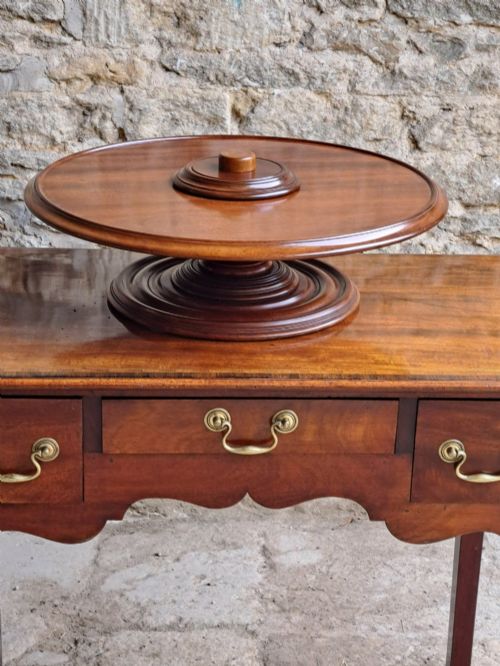


Mahogany Lazy Susan
A mahogany lazy susan brings effortless shared dining to the table, uniting practicality with rich timber grain across several periods.
Mahogany Lazy Susan
A mahogany lazy susan is a revolving table top round stand designed for serving food and condiments easily amongst diners. These pieces appear across Georgian, Victorian, and Edwardian periods as solid round wooden trays mounted on turning mechanisms.
Most examples found on this page date from the nineteenth century and the Georgian era, offering classic round proportions. They serve as functional dining accessories that allow dishes to rotate smoothly during meals.
The form ranges from plain circular trays to larger revolving stands and dumb waiters, reflecting the dining customs of the eighteenth, nineteenth, and early twentieth centuries.
Materials and construction
Every piece recorded in the evidence is made from mahogany, utilising the rich timber's natural strength and deep brown tones. Cabinet makers turned these woods on lathes or joined solid planks to form wide, stable circular surfaces.
Some Edwardian examples incorporate inlaid details, while others rely on the unadorned beauty of solid mahogany boards. The underside conceals the revolving pivot mechanism that allows the tray to turn smoothly on a central bearing.
Mahogany Lazy Susan Retail Price Guide 2026
Typical asking prices for mahogany lazy susan among the pieces listed under this phrase on Sellingantiques today, from the lower quarter to the upper quarter. They describe what is for sale here now, not the wider market.
Some nineteenth-century makers affectionately nicknamed their revolving trays 'Suzie'.
Distinctions in quality
Quality in these revolving trays rests primarily on the selection of the mahogany timber and the stability of the revolving action. Superior examples display rich grain patterns and solid construction that prevents warping across the wide circular top.
The engineering of the pivot mechanism dictates how quietly and evenly the surface rotates under weight. Finer pieces demonstrate precise joinery and smooth movement without wobble or friction.
Wylie & Lockhead
The Mahogany Lazy Susan Glossary
- Lazy Susan
- A revolving circular tray placed on a table to assist in passing food. This serving accessory sits on a central pivot for easy rotation.
- Dumb waiter
- A tiered or revolving serving stand designed to hold dishes near a dining table. These pieces reduce the need for servant attendance during meals.
- Georgian
- Pertaining to the period spanning the reigns of the first four Georges, known for refined cabinet making. Pieces from this era often exhibit classic proportions and elegant timber selection.
- Edwardian
- Dating from the reign of King Edward VII, characterised by lighter proportions and occasional decorative inlay. Items from this time blend traditional forms with fresh aesthetic touches.
- Solid mahogany
- Timber derived from tropical trees, prized for its durability and deep reddish brown colour. This material forms the primary construction medium for all pieces listed.
Mahogany Lazy Susan: Frequently Asked Questions
What is a mahogany lazy susan?
A mahogany lazy susan is a revolving circular wooden tray designed to sit in the centre of a dining table. It allows guests to share dishes and condiments easily without passing plates across the board.
These accessories are constructed entirely from mahogany and span several historical eras, including the Georgian, Victorian, and Edwardian periods.
How do you use a lazy susan?
These revolving stands sit directly on a dining table or sideboard to hold dishes, sauces, and condiments. Diners simply spin the tray gently to bring the desired item within reach.
They function as practical serving accessories that streamline large meals and gatherings.
How do I care for mahogany?
Maintain mahogany surfaces by dusting regularly with a soft, dry cloth and avoiding direct sunlight to preserve the rich timber colour. Conditioning the wood occasionally helps maintain its natural lustre.
Keep these revolving trays away from excessive moisture and extreme temperature fluctuations to protect the underlying mechanism and wood.
How do I date a lazy susan?
Dating relies on observing the timber characteristics, construction methods, and any decorative details such as Edwardian inlay. Georgian and early nineteenth-century pieces often display heavier solid timber construction.
Comparing the turning mechanism and the grain finish to known period examples helps determine the age of the piece.