
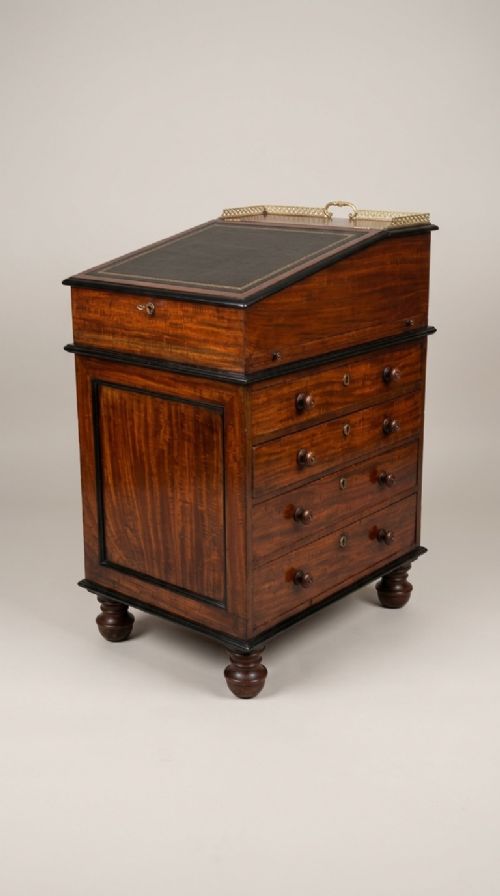

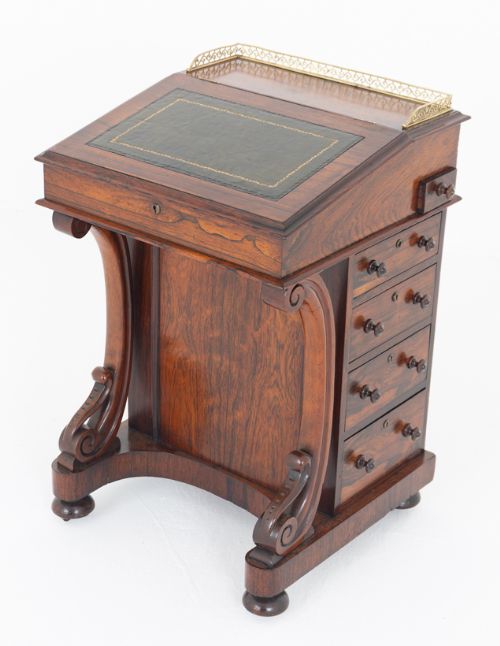


William IV Writing Slope
A william iv writing slope brings solid nineteenth-century craftsmanship and portable practicality straight to your desk.
William IV Writing Slope
A william iv writing slope is a portable desk designed for correspondence, fitted with compartments for stationery and an inclined writing surface. These pieces sit on tabletops or serve as compact standalone desks like the Davenport form.
The material palette leans heavily on rich timbers like rosewood and mahogany, often enhanced with brass inlay or mother of pearl. You will frequently encounter variants incorporating leather writing surfaces and internal storage drawers.
Originating primarily within the nineteenth century, these objects bridge the elegance of the Regency period and the sturdiness of early Victorian furniture design. Many examples take the form of table top boxes or dedicated Davenport desks.
Materials and Construction
Cabinet makers utilised dense timbers such as rosewood and Cuban mahogany, constructing carcasses designed to withstand frequent travel and daily use. These woods received fine polish finishes that highlight natural grain patterns.
Brass corners, hinges, and inlay work provided both structural reinforcement and decorative contrast against the dark timber. Internal writing surfaces were typically lined with fitted leather to offer a smooth texture for pen work.
Object forms span table top writing boxes, Davenport desks, library tables, and reclining armchairs fitted with writing slopes.
Quality and Construction Differences
Superior examples showcase precise joinery and intricate decorative detailing, such as mother of pearl inlay or complex brass banding. Lesser pieces rely on simpler box construction without specialised internal fittings.
The choice of primary timber significantly dictates the grade of the piece, with richly figured rosewood and flame mahogany commanding higher regard than standard utility woods. Well-preserved original leather inserts and intact internal secret drawers elevate the standing of an individual slope.
Gillows·Austin·James Winter and Son·Lowe Bristol
The William IV Writing Slope Glossary
- Writing slope
- A portable box with a slanted lid that opens to reveal a desk surface and stationery compartments. This design allowed writers to work comfortably while travelling.
- Davenport
- A compact pedestal desk incorporating a sloping writing surface and side drawers. It emerged during the Regency period and remained popular through the nineteenth century.
- Brass inlay
- The technique of embedding thin brass strips or decorative motifs into wood surfaces. It adds geometric contrast and structural protection to edges.
- Mother of pearl
- An iridescent inner shell layer used to create small inlaid decorative accents on boxes and furniture. It reflects light with a subtle pearl-like sheen.
William IV Writing Slope: Frequently Asked Questions
How do I use a writing slope today?
Place the box on a stable table or desk, release any internal latches, and fold down the sloping writing surface to access the compartment.
Store modern stationery, pens, or small notebooks inside the fitted internal wells just as historical users stored paper and ink.
What is the difference between a slope and a Davenport?
A writing slope is typically a portable box designed to sit on top of another table or be carried during travel. It folds open into an angled board.
A Davenport is a fixed, standing piece of furniture featuring a built-in desk pedestal with drawers underneath and a stationary writing slope on top.
How do I care for the leather interior?
Keep the leather writing surface away from direct sunlight and excessive moisture to prevent cracking or fading over time. Dust the surface gently with a dry, soft cloth during routine maintenance.
Avoid applying modern chemical cleaners or heavy oils unless specifically formulated for antique leather preservation.
Are these boxes meant for travel?
Historical users carried these slopes on coaches, ships, and trains to maintain correspondence while away from home. They include secure brass locks and robust hinges to protect contents during transit.
While structurally sound, modern collectors generally keep them in static home settings to preserve their antique timber and delicate brass or mother of pearl details.