



White Marble Cherub
A white marble cherub brings classical French and Italian presence to a room, cast in bronze and carved stone.
White Marble Cherub
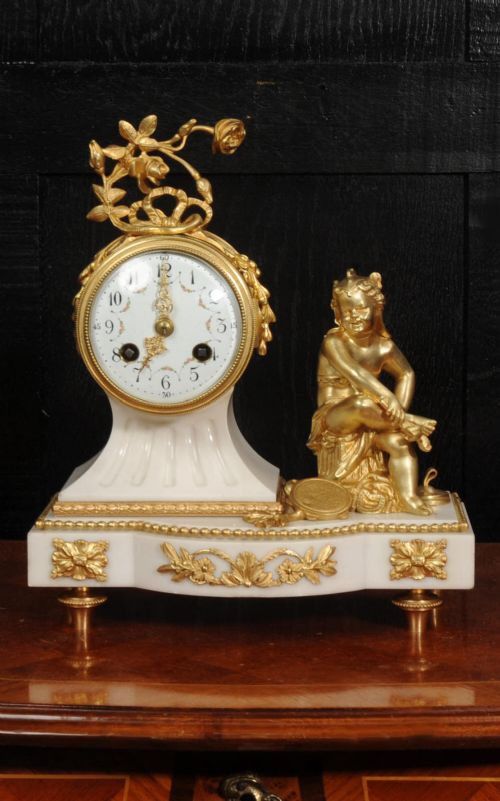
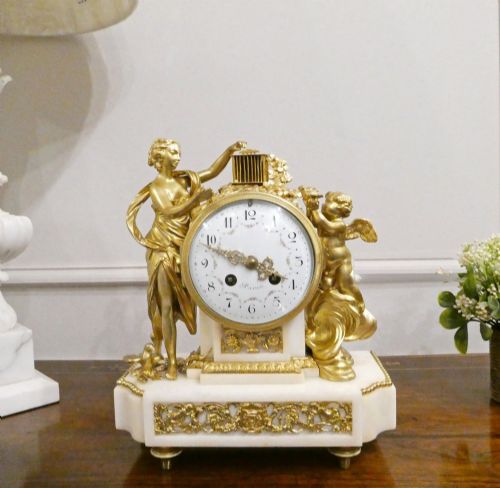
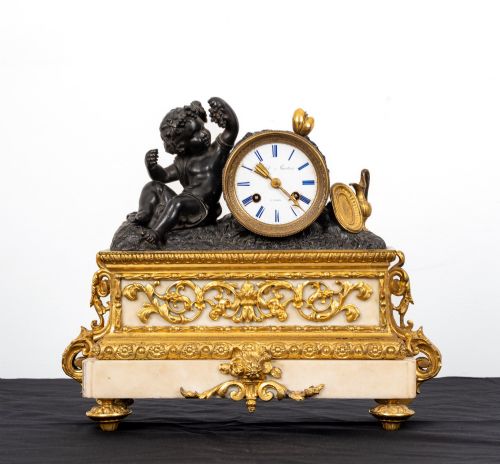
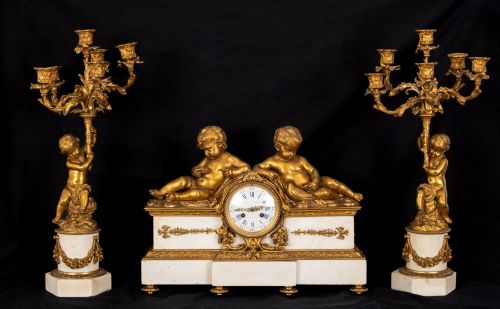
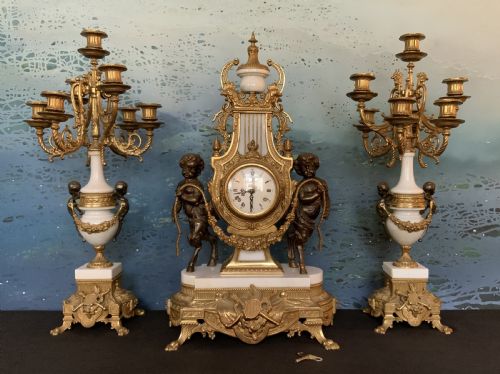
A white marble cherub most frequently appears on this page as part of a nineteenth-century French mantel clock or garniture set, paired with ormolu and gilt bronze. These decorative objects draw heavily on Louis XVI and Neoclassical styles, placing winged figures alongside clock faces and candelabra.
Beyond timepieces, the search phrase encompasses standalone sculptures and pairs of bronze and marble candle holders depicting putti and children. The materials span white marble, Carrera marble, and alabaster, shaped during the Victorian era and the later decades of the nineteenth century.
How they were made
The construction combines carved white marble or alabaster bases and figures with cast bronze components, often finished with fire-gilded ormolu. Artisans chased the metal mounts by hand to achieve crisp detail in the drapery and hair of the figures.
Clock movements relied on eight-day striking mechanisms housed within stone and metal cases, while sculptural groups utilised pinned and fitted joints to secure bronze putti to their heavy stone plinths.
Listings feature white marble alongside gilt bronze, ormolu, and patinated bronze in nineteenth-century French and Italian forms.
What varies in quality
Quality rests primarily in the crispness of the bronze chasing and the purity of the marble carving, where softer lines indicate a later or less skilled hand. Heavier gilt bronze mountings and deeply undercut figures separate the finer workshop productions from standard commercial output.
The integration of the garniture sets also dictates standing, as matched components sharing identical patination and original fire-gilding hold greater sculptural cohesion than assembled pairs.
Japy Freres·Siffel and Cartier·Antonio Canova·H Luppens Paris·Claude Clodion·Denise Delavigne·F Marti·Pugi·Le Roy and Fils Paris
The White Marble Cherub Glossary
- Ormolu
- A method of applying finely ground high-carat gold to a bronze object using a mercury amalgamation technique. This produces a rich, durable golden surface characteristic of fine French decorative arts.
- Garniture
- A set of matching ornamental objects designed to sit together on a mantelpiece, typically consisting of a central clock flanked by matching candelabra or vases.
- Putto
- A plump, naked male child figure frequently depicted in classical art, often winged and styled as a cherub or cupid in nineteenth-century sculpture.
- Portico clock
- A timepiece suspended within a architectural frame supported by columns, commonly executed in marble and gilt bronze during the neoclassical period.
- Chasing
- The manual tooling of metal surfaces with punches and hammers after casting to refine details and impart texture.
White Marble Cherub: Frequently Asked Questions
How do I clean a white marble cherub?
Dust the marble gently with a soft dry cloth, avoiding abrasive cleaners or harsh chemicals that can etch the polished stone surface. Bronze and ormolu mounts require similar care to protect the original gilding.
Keep the pieces away from direct heat sources and moisture, which can damage internal clock mechanics and stain porous white marble over time.
Are these clock movements original?
Many nineteenth-century French clocks retain their period eight-day movements, which often require professional servicing to maintain accurate timekeeping. Dial signatures and movement stamps help confirm the origin of the mechanical parts.
Matching the clock with its original bell or pendulum completes the functional integrity of the piece.
What is a clock garniture set?
A clock garniture set comprises a central mantel clock accompanied by matching side pieces such as candelabras or urns. These arrangements were designed to create a balanced display across a fireplace mantel.
Individual pieces within a garniture share identical casting styles, marble types, and decorative motifs.
How do I distinguish Louis XVI style from earlier periods?
Louis XVI style pieces rely on classical symmetry, straight architectural lines, and restrained ornamentation like beading and fluting. Cherubs and putti in this style reflect revived classical motifs rather than the dynamic asymmetry of earlier rococo designs.
Materials such as white marble and gilt bronze dominate this aesthetic, emphasising formal balance and proportion.