


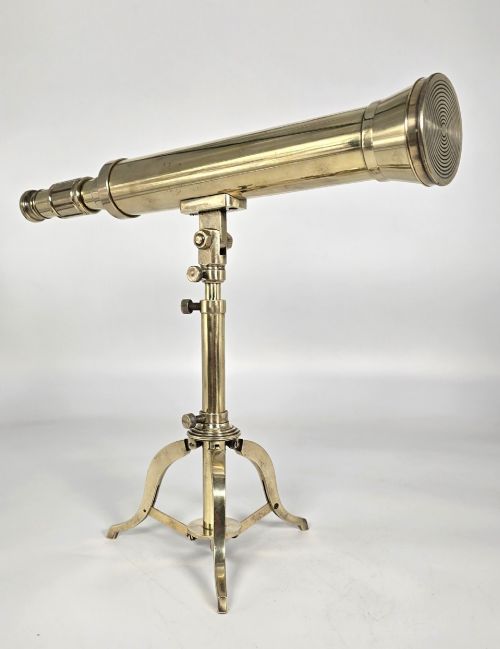


Vintage Nautical Telescope
These vintage nautical telescope pieces are working instruments of brass and leather designed for maritime navigation and terrestrial observation.
Vintage Nautical Telescope
A vintage nautical telescope is an instrument built for observing distant objects at sea or across land. When searching for a vintage nautical telescope, buyers encounter multi-draw handheld spyglasses alongside larger library and table top instruments.
The pieces on this page span several periods, reaching from the Georgian and Regency eras through the Victorian and Edwardian periods into the early twentieth century. Marine and naval instruments dominate the selection, accompanied by scientific and navigational pieces.
Most examples are signed by London or regional makers and function through extending brass draws, sometimes wrapped in leather, mahogany, oak, or fruitwood. Buyers find both compact pocket versions and substantial mounted instruments designed for serious viewing.
Materials and construction
Brass forms the primary structural material for barrels, draws, and fittings, often polished or gilt, combined with optical glass lenses. Workshops paired this metal with timber sleeves such as mahogany, walnut, oak, and fruitwood to improve grip and appearance.
Leather dressing frequently wraps the brass body tubes of marine and explorer models, stitched neatly along the seam to protect the metal underneath. Draw tubes slide smoothly within one another, maintaining alignment to bring distant terrestrial and celestial targets into sharp focus.
One signed instrument carries an unexpected French presentation inscription, proving that even practical naval gear sometimes dressed up for diplomacy.
Factors that separate the range
Optical clarity and the precision of the lens configuration define the performance tier of any instrument. Clear, sharp glass without internal clouding or severe scratching marks the distinction between a working scientific tool and a purely decorative object.
The quality of mechanical execution in the sliding draws and the retention of signed maker engravings on the brass barrel elevate an instrument. Intact leather coverings, original tripod stands, and fitted wooden cases also separate standard field pieces from finer examples.
Nairne & Blunt·Ross of London·Voigtländer & Sohn AG·Clarkson·Steward of London·Newton & Co·Broadhurst Clarkson & Co·Cary London·L. Casella·Alexander Adie·Chadburn Brothers·John Gilbert
The Vintage Nautical Telescope Glossary
- Draw
- A sliding tube section that extends from the main barrel to alter the focal length. Most instruments feature multiple draws numbered from two up to six.
- Spyglass
- A small, portable refracting telescope used for terrestrial viewing. These compact handheld units were standard equipment for officers of the watch and explorers.
- Achromatic
- An optical lens designed to correct chromatic aberration, bringing light of different colours to the same focal point. This technical improvement provided clearer, colour-corrected images.
- Altazimuth
- A mounting that allows an instrument to rotate independently in both altitude and azimuth axes. This setup proved essential for astronomical and navigational surveying.
- Terrestrial
- Designed for viewing objects on land rather than stars. These instruments incorporate erecting lenses so the resulting image appears right side up.
Vintage Nautical Telescope: Frequently Asked Questions
How do I use a multi-draw telescope?
Extend every draw fully until each section locks or seats firmly in place. Hold the instrument steady against a solid surface and rotate the eyepiece end slightly until the distant image sharpens.
Keep the lenses clean using appropriate optical cloths and avoid forcing the brass tubes if they stick within one another during extension.
What is an officer of the watch telescope?
An officer of the watch telescope is a marine spyglass built for naval use aboard ships. Officers utilised these portable instruments for signalling, identifying vessels, and general navigation at sea.
They typically feature leather-wrapped brass bodies designed to withstand harsh maritime environments while remaining light enough for single-handed operation.
How do I date a brass telescope?
Examine the engraved signature on the draw tube or bell end for the maker's name and address, which often corresponds to known working dates. The number of draws, style of lettering, and choice of materials like mahogany or leather also indicate the period of manufacture.
Georgian and Regency pieces tend to display simpler lines and different signature formats compared to Victorian or Edwardian instruments.
Are these telescopes still functional?
Many of these antique instruments remain fully operational for viewing distant terrestrial targets. The brass draws extend correctly and the glass lenses continue to magnify distant views.
Some larger library and table top models function primarily as scientific display pieces or focal points within a room due to their size and mounting.