

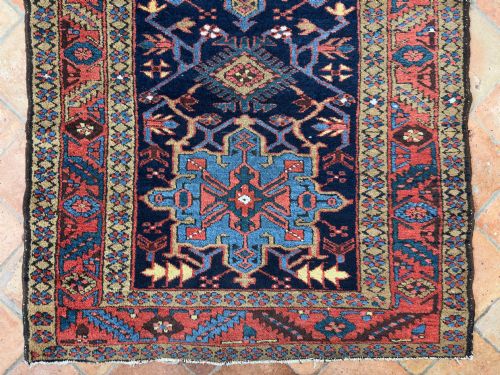


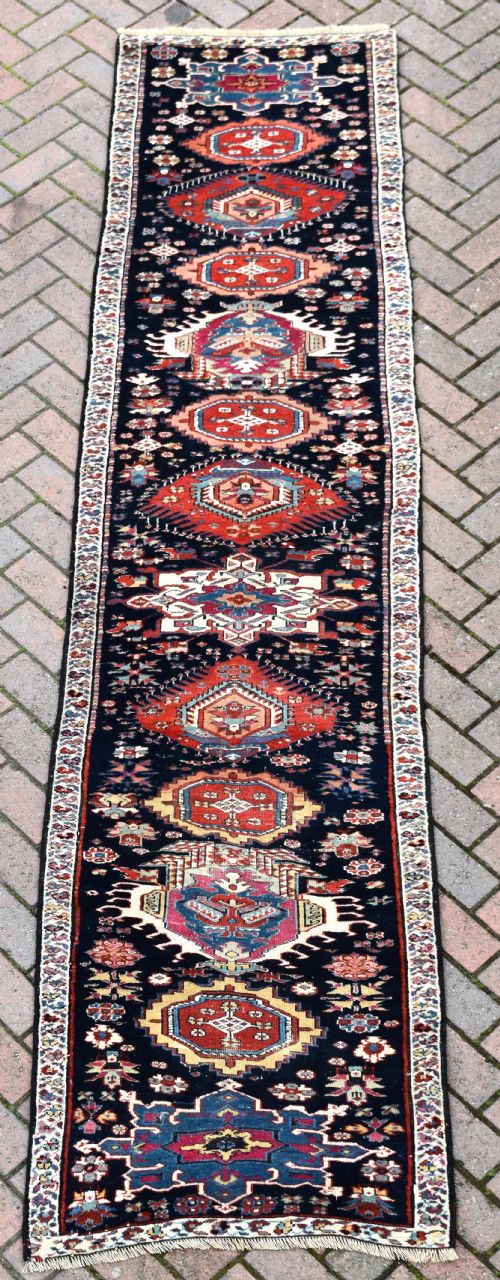


Vintage Karaja Hallway Rug
A vintage karaja hallway rug brings striking tribal design and robust wool construction to long spaces.
Vintage Karaja Hallway Rug
When you search for a vintage karaja hallway rug, you are looking at resilient tribal floor coverings originating from North West Persia. These pieces appear primarily as narrow runners designed specifically for corridors, hallways, and long spaces.
The versions you are most likely to meet on this page date from the late nineteenth century through to the early decades of the twentieth century. They manifest as traditional Persian tribal rugs and specific Karaja or Heriz Karaja runner formats.
These floor coverings utilise elongated proportions suited to high-traffic domestic areas while maintaining distinct regional weaving patterns. Each piece reflects the characteristic geometric layouts and saturated tones of North West Persian workshops.
How they were made
Weavers constructed these hallway rugs using durable wool pile knotted firmly onto cotton foundations. This pairing of materials provided the structural rigidity necessary to withstand heavy footfall in corridors.
The production relied on hand-spun natural yarns dyed in deep, contrasting shades to form the bold geometric medallions and repeating motifs. Artisans in North West Persian regions executed these designs entirely by hand without modern mechanical aids.
Vintage Karaja Hallway Rug Retail Price Guide 2026
Typical asking prices for vintage karaja hallway rug among the pieces listed under this phrase on Sellingantiques today, from the lower quarter to the upper quarter. They describe what is for sale here now, not the wider market.
Listings span periods from the 1870s to the 1920s, featuring wool and cotton construction across traditional Persian tribal styles.
What varies in quality
The distinction between standard examples and superior pieces rests in the crispness of the geometric drawing and the balance of the natural dyes. Denser knotting yields greater structural integrity and sharper definition across the runner field.
Proportion and scale also separate the better examples, particularly in narrow formats where maintaining a straight edge requires exceptional weaver skill. Preserved pile depth and intact original borders elevate the standing of any runner.
The Vintage Karaja Hallway Rug Glossary
- Karaja
- A style of rug originating from the North West Persian region known for bold geometric designs and medallion formats.
- Runner
- A long, narrow carpet format specifically proportioned for hallways, corridors, and staircases.
- Medallion
- A central ornamental motif set into the field of a rug, frequently seen in Persian tribal weaving.
- Warp
- The vertical foundation threads running lengthwise through a rug, upon which the knots are tied.
- Pile
- The upright surface yarn of a rug, formed by the cut ends of knots, which provides the tactile layer underfoot.
Vintage Karaja Hallway Rug: Frequently Asked Questions
Where should I place a hallway runner?
These narrow rugs suit long corridors, entrance halls, and narrow gallery spaces where floor coverings add warmth and texture.
Their elongated proportions ensure they fit comfortably between walls without obstructing doors.
How do I date an old rug?
Dating relies on examining structural characteristics, wool types, and dye palettes alongside stylistic markers from specific eras.
Nineteenth-century examples often display subtle dye variations and softer wool handling compared to later pieces.
Are these rugs durable enough for daily use?
Traditional Persian tribal rugs were built for heavy domestic traffic using robust wool and cotton materials.
Regular rotation and proper underlay help maintain their structural integrity in busy hallways.
What defines North West Persian weaving?
This regional grouping encompasses rugs made in areas such as Karaja and Heriz, notable for geometric discipline.
Weavers favoured structured medallion layouts and saturated colour palettes over curved floral designs.