
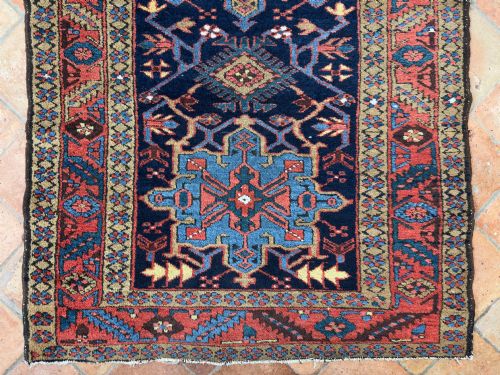
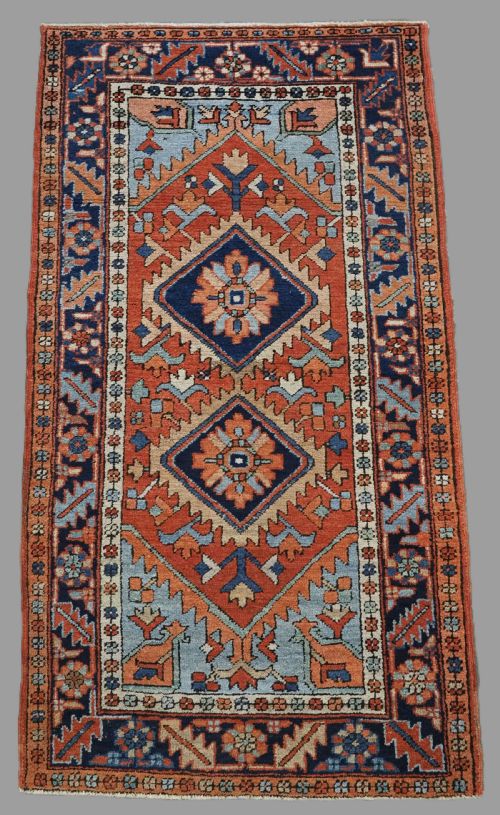


Karaja Runner Rug
These karaja runner rug pieces are hand-knotted North West Persian floor coverings that bring robust tribal character and deep saturated wool to narrow spaces.
Karaja Runner Rug
A karaja runner rug is a traditional North West Persian floor covering designed in elongated formats suited for hallways and narrow rooms. When you search for a karaja runner rug, you encounter pieces that originate from the Heriz region and exhibit strong tribal motifs.
The selections available here span the nineteenth century into the early decades of the twentieth century, including pieces dated across the 1870s, 1880s, 1890s, and 1900s. These formats range from small proportions to extended narrow runners exceeding three metres in length.
Makers in this tradition utilise regional geometric patterns and characteristic medallion layouts. The pieces present a distinct tribal aesthetic tied firmly to Persian weaving centres.
Factors of Quality
The distinction between tiers of quality rests upon knot density and the crispness of the geometric design. Tighter knotting allows for sharper delineation of tribal motifs and medallions across the field.
Quality also depends on the preservation of the original wool pile and the integrity of the outer borders. Pieces retaining substantial pile depth and balanced proportions command greater attention from collectors.
Listings for this phrase encompass cotton and wool materials spanning the nineteenth century through the 1920s, styled within Persian tribal traditions.
The Karaja Runner Rug Glossary
- Runner
- A long, narrow carpet format designed specifically for corridors, hallways, and staircases. It typically measures significantly greater in length than in width.
- Medallion
- A central ornamental motif placed in the field of the rug. In these regional pieces, it often takes a geometric or polygonal form.
- Pile
- The upright yarn loops or cut ends that form the usable surface of the carpet. Wool pile provides both texture and resilience.
- Heriz region
- A major Persian weaving district in North West Persia encompassing villages such as Karaja. It is known for durable carpets with strong geometric structures.
- Warp
- The vertical foundation threads stretched lengthwise on the loom before knotting begins. Cotton warps provide rigid support for the heavy wool pile.
Karaja Runner Rug: Frequently Asked Questions
Where were karaja runner rugs made?
These floor coverings were produced in the North West Persian region, specifically associated with the Heriz district and the village of Karaja. Weavers in these communities applied distinct tribal designs onto sturdy looms.
The geographic origin dictates the geometric vocabulary and structural makeup found in these nineteenth and early twentieth-century examples.
How do I measure for a hallway runner?
Measure the clear floor space of your hallway while leaving a uniform border of exposed flooring around the perimeter. Account for door clearances so that doors swing freely above the pile.
Keep the narrow proportions of these Persian pieces in mind, as traditional widths often measure under a metre across.
How do I care for an antique wool runner?
Vacuum the piece regularly with direct suction only, avoiding rotating brush bars that can pull at the wool pile. Rotate the runner periodically to ensure even wear across high-traffic areas.
Protect the cotton foundation from excessive moisture and consult a textile specialist for professional cleaning when necessary.