


Vintage French Garniture Set
A vintage french garniture set brings a central clock and its matching side pieces together on the mantel to anchor a room.
Vintage French Garniture Set
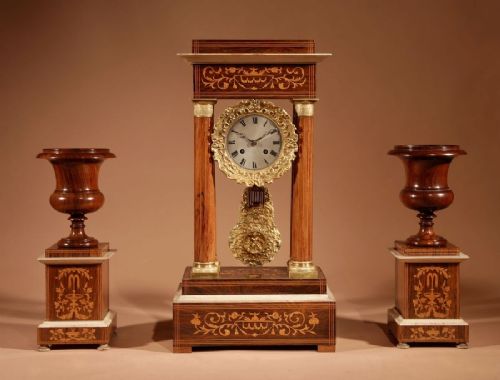
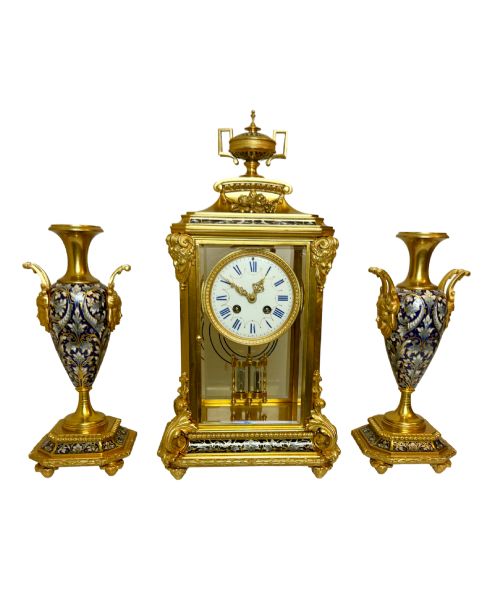
A vintage french garniture set consists of a central mantel clock accompanied by a matching pair of side ornaments, usually taking the form of urns, candelabras or sculpted figures. These three-piece arrangements emerged from nineteenth-century interiors to create a balanced display across a fireplace or sideboard.
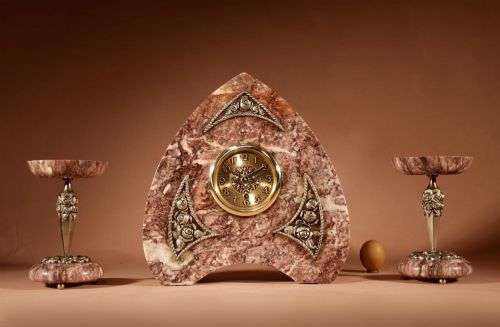
The variants encountered span from ornate nineteenth-century designs in marble and gilt bronze to streamlined geometric forms from the Art Deco period. Buyers regularly find sets combining a striking clock with flanking vases or animal sculptures rendered in bronze, spelter or ceramic.
Origins trace back to French workshops across the Victorian era, the Second Empire and into the 1920s and 1930s. Each set operates as a unified composition where materials and decorative motifs repeat identically across the central timepiece and its companions.
Materials and Construction
Makers constructed the primary structures using heavy natural stones including white marble, pink marble, green onyx and grey breccia marble, paired with metal elements cast in brass, ormolu, gilt bronze and silver-plated bronze. These dense materials provided the necessary weight to support mechanical clock movements and substantial side pieces without instability.
Surface ornamentation often incorporated champleve enamel panels, hand-painted porcelain and detailed metal castings depicting cherubs, greyhounds, German shepherds or elephants. Clock dials typically sat behind glazed bezels, driven by eight-day movements that struck the hours and half-hours.
Materials documented across the selection include green onyx, white and pink marble, brass, ormolu, and champleve enamel.
Distinctions in Quality
The standard of a vintage french garniture set rests heavily on the crispness of the metal casting and the depth of the hand-chasing on gilt bronze or ormolu elements. Weaker examples show soft surface details and simplified mountings, whereas superior pieces exhibit sharp, deeply articulated ornamentation with crisp edges.
The selection and matching of the stone body also dictate overall quality, with high-end sets utilising solid, finely polished blocks of marble or onyx paired harmoniously across all three components. Integrated sculptural works by named artists or distinct animal figures cast in metal further elevate the standing of the ensemble.
The Vintage French Garniture Set Glossary
- Garniture set
- A matched group of decorative mantel objects comprising a central clock flanked by two symmetrical side pieces like urns or candelabras. They were designed to create a balanced decorative arrangement on a fireplace mantel.
- Ormolu
- Finely chopped high-karat gold applied to a bronze base using a mercury amalgamation process. This technique gives the metal parts a rich, lasting golden glow that does not tarnish easily.
- Champleve enamel
- A technique where troughs are hollowed out of a metal surface and filled with vitreous enamel powder before being fired. This creates colourful patterned designs across the clock case or side ornaments.
- Portico clock
- A distinct architectural clock style supported by four or more columns resembling a classical temple facade. These often form the centrepiece of nineteenth-century garniture arrangements.
- Spelter
- A zinc alloy frequently used as a cost-effective alternative to bronze for casting decorative figures and mounts. It takes patination and gilding well to mimic more expensive metals.
Vintage French Garniture Set: Frequently Asked Questions
How do I set up an eight-day clock movement?
Wind the clock using the appropriate key inserted into the dial winding holes, turning carefully until resistance is felt. Ensure the clock sits level on the mantelpiece so the pendulum swings evenly without catching.
Allow the pendulum to settle into a steady beat by gently moving it to one side and listening for an even tick-tock rhythm. Adjust the regulation nut on the pendulum if the clock runs too fast or too slow over the course of a day.
How do I date a marble clock set?
Examine the style of the case and the materials used, as nineteenth-century Victorian and Second Empire pieces lean toward ornate classical revival forms in white or pink marble with gilt bronze mounts. Art Deco sets from the 1920s and 1930s utilise geometric lines, grey breccia marble, and stylised animal sculptures.
Look at the clock movement and dial construction for further clues, noting whether the escapement is visible through the glass bezel. Stamped maker marks or serial numbers on the backplate of the movement can also help narrow down the production decade.
Where should I display a heavy marble garniture?
Place the set on a sturdy mantelpiece, sideboard, or large console table capable of supporting substantial weight. Natural stone and bronze sets are remarkably heavy and require a stable, level surface.
Keep the arrangement away from direct heat sources like active fireplaces and out of direct sunlight to protect the clock movement and the polished stone surfaces. Leave enough space around the side pieces so the entire composition can be appreciated without crowding.