

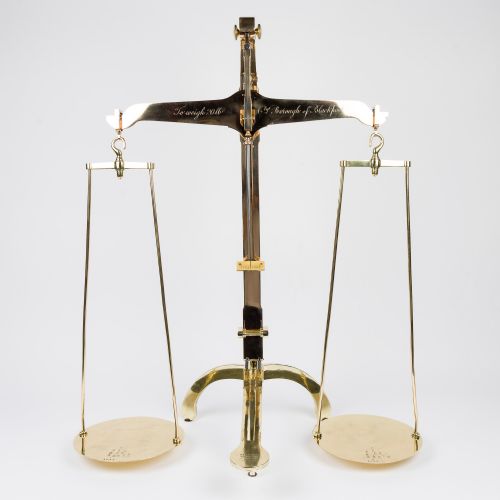

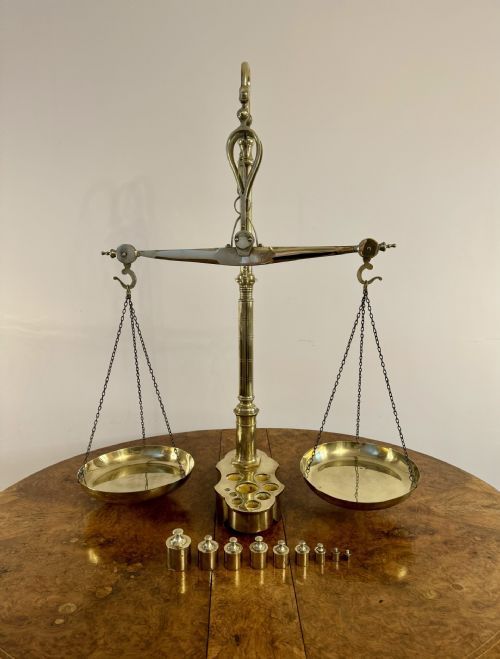

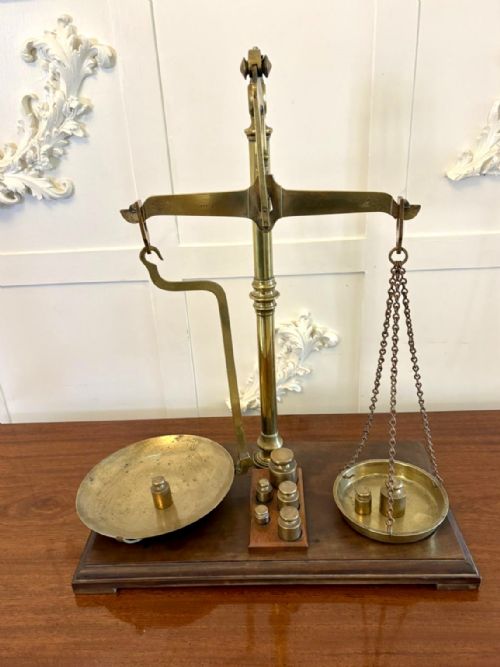


Vintage Brass Weighing Scales
These vintage brass weighing scales bring the precise mechanics of nineteenth and early twentieth century trade, office and surgery directly into the modern room.
Vintage Brass Weighing Scales
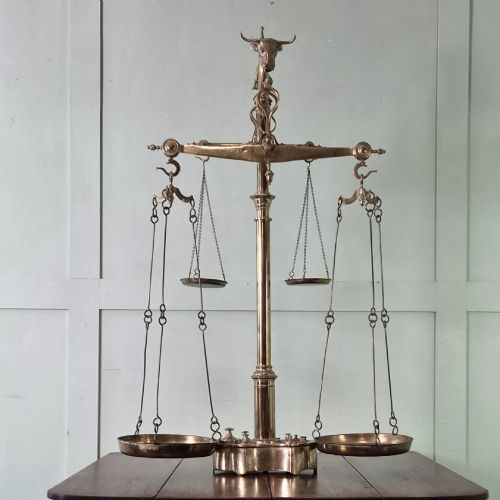
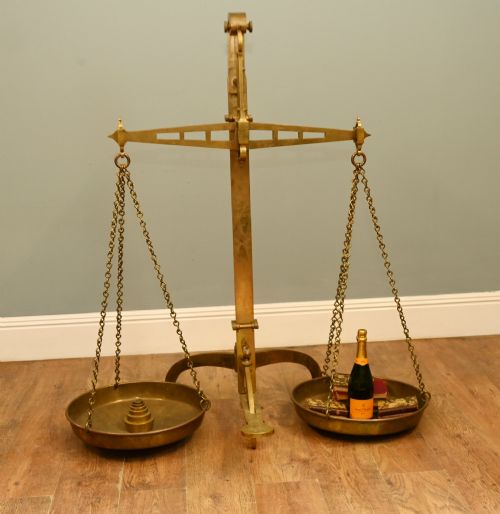
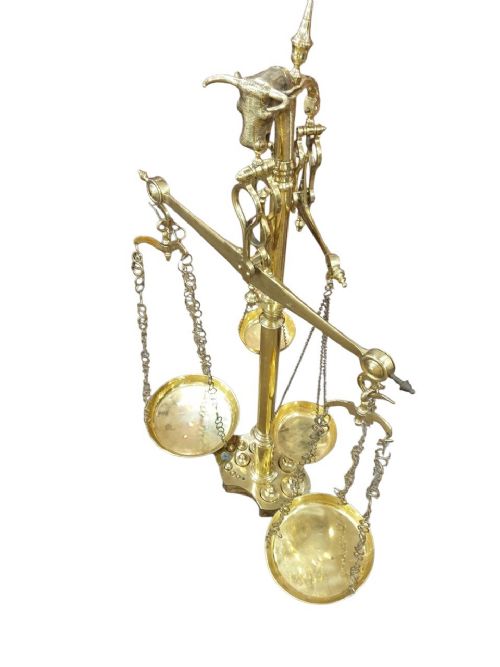
When you search for vintage brass weighing scales, you find a diverse collection of utilitarian objects spanning from the mid-nineteenth century through the Edwardian period and into the early twentieth century. These include postal scales for correspondence, apothecary and doctors scales for medicine, grocers and butcher scales for provisions, and specialised jockey or personal scales.
The most common versions on this page are balance scales and beam scales mounted on wooden bases of mahogany or oak, alongside postal designs and commercial shopkeeper models. Origins range across British workshops as well as French, Dutch, and colonial traditions, reflecting the widespread reliance on precise mechanical weighing.
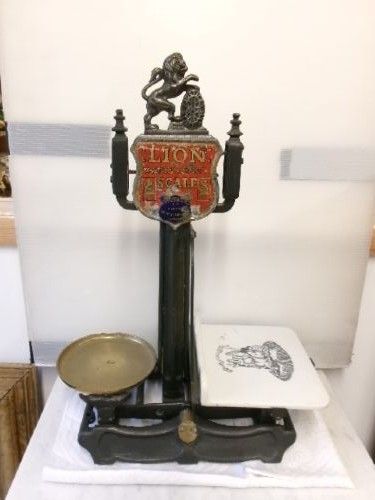
Forms vary from compact desktop postal balances to monumental floor-standing butcher scales and hanging balance beams. Makers such as W & T Avery, De Grave & Co, and Parnall & Sons frequently appear, grounding these functional instruments in established manufacturing history.
Materials and construction of period scales
Makers built these pieces primarily from bright brass for beams, pans, and indicator arms, pairing the metal with dense hardwoods such as mahogany and oak for the mounting bases. Wrought iron and cast iron frequently provide the structural support for larger commercial floor-standing and counter models, while glass and marble occasionally appear in specific medical or pharmaceutical contexts.
Construction relied on precise mechanical balancing, utilising knife-edge pivots and delicate beam assemblies to ensure exact measurement. Wood bases were typically joined with traditional cabinetry techniques, often incorporating drawers to store calibrated metal weights.
Vintage Brass Weighing Scales Retail Price Guide 2026
Typical asking prices for vintage brass weighing scales among the pieces listed under this phrase on Sellingantiques today, from the lower quarter to the upper quarter. They describe what is for sale here now, not the wider market.
Distinctions in construction and material integrity
Quality in these instruments rests on the precision of the brass beam, the crispness of maker markings, and the selection of timber for the base. Finer examples retain matching calibrated weights, original lacquering or polished surfaces, and smooth mechanical action without play in the pivots.
Commercial and industrial scales differ from domestic postal or pocket balances through sheer scale and robust iron framing. The presence of verified maker stamps from established firms elevates an instrument above unmarked commercial production.
W & T Avery·De Grave & Co·Parnall & Sons·Stephen Houghton & Son·Bartlett & Sons
The Vintage Brass Weighing Scales Glossary
- Balance scales
- A weighing instrument featuring a central fulcrum and two suspended pans. Exact weight is determined when the beam levels horizontally.
- Beam scale
- A heavy-duty weighing device utilising a rigid metal bar supported at the centre. These often handle larger commercial provisions in shops and markets.
- Postal scales
- Compact desktop balances designed specifically for weighing letters and parcels to calculate postage rates. They frequently incorporate tiered brass weights.
- Apothecary scales
- Precision instruments used by chemists and doctors for measuring small medicinal quantities. They are typically housed in fitted wooden boxes with delicate brass weights.
- Stick balance
- A portable weighing tool utilising a linear arm rather than dual pans. Examples include folding gold balances and jockey scales.
Vintage Brass Weighing Scales: Frequently Asked Questions
How do balance scales work?
Balance scales operate on the principle of equilibrium, using a central fulcrum to compare an unknown mass against known standard weights placed on the opposite pan. When the pointer rests at the vertical centre, the loads are equal.
Most period examples rely on finely tuned brass beams and knife-edge pivots to minimise friction and ensure precise measurement.
Were these scales used in shops?
Many of the larger examples served commercial roles in grocers, butchers, and cooperative stores. Retailers required reliable mechanical scales to weigh provisions accurately for customers.
Sturdier floor-standing and counter models handled heavy daily trade, while specialised inspectors verified their accuracy for public commerce.
How do I clean brass scales?
Brass components respond best to gentle dusting and occasional cleaning with a non-abrasive metal polish to maintain their lustre without removing historical patina. Wooden bases benefit from standard furniture wax suited to mahogany or oak.
Harsh chemical cleaners should be avoided to preserve original maker stamps and surface finishes.
How do I identify Victorian scales?
Victorian scales often feature robust brass construction mounted on rich mahogany or oak bases, frequently accompanied by maker inscriptions from firms active during the nineteenth century. Stylistic cues align with Victorian and Edwardian manufacturing standards.
Examining the casting quality, screw types, and accompanying brass weights helps narrow down the period of production.