




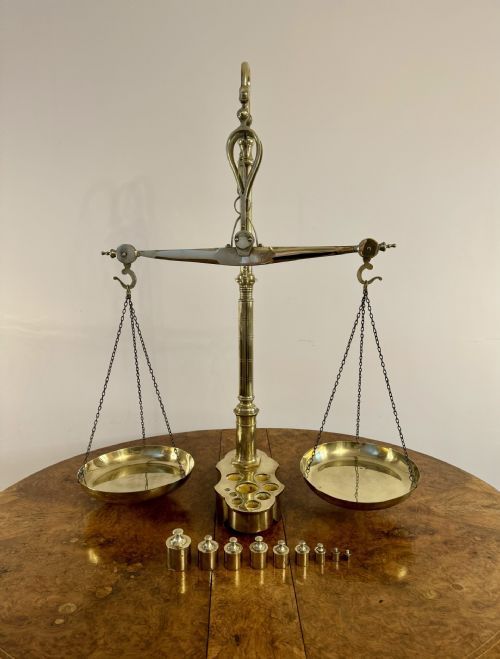
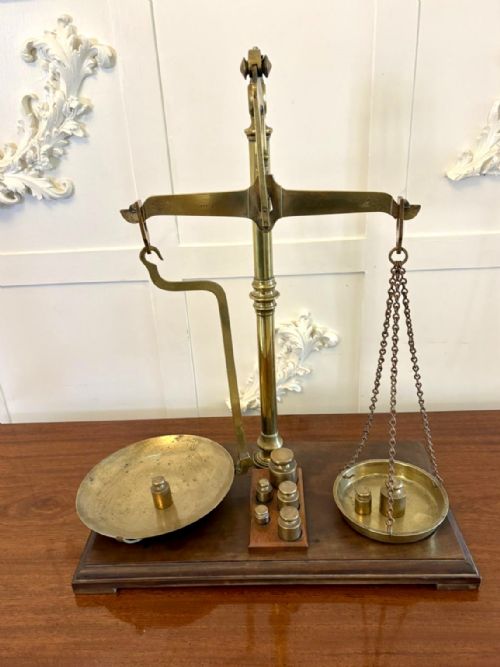


Brass Weighing Scales
Brass weighing scales are functional instruments of precision made in domestic, shop and scientific forms, valued for their mechanics and rich metal surfaces.

Brass Weighing Scales
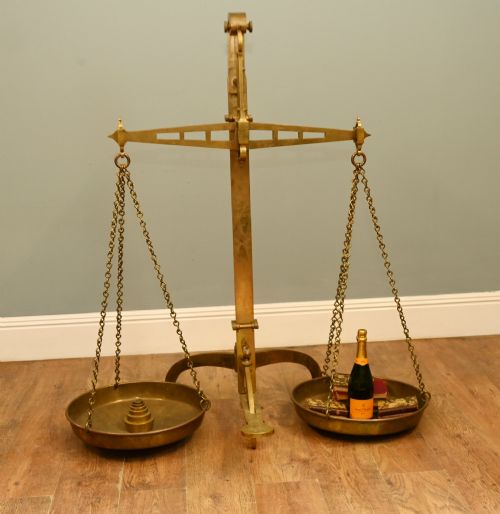
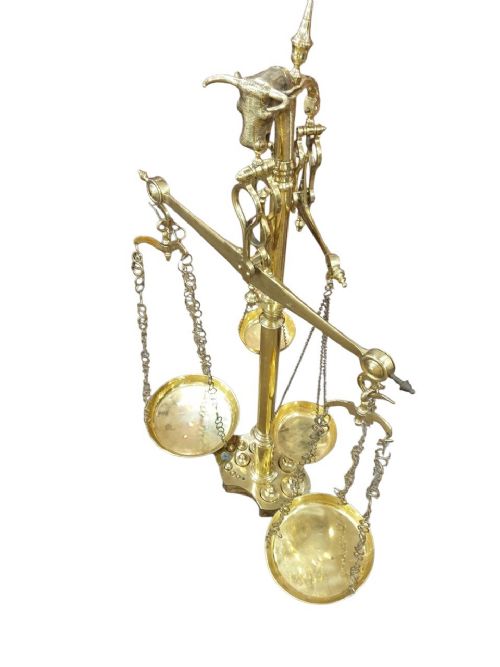
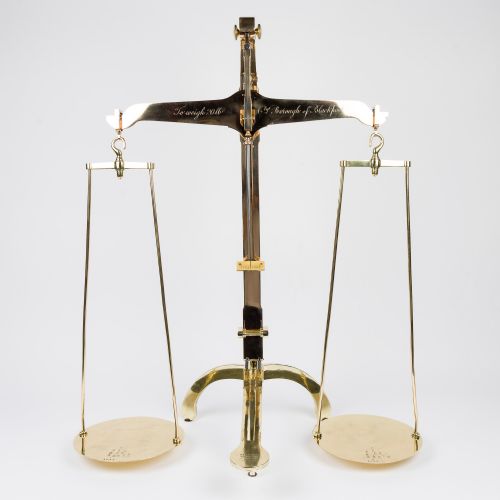
Brass weighing scales encompass a wide range of measuring devices, from compact postal balances to monumental floor-standing butcher apparatus. When searching for brass weighing scales, buyers encounter everything from delicate apothecary balances housed in mahogany boxes to heavy-duty grocers' beam scales used in commercial co-operatives.
The selection on this page reflects domestic, professional and scientific origins spanning the Georgian era through to the early twentieth century. Victorian and Edwardian examples dominate the listings, frequently paired with mahogany or oak bases and complete with original brass weights.
Specialised variants such as jockey scales, personal weighing scales with height measures, and portable chondrometers appear alongside traditional beam balances and postal letter scales. These pieces originate from British workshops as well as French and Dutch makers, reflecting diverse functional requirements across different trades.
Materials and construction
Makers constructed these instruments using cast and sheet brass for the pans, beams and indicators, ensuring durability and a polished finish. Hardwoods such as mahogany and oak formed the supportive bases, box housings and drawer mounts, often providing a stable platform for delicate balance mechanisms.
Iron, cast iron and wrought iron components were integrated into larger floor-standing scales and stick balances to provide necessary structural strength. Glass panels and marble details occasionally appeared in medical and scientific instruments to protect sensitive movements and maintain clean surfaces.
Brass Weighing Scales Retail Price Guide 2026
Typical asking prices for brass weighing scales among the pieces listed under this phrase on Sellingantiques today, from the lower quarter to the upper quarter. They describe what is for sale here now, not the wider market.
Listings feature oak, mahogany, cast iron and marble alongside polished brass.
Judging the standard
Quality in these instruments depends upon the precision of the engineering and the integrity of the original components. Finer examples retain matching numbered parts, complete sets of calibrated weights, and crisp maker signatures engraved into the metal beams or wooden bases.
The choice of materials also dictates the standard of the piece, with dense hardwoods, substantial cast brass beams, and well-fitted glazed enclosures marking out superior workshop production. Pieces that maintain smooth movement across the balance points without excessive play demonstrate careful assembly and adjustment by skilled mechanists.
Robert Brettell Bate·Day & Millward·Parnall & Sons·Ratcliff Birmingham·W & T Avery·Stephen Houghton & Son·Bartlett & Sons·De Grave & Co·De Grave Short & Co·Young & Son
The Brass Weighing Scales Glossary
- Chondrometer
- A portable instrument used for measuring the mass or weight of grain to determine quality. These specialised devices were essential for agricultural merchants and corn factors.
- Beam scale
- A weighing device consisting of a horizontal lever suspended from its centre with two pans hanging from equal arms. It operates on the principle of moment equilibrium to determine mass.
- Postal scales
- Compact balance devices designed for weighing letters and small parcels to calculate postage rates accurately. They often feature tiered brass weights stored directly on the wooden base.
- Apothecary balance
- A sensitive instrument enclosed in a glazed wooden case, used by chemists for weighing medicinal ingredients. Precision was paramount in these medical scales to ensure correct compounding of drugs.
Brass Weighing Scales: Frequently Asked Questions
How do I date an old brass scale?
Dating relies on stylistic clues, maker marks, and registration numbers stamped into the brass beams or wooden bases. Victorian and Edwardian pieces often display specific crown inspector stamps or patent details that narrow down the period of manufacture.
Changes in material combinations, such as the transition from solid mahogany boxes to simpler oak platforms, also help historians place an instrument within a particular decade.
Were these scales used in shops or homes?
These instruments served both domestic and commercial environments depending on their size and design. Smaller brass letter scales and apothecary balances were standard household or surgery fixtures, while heavy beam scales belonged in butchers, grocers and post offices.
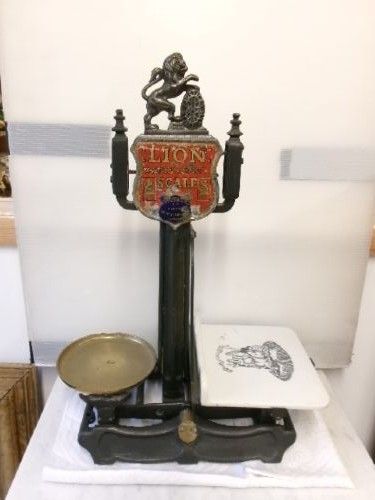
Many commercial examples feature advertising plaques or local authority verification stamps indicating heavy daily trade use.
Are the original weights usually included?
Many surviving sets retain their matching brass weights, often neatly nested or stored in purpose-built slots within the wooden base. Finding a set complete with its correct contemporary weights significantly enhances the historical integrity of the piece.
When weights are missing, collectors look for matching fractional denominations stamped with corresponding maker ciphers or verification marks.
How should I clean antique brass?
Antique brass is best maintained with minimal intervention to preserve the natural aged patina developed over generations. Gentle dusting with a soft dry cloth prevents dirt build-up without stripping the surface character.
Harsh chemical polishes should be avoided because they remove the dark oxidation that authenticates the age of the metal.