
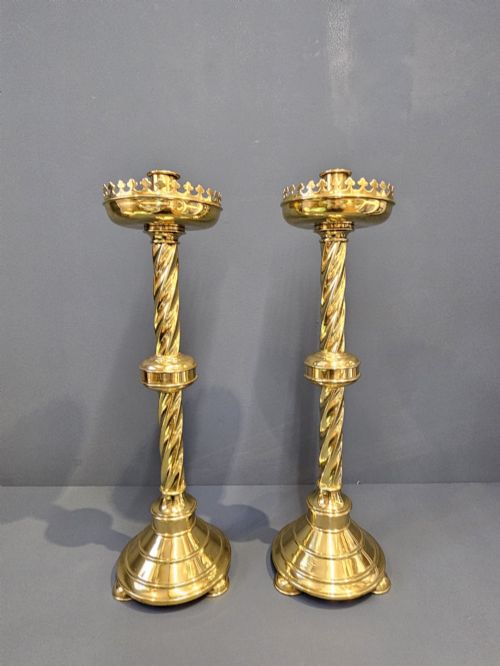
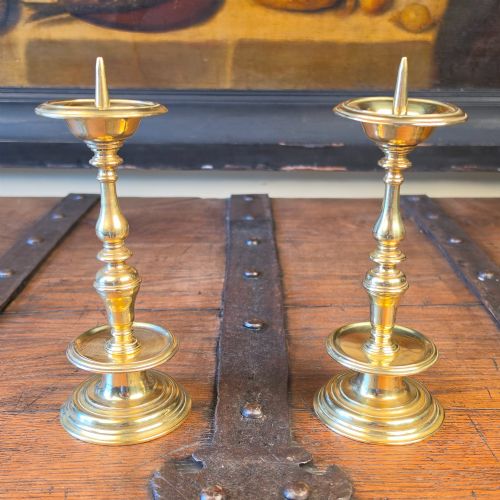
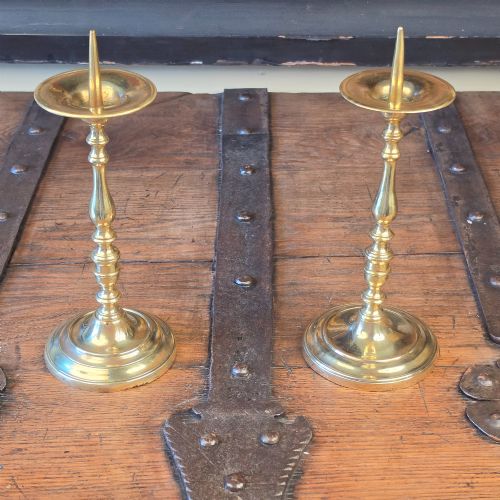


Vintage Brass Pricket Pair
These vintage brass pricket pair items bring ecclesiastical ceremony and striking industrial form into modern interiors through heavy metalwork and central spikes.
Vintage Brass Pricket Pair
When you search for a vintage brass pricket pair, you are looking at heavy altar candlesticks designed with a central spike rather than a socket to hold large candles. These pieces emerge from the nineteenth century and the early twentieth century, spanning styles from Victorian Gothic Revival to Amsterdam School.
The versions you are most likely to meet on this page take the form of church candlesticks cast in solid brass, sometimes combined with wrought iron or patinated metal. They originate from British, continental European and Japanese workshops, presenting distinct sculptural silhouettes that command attention on tables or mantels.
How they were made
These items rely primarily on cast brass and heavy bronze, shaped through traditional foundry methods that produce thick walls and substantial weight. Makers frequently integrate wrought iron or apply patinated finishes to achieve dark, textured surfaces that contrast with polished brass details.
Construction techniques focus on structural solidity to support large candles securely upon the upward-pointing pricket spike. Individual components are threaded or joined mechanically, resulting in robust candlesticks designed for sustained ecclesiastical use.
Current listings on this site feature brass, bronze, wrought iron and patinated metal across Victorian and Amsterdam School forms.
What varies in quality
Quality in these items rests upon the crispness of the casting and the proportional balance of the base, stem and drip pan. Superior examples display clean geometric or Gothic detailing without messy seams or sloppy finishing from the foundry mould.
The choice of materials also separates standard production from exceptional pieces, particularly where heavy cast brass meets patinated metal or wrought iron with deliberate artistic intent. The integrity of the central pricket spike and the overall heft of the metal dictate the presence and longevity of the object.
The Vintage Brass Pricket Pair Glossary
- Pricket
- A sharp metal spike atop a candlestick designed to impale the base of a candle to hold it upright. This ancient method precedes modern socket cups.
- Amsterdam School
- An early twentieth-century architectural and design movement known for expressive, rounded brickwork forms and heavy, tactile metalwork. Pieces from this tradition often feature organic silhouettes and dark patination.
- Gothic Revival
- An architectural and decorative style drawing on medieval ecclesiastical forms, prevalent during the Victorian era. It utilises pointed arches, heavy tracery and solemn vertical lines.
- Patinated Metal
- Metal surface altered by chemical treatment, age or wear to produce a darkened, weathered finish. This layer protects the underlying alloy while adding visual depth.
Vintage Brass Pricket Pair: Frequently Asked Questions
What is a pricket candlestick?
A pricket candlestick uses an upright metal spike instead of a socket to secure the candle. The base of the candle is pressed directly onto this point.
This traditional design appears frequently in church settings and medieval lighting formats, offering a stable hold for thick wax pillars.
How do I style these candlesticks at home?
These tall metal pieces work best on heavy dining tables, sideboards or large mantelpieces where their height provides strong vertical balance. Pair them with simple surroundings to let the industrial and ecclesiastical metalwork stand out.
When using them, select thick pillar candles that fit securely onto the central spike without wobbling.
How can I tell the period?
Dating relies on stylistic clues such as the decorative vocabulary of Victorian Gothic Revival or the distinct curved lines of Amsterdam School design. Examining the casting methods, weight and surface patination also helps determine age.
Signatures or foundry marks are uncommon on these altar pieces, so period attribution depends heavily on construction traits.
Are these made of solid brass?
Most examples utilise heavy cast brass, often combined with bronze, wrought iron or patinated metal for structural variety and visual contrast. The substantial weight comes from thick metal walls rather than hollow plating.
Different sections may display contrasting finishes, ranging from bright polished brass to darkened, aged patinas.