


Victorian Pricket Candle Holders
Victorian pricket candle holders are solid ecclesiastical metalwork and altar lighting designed to spike candles directly onto a central pin.
Victorian Pricket Candle Holders
When you search for victorian pricket candle holders, you meet heavy altar lighting and church candlesticks dating from the nineteenth century. These ecclesiastical pieces emerge primarily from the Victorian and Edwardian periods, frequently taking the form of tall floor standing holders or heavy pairs of table candlesticks.
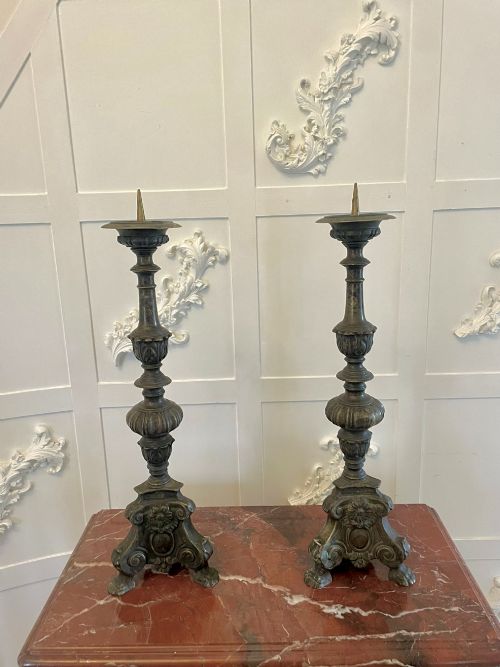
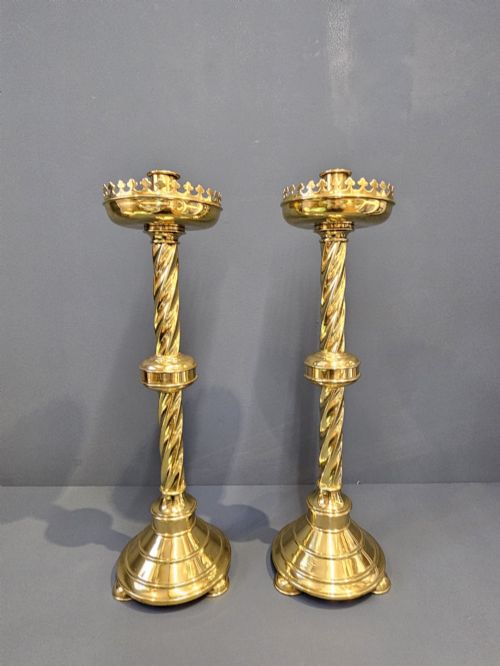
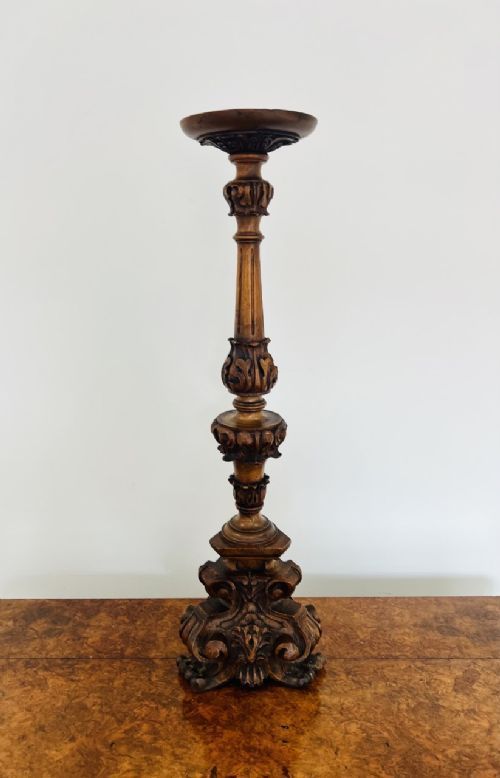
The selection on this page demonstrates styles spanning Gothic Revival and Baroque Revival aesthetics. Alongside standard brass table examples, the listings include floor standing church candle holders and carved walnut stands.
Makers and workshops from the nineteenth century built these items for liturgical use, meaning surviving examples retain a strong architectural presence. Brass and bronze dominate the forms, supplemented by wrought iron and gilt metal.
How they were made
The construction relies heavily on cast and wrought metals, with brass, bronze, and iron shaped into substantial altar pieces. Foundries utilised casting techniques for ornate bases and stems, incorporating structural spikes known as prickets to secure the wax candles directly.
Detailing often reflects Gothic Revival and Baroque Revival motifs, achieved through surface carving on walnut stands or applied gilding on brass and metal surfaces. Heavier pairs demonstrate solid metal construction designed to support large ecclesiastical candles without tipping.
Materials recorded across the inventory include brass, bronze, wrought iron, gilt metal, cast brass, and walnut.
What varies in quality
The distinction between standard ecclesiastical production and finer pieces rests in the weight of the metal and the depth of the casting. Heavier bronze and cast brass examples display sharper decorative relief and more complex architectural bases than lighter alternatives.
Proportion and scale also separate tall floor standing church candle holders from standard table pairs. Surface finishes range from simple cleaned brass to rich patinated bronze and gilt metal, influencing the visual weight of the object.
The Victorian Pricket Candle Holders Glossary
- Pricket
- A sharp metal spike on the top of a candlestick designed to impale and hold a candle upright. This form appears frequently on church and altar candlesticks.
- Gothic Revival
- An architectural and decorative style drawing on medieval forms, featuring pointed arches and ornate tracery. This aesthetic shapes many nineteenth century ecclesiastical metalwork pieces.
- Ecclesiastical
- Relating to the Christian Church or its clergy, describing items manufactured specifically for use in chapels, churches, and cathedrals. Altar candlesticks fall directly into this category.
- Baroque Revival
- A theatrical design style popular in the nineteenth century, characterised by exuberant ornamentation and heavy scrolls. This movement influences the more ornate brass and bronze candle holders.
Victorian Pricket Candle Holders: Frequently Asked Questions
Are these candle holders safe to use?
These items were built to hold large church candles on a metal spike, meaning they remain entirely functional for modern use. Modern wax candles can be pressed directly onto the central pricket.
Care should be taken to protect surfaces from melting wax, as these historical pieces lack modern drip pans.
How do I date a pricket candlestick?
Dating relies on stylistic clues such as Gothic Revival motifs and the specific composition of the brass, bronze, or wrought iron. Nineteenth century pieces often show sand cast textures and heavy material weight.
Comparing the base construction and decorative casting helps distinguish mid-Victorian examples from later Edwardian ecclesiastical items.
What is the difference between a pricket and a socket candlestick?
A pricket candlestick uses an upward pointing metal spike to secure the base of a candle. Socket candlesticks feature a hollow cup or tube that surrounds the lower portion of the candle.
Ecclesiastical and altar pieces predominantly utilised the pricket design throughout the nineteenth century.
Where were these candle holders originally used?
These metal and wooden pieces originated in churches, chapels, and cathedrals as altar lighting. Tall floor standing versions and heavy pairs sat near the altar for liturgical services.
Today, collectors place them in domestic interiors as statement decorative objects.