


Ecclesiastical Brass Candleholders
These ecclesiastical brass candleholders bring heavy altar metalwork into domestic rooms, offering structural Gothic forms and deep warm finishes that ground a mantel or sideboard.
Ecclesiastical Brass Candleholders
Ecclesiastical brass candleholders encompass heavy altar lighting designed for churches and chapels, appearing on this page mostly as paired candlesticks, prickets, and wall sconces. Dating chiefly from the Victorian period alongside Georgian and Edwardian examples, these pieces translate sacred sanctuary furnishings into domestic spaces.
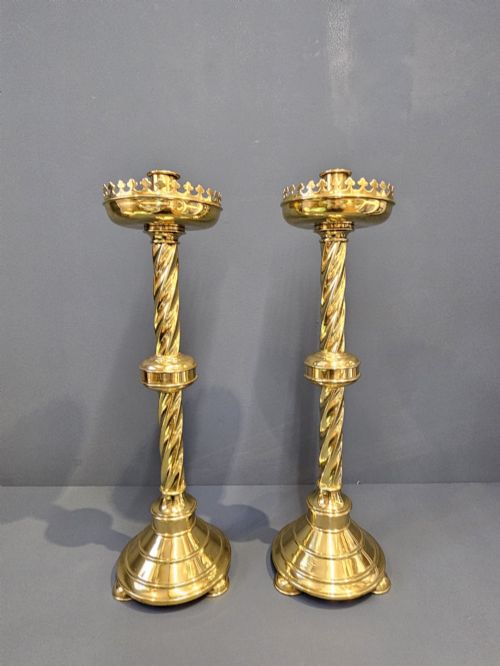
The forms span tall altar candlesticks, multi-branch candelabra, and pricket types which feature a central spike to impale large wax candles rather than a traditional socket. Gothic Revival and Neo-Gothic styles dominate the selection, bringing architectural lancet motifs, trefoils, and heavy saucer bases into everyday view.
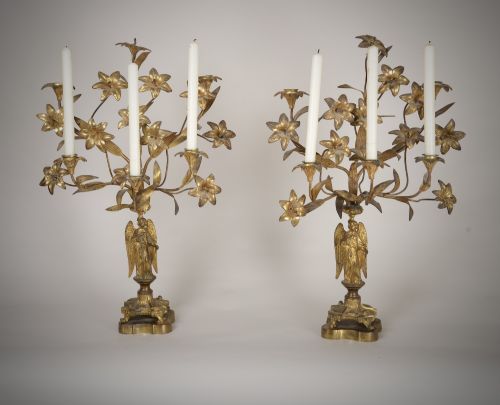
Makers and workshops of the nineteenth century produced these durable fixtures in brass, gilt brass, and bronze, often accented with enamel details. Buyers encounter everything from simple desk or altar pairs to grand sets of four and wall-mounted sconces designed for ambient church lighting.
How they were made
Foundry casting formed the solid structural core of these ecclesiastical pieces, creating heavy bases and stems designed to support large altar candles securely. Artisans utilised brass, bronze, and gilt brass, employing weight and thickness to ensure stability on church altars and ledges.
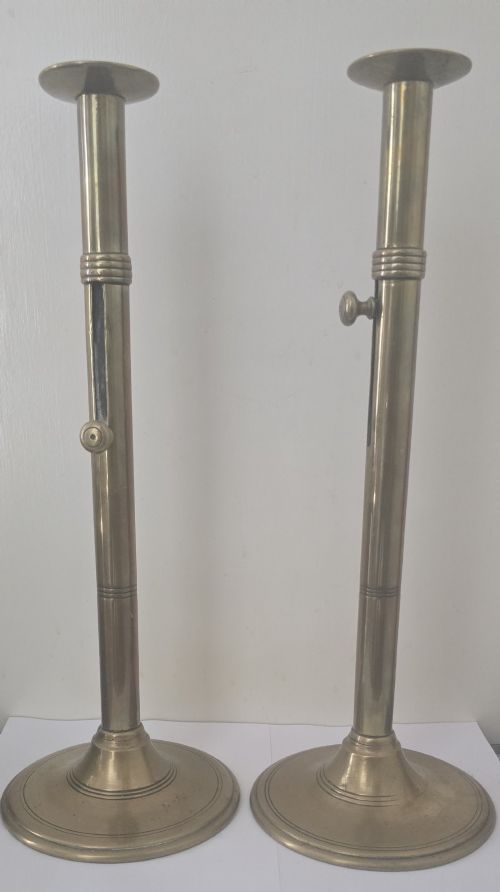
Surface finishing combined polished brass with applied gilding or ormolu accents, sometimes incorporating enamel panels to add rich colour to the metalwork. Secondary elements like side ejectors in Georgian pieces or pricket spikes welded to drip pans demonstrate traditional mechanical assembly by period metalworkers.
Listings feature pieces spanning the Georgian, Victorian, and Edwardian periods, constructed primarily in brass, gilt brass, and bronze with distinct Gothic Revival styling.
What varies in quality
Casting precision dictates the crispness of architectural Gothic ornament, separating sharp tracery and clean mouldings from soft, blurred surface detail. Heavier gauge metal and complete sets of four command attention for their substantial presence compared to lighter individual pairs.
Surface preservation marks the distinction between untouched period patination and excessive modern polishing that strips away character. Original gilding, intact enamel work, and signed foundry markings elevate specific examples above standard production pieces.
T Thomason & Co
The Ecclesiastical Brass Candleholders Glossary
- Pricket
- A candlestick featuring a sharp upward-pointing metal spike designed to hold a large candle in place. This form appears frequently on heavy altar pieces from the nineteenth century.
- Gothic Revival
- An architectural and decorative style reviving medieval forms like pointed arches, trefoils, and heavy vertical lines. This aesthetic shapes the majority of church metalwork seen in these listings.
- Gilt-Brass
- Base brass metal treated with a thin layer of gold or gold-coloured wash to impart a richer finish. This treatment catches candlelight warmly.
- Ormolu
- Finely chaste and gilt bronze or brass applied to decorative objects and lighting fixtures. The technique yields a bright golden decorative surface.
- Side Ejector
- A mechanical lever fitted to the stem of a candlestick to push out remaining candle stubs. This functional detail appears on Georgian and older domestic adaptations.
Ecclesiastical Brass Candleholders: Frequently Asked Questions
What is a pricket candlestick?
A pricket candlestick uses a sharp metal spike on top to secure a large candle instead of a standard hollow socket. This design originates from traditional church altars where thick wax tapers stood firmly upon a central point.
These pricket pieces are built with heavy bases to support the weight of substantial candles. They bring an authentic ecclesiastical character to mantelpieces and dining tables.
How do I date an antique brass candlestick?
Dating relies on observing stylistic markers, construction methods, and material finishes recorded across the Victorian, Georgian, and Edwardian eras. Gothic Revival motifs point firmly to the nineteenth century, while side ejectors often indicate earlier Georgian origins.
Examining the weight, casting seams, and surface wear helps distinguish mid-nineteenth-century church pieces from later reproductions. Maker stamps, where present, provide a direct link to specific workshops.
Were these pieces used in homes?
Most of these heavy brass fixtures originated in churches, chapels, and cathedrals as altar lighting before entering the domestic market. Their robust construction and grand scale were intended for large religious spaces rather than ordinary domestic rooms.
Today, collectors place these ecclesiastical items in homes to create strong focal points. Their architectural lines suit both period interiors and modern minimalist spaces.
What is the difference between brass and gilt-brass?
Standard brass is an alloy of copper and zinc with a natural metallic golden sheen that develops a darker patina over time. Gilt-brass has a micro-thin layer of gold or gold-coloured finish applied to the surface to enhance brightness.
Gilt finishes provide a warmer, more reflective glow under candle flame. This treatment was often reserved for high-altar vessels and important ecclesiastical furnishings.
How do I clean antique church brass?
Preserving the dark patinated finish built up over decades is usually preferred over aggressive chemical polishing. Dusting with a soft dry cloth maintains the surface without removing historical character.
Harsh metal cleaners strip away the aged tones that collectors value. Gentle care ensures the metal retains its deep, authentic warmth.