




Antique Brass Pricket Holders
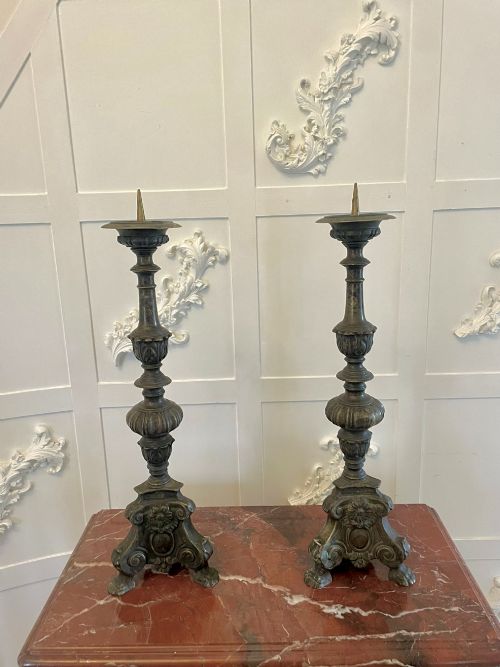
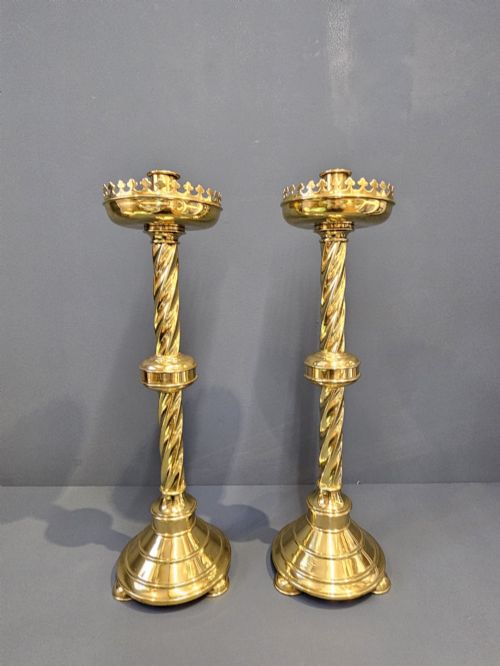
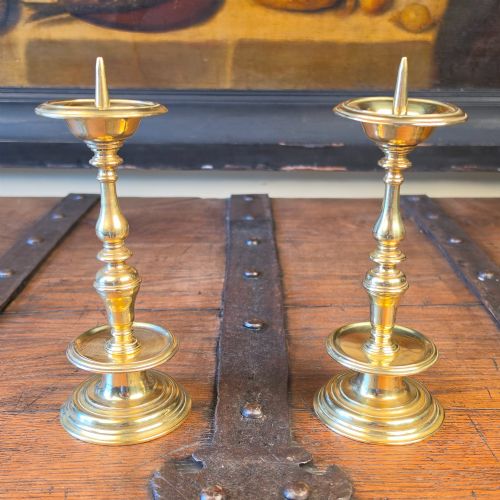
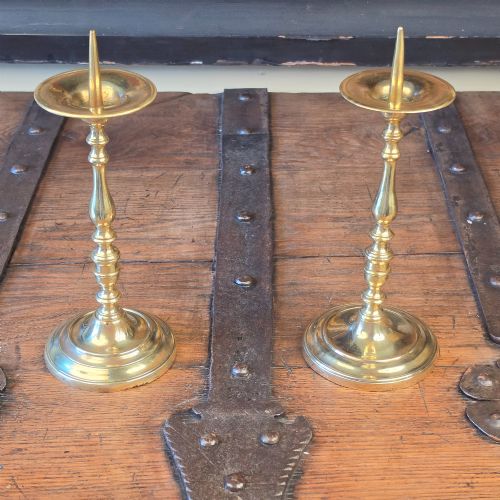
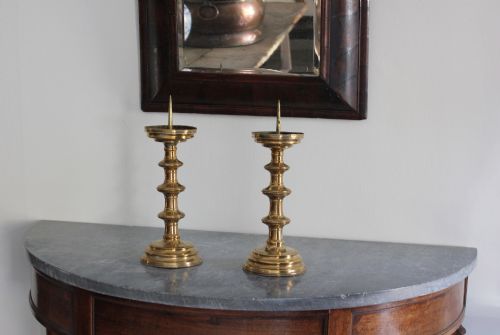
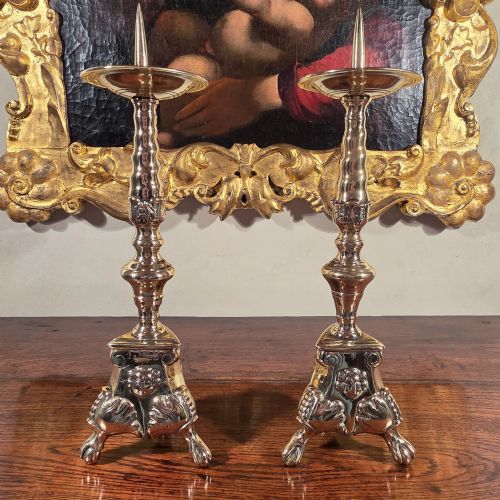
Antique brass pricket holders are spike-top altar sticks that bring ecclesiastical height and heavy metal warmth to a room.
Antique Brass Pricket Holders
When searching for antique brass pricket holders, you encounter altar and church lighting spanning from the sixteenth century to the early twentieth century. The selection ranges from diminutive low-country domestic examples to tall floor-standing ecclesiastical pieces.
Victorian Gothic Revival interpretations appear frequently alongside earlier seventeenth-century style and Amsterdam School designs. These metal objects serve as vertical supports featuring a central spike designed to hold a pillar candle steady rather than a socket.
The inventory includes pairs and sets originating from France, the Netherlands, and Britain, executed in varied proportions from modest table heights to imposing sanctuary scales.
Materials and construction methods
Foundry work relies heavily on cast brass, bronze, and copper alloys, often paired with wrought iron structural elements or patinated metal surfaces. Gilt-brass finishes appear on specific ecclesiastical examples to provide a reflective liturgical gleam.
Construction techniques involve heavy casting and forging, yielding substantial weight in larger church candlesticks and floor-standing models. Surface textures range from dark patination to polished brass and mixed metal combinations.
The listings span from the 16th century through the Victorian era to early 20th-century Amsterdam School designs.
Assessing quality and craftsmanship
Quality rests in the heaviness of the casting, the crispness of moulded details, and the integrity of the original metal surfaces. Finer examples display balanced proportions and deliberate weight that anchor their vertical height.
Design ambition separates standard production from exceptional pieces, particularly in Amsterdam School or Gothic Revival variants where architectural mouldings and mixed metals demonstrate superior workshop execution.
The Antique Brass Pricket Holders Glossary
- Pricket
- A sharp metal spike atop a candlestick designed to impale the base of a pillar candle. This spike secures the wax upright without requiring a traditional socket.
- Ecclesiastical
- Pertaining to the Christian church or its clergy. Items described thus were originally manufactured for chapel or cathedral use.
- Patinated
- Showing a surface sheen or tarnish developed through age and exposure. This discoloration indicates historical use and metal oxidation.
- Amsterdam School
- An early twentieth-century architectural and design movement characterised by expressive forms and brickwork-inspired details. Pieces in this style utilise traditional metals in unconventional profiles.
- Gothic Revival
- An architectural and decorative style drawing inspiration from medieval forms. This aesthetic manifests in pointed arches, heavy tracery, and vertical emphasis.
Antique Brass Pricket Holders: Frequently Asked Questions
How do I use a pricket holder safely?
Push the base of a pillar candle firmly onto the central metal spike until the wax sits level on the drip pan. Ensure the candle diameter matches the scale of the plate to catch melting wax.
Keep the holder away from drafts to prevent uneven burning and drips running down the metal shaft. Clean cooled wax gently with warm water rather than scraping with sharp metal tools.
What distinguishes church candlesticks from domestic ones?
Church candlesticks typically feature much larger dimensions, heavier bases, and the pricket top necessary for altar candles. They were engineered for visibility in large spaces rather than close-range domestic use.
Domestic models from similar periods tend to be shorter and frequently utilised sockets rather than spikes. Ecclesiastical pieces also incorporate Gothic or baroque religious iconography.
How do I date an antique brass pricket?
Dating relies on examining the casting technique, alloy composition, and stylistic details such as baluster turnings or base shapes. Earlier pieces often show uneven hand-finishing and distinct component assembly.
Later Victorian and twentieth-century interpretations adopt revival motifs or modernist Amsterdam School geometries. Comparing the weight and construction methods against known periods clarifies the timeline.