
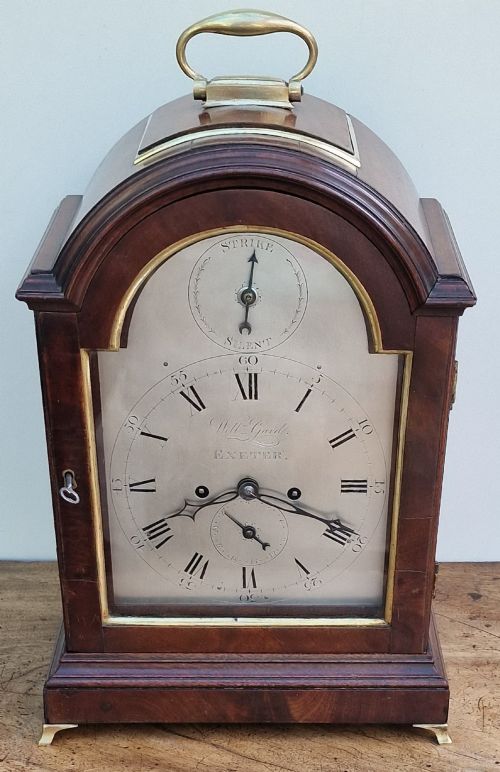


Vintage Brass Handle Clock
These vintage brass handle clock pieces bring together heavy metalwork and precise timekeeping, offering a practical yet decorative addition to any mantelpiece.
Vintage Brass Handle Clock
When you search for a vintage brass handle clock, you encounter portable timepieces and shelf clocks designed with carrying grips for easy movement between rooms. These objects primarily take the form of carriage clocks and bracket clocks spanning the nineteenth and twentieth centuries.
The selections on this page lean heavily towards carriage clocks featuring glass panels and brass framework alongside wooden bracket clocks encased in mahogany, walnut, or rosewood. Victorian, Edwardian, and French nineteenth-century examples dominate the offerings, bringing distinct regional designs into domestic spaces.
Makers and retailers such as Mappin & Webb, Garrards, and Paul Garnier represent the manufacturing standard found among these pieces. Buyers will find everything from miniature brass specimens to giant rouge marble or ebonised striking models equipped with bells.
What varies in quality
Quality differences stem from the intricacy of the clock movement, such as the presence of strike-repeat functions, eight-day capacities, or special chiming capabilities. The execution of the case work also dictates value, distinguishing standard production models from royal presentation pieces or signed works by notable makers.
Material selection plays a role, moving from basic brass housings to heavier gilt brass, rouge marble, or finely figured rosewood and mahogany veneers. The crispness of cast brass details like columns and frets separates ordinary pieces from superior examples.
One extraordinary nineteenth-century carriage clock comes equipped with a chaff-cutter, proving that Victorian timepieces could handle agricultural multitasking.
William Gard·Mappin & Webb·Pickford of London·Garrards·Thomas Moss·Henry Marc·Paul Garnier·Perigal & Duterrau·Joseph Lum·Malecot of Paris
The Vintage Brass Handle Clock Glossary
- Carriage clock
- A portable spring-driven timepiece originally designed for travellers, housed in a brass and glass case with an integrated handle on top.
- Bracket clock
- A shelf or table clock, traditionally with a wooden case, which historically sat on a matching wall bracket.
- Strike-repeat
- A mechanism that allows the clock to repeat the last struck hour or quarter-hour on demand via a button or cord.
- Enamel dial
- A metal face covered with fused powdered glass, providing a smooth white background for painted clock numerals.
- Fret
- An ornamental pattern cut out of wood or metal, frequently seen allowing sound to escape from the sides of clock cases.
Vintage Brass Handle Clock: Frequently Asked Questions
How do I wind a vintage carriage clock?
Most mechanical carriage clocks require a specialised key inserted into the backplate squares to tension the mainsprings for timekeeping and striking. Care must be taken not to overwind the springs.
Moving the hands should be done gently and strictly in a clockwise direction to avoid damaging the internal gear train.
What is the difference between a carriage clock and a bracket clock?
Carriage clocks are typically smaller, portable brass and glass pieces fitted with a fixed handle on the crown for transport. They originated for travel use in the nineteenth century.
Bracket clocks are heavier wooden table clocks made of mahogany, walnut, or ebonised timber, designed to sit permanently on furniture or wall brackets.
Where should I place a heavy marble clock?
Rouge marble and large brass pieces require a sturdy, level surface capable of supporting considerable weight without sagging. Mantelpieces and low sideboards are traditional locations.
Keeping the clock away from direct sunlight and damp walls protects the internal metal components and exterior finishes from premature wear.
How do repeat striking mechanisms work?
A repeat mechanism allows the owner to press a button or pull a lever on the case to make the clock restrike the last hour or quarters immediately. This was useful for telling time in the dark before electric lighting.
Such complications indicate a higher grade of horological construction found in better nineteenth-century examples.