
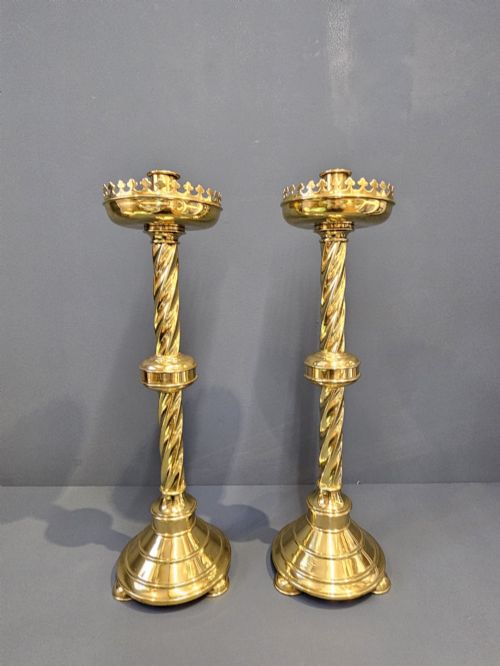
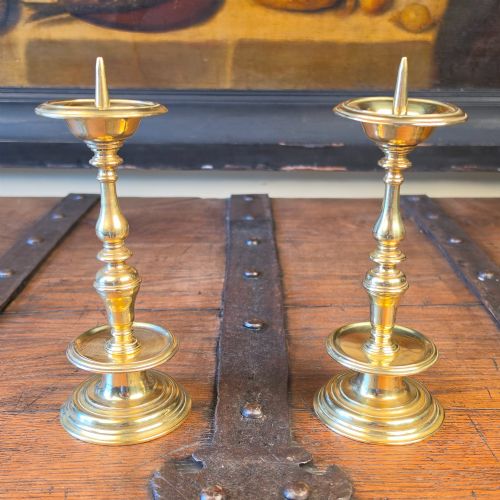
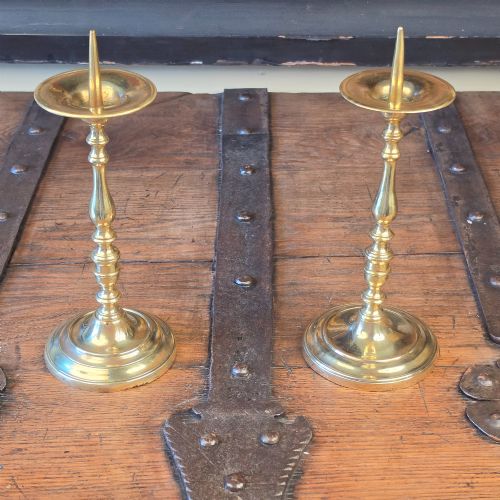


Vintage Altar Prickets
Vintage altar prickets are substantial ecclesiastical candle holders terminating in a sharp spike, designed to support large candles in devotional settings.
Vintage Altar Prickets
Vintage altar prickets comprise ecclesiastical candle holders and lamps originating from the nineteenth and early twentieth centuries, designed with a central spike to secure large wax candles. These pieces emerge in styles including Gothic Revival, Amsterdam School, and various baroque revivals, reflecting the sustained influence of earlier liturgical aesthetics on later production.
The versions most commonly met on this page span the Victorian era up to the nineteen-forties, appearing frequently in pairs or as single tall standards. Makers and workshops constructed these objects for sacred interiors, though many later examples show adaptation into table lamps while retaining their foundational pricket form.
Materials and construction
Foundry work dominates the metal pieces, utilising cast brass, bronze, copper, and wrought iron to achieve robust structures capable of supporting heavy wax columns. These metal prickets often combine cast components with turned shafts, creating sturdy altar furnishings designed for ecclesiastical service.
Wood construction relies on carved timber, treen, and giltwood, frequently enhanced with gesso surfaces and applied gilding. Artisans shaped these wooden candle holders into sculptural forms, including carved angel figures and baroque Revival standards.
Object forms on this page include heavy church candlesticks, carved table lamps, and Amsterdam School copper prickets.
Judging quality in altar prickets
Quality rests upon the crispness of casting in the brass and bronze examples, where sharply defined ornamentation and substantial weight separate superior foundry work from simpler production. Amsterdam School pieces and Gothic Revival designs demonstrate the maker's skill through balanced proportions and deliberate architectural detailing.
In wooden and giltwood pieces, the depth and execution of the carving dictate the calibre of the object. Hand-carved details, intact gilding over gesso, and well-preserved structural joins distinguish finer decorative altar items from standard commercial turnings.
The Vintage Altar Prickets Glossary
- Pricket
- A sharp metal spike set on a drip pan to hold a large candle firmly in place. This form predates socket candlesticks and remains standard in ecclesiastical contexts.
- Gothic Revival
- An architectural and decorative style drawing on medieval forms, featuring pointed arches and structural verticality. This aesthetic heavily influenced nineteenth-century church metalwork.
- Amsterdam School
- An architectural and design movement originating in the Netherlands around nineteen hundred, characterised by expressive forms and sculptural use of metal and brick. Pieces in this style display robust craftsmanship.
- Giltwood
- Timber coated with gold leaf or a gilt finish, frequently applied over a gesso ground on carved church furnishings. This treatment provided the visual splendour required for liturgical spaces.
- Treen
- Small handmade wooden household objects and utilitarian items produced by turning or carving. In church furnishings, treen elements appear in candle holders and lamp bases.
Vintage Altar Prickets: Frequently Asked Questions
What is an altar pricket?
An altar pricket is a heavy candle holder featuring an upright metal spike instead of a socket, built to secure large wax candles used in religious ceremonies. These objects were standard furnishings on church altars.
Over time, many of these pieces transitioned from ecclesiastical settings into domestic interiors, where their height and sculptural presence made them desirable decorative objects.
How do I date a brass pricket?
Dating relies on stylistic markers such as Gothic Revival motifs or Amsterdam School shaping, alongside the casting texture and assembly methods visible in the metal. Nineteenth-century and early twentieth-century examples often exhibit heavier casting and distinct patination.
Comparing the turned profiles and base construction with documented pieces from the Victorian era or nineteen-hundreds helps narrow the period of manufacture.
Were these converted into lamps?
Many vintage pricket candlesticks and altar stands received electrical wiring during the twentieth century to function as table lamps. This conversion often involved running a flex through the centre or mounting fittings above the original spike.
Buyers encounter both unconverted candle holders and period lamp adaptations among these ecclesiastical survivals.
How do I clean a brass pricket?
Maintaining these pieces typically involves dusting with a soft, dry cloth to preserve the accumulated patina developed over decades of use. Aggressive metal polishes can strip away historical surface character.
Gentle cleaning with appropriate conservation wax protects exposed metal and wood without diminishing the age of the object.
What materials are used?
The listings show a prevalence of cast brass, bronze, copper, and wrought iron for the metal church furnishings. These metals provided the necessary weight and durability for altar service.
Wooden examples utilise carved timber, giltwood, and gessoed surfaces, frequently incorporating hand-carved details like angels or baroque scrollwork.