



Gothic Altar Candlesticks
Gothic altar candlesticks bring heavy ecclesiastical gravity into a room, forged from brass and bronze with soaring architectural lines.
Gothic Altar Candlesticks
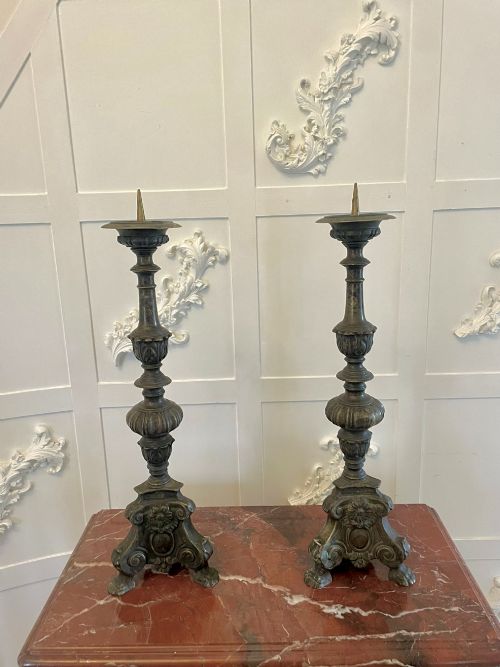
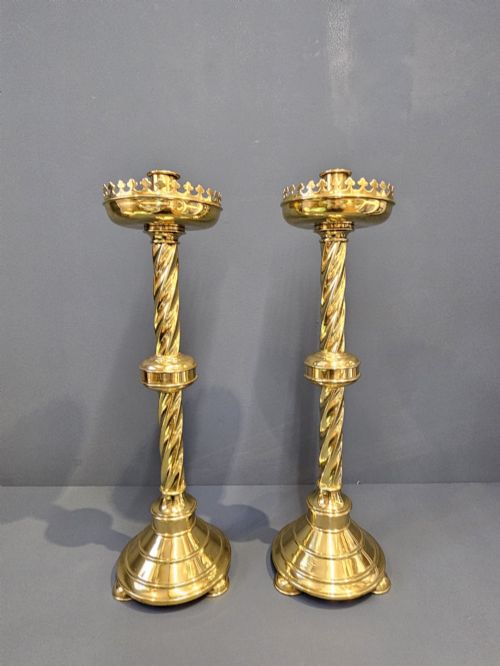
When you search for gothic altar candlesticks, you encounter heavy church metalwork designed for devotional spaces, most frequently appearing as Victorian pairs in cast brass and gilt brass. These pieces reflect the nineteenth century revival of medieval design, featuring tall stems, knopped shafts, and wide drip pans intended for liturgical use.
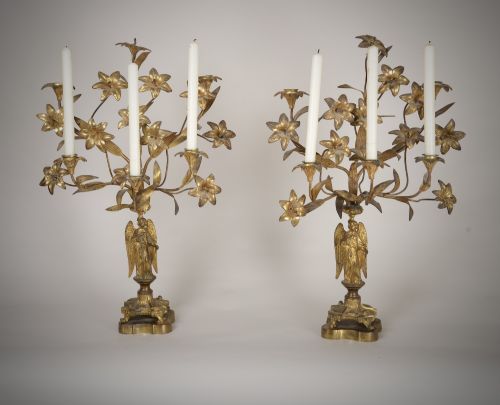
The inventory on this page spans the nineteenth century through to the early twentieth century, taking forms such as pricket candlesticks, socket candlesticks, and adapted table lamps. You also find continental examples alongside English work, including French ecclesiastical designs and Dutch Amsterdam School interpretations of the gothic idiom.
Materials and construction
Brass dominates the selection, utilised both in its bright cast form and with gilt or silver plated surfaces that catch the candlelight. Bronze and copper appear alongside iron components, particularly in heavier pricket forms and Amsterdam School variations where robust metal casting defines the silhouette.
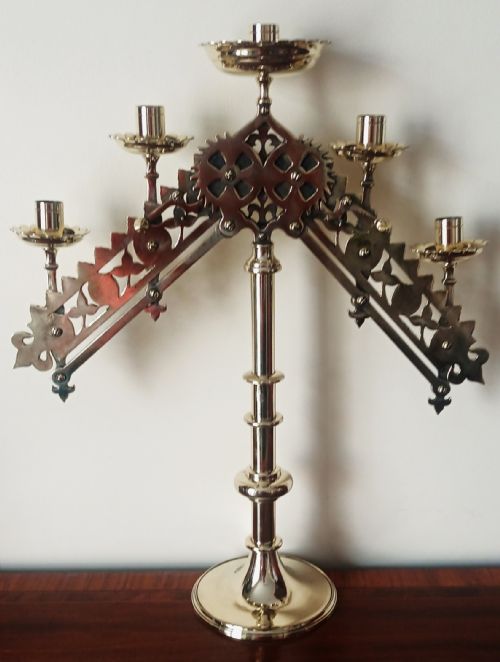
Manufacturers employed sand casting and assembly of multiple turned and cast sections, securing heavy stems to wide stepped bases. Articulated joints and screw fittings feature in adjustable or multi-armed candelabra, while pricket versions mount a sharp metal spike to hold large wax candles directly.
Some nineteenth century church candles leaked so copiously that deep drip pans became an altar candle's best friend.
Evaluating the metalwork
Quality rests upon the crispness of the casting and the gauge of the metal used in the shaft and base. Finer examples display deeply chased surface detail, well-defined architectural mouldings, and substantial weight that prevents tipping.
The integrity of the original components matters greatly, as does the presence of matching pairs or sets of four rather than mismatched assemblies. Retaining the original pricket spike or socket without excessive replacement parts distinguishes superior ecclesiastical pieces.
T Thomason & Co
The Gothic Altar Candlesticks Glossary
- Pricket candlestick
- A candlestick featuring a sharp metal spike at the top to impale and secure a large candle, rather than a socket to hold it.
- Gothic Revival
- An architectural and decorative style popular in the nineteenth century that revived medieval pointed arches, tracery, and vertical emphasis.
- Ecclesiastical
- Design relating to a Christian church or its clergy, which heavily influenced the scale and ornamentation of these metal wares.
- Knoop
- A solid decorative protuberance or knob on the stem of a candlestick, providing grip and visual division along the vertical shaft.
- Amsterdam School
- An early twentieth century architectural and design movement characterised by expressive forms, brickwork, and rich metal detailing.
Gothic Altar Candlesticks: Frequently Asked Questions
What is a pricket candlestick?
A pricket candlestick uses a sharp metal spike on the top plate to hold candles in place, unlike standard socket holders. This design originates from medieval church altars where large wax candles sat directly upon the spike.
Today, these pieces serve as striking decorative objects on mantelpieces or side tables, though modern pillar candles require careful balancing or slight melting to sit securely on the point.
How do I date these candlesticks?
Dating relies on stylistic clues like Victorian gothic revival motifs, manufacturing techniques such as sand casting marks, and associated periods like the nineteenth century or Edwardian era. Heavy brass construction and ecclesiastical provenance typically point toward the mid to late eighteen hundreds.
Later pieces from the early nineteen hundreds may show influences from the Amsterdam School or Arts and Crafts movement, shifting away from strict gothic revival toward more expressive, simplified metal forms.
Were these used in homes?
These candlesticks were originally manufactured for use in churches, chapels, and cathedrals during services and devotions. Their robust scale and religious ornamentation reflected their sacred function on altars.
Over time, many found their way into domestic interiors as collectors and homeowners embraced ecclesiastical aesthetics, and some were later converted into table lamps with wiring running through the stem.
Are pairs common?
Pairs appear frequently because church altars traditionally required symmetrical arrangements of candlesticks flanking a cross or crucifix. Complete sets of four also occur for larger altars.
When buying, matching pairs command greater interest from collectors who wish to display them symmetrically on a sideboard or fireplace mantle.