


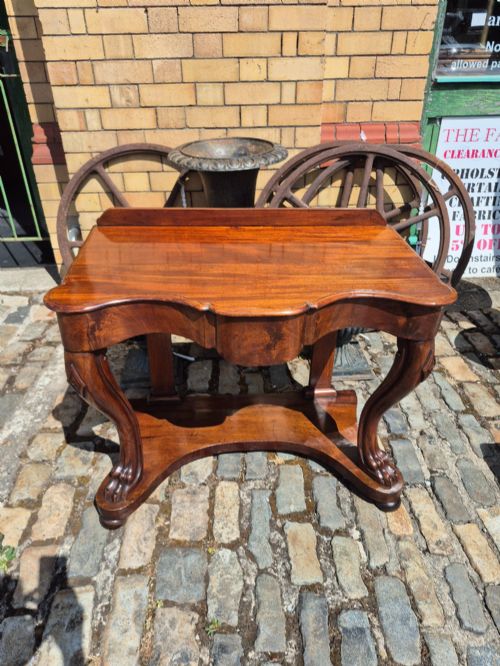
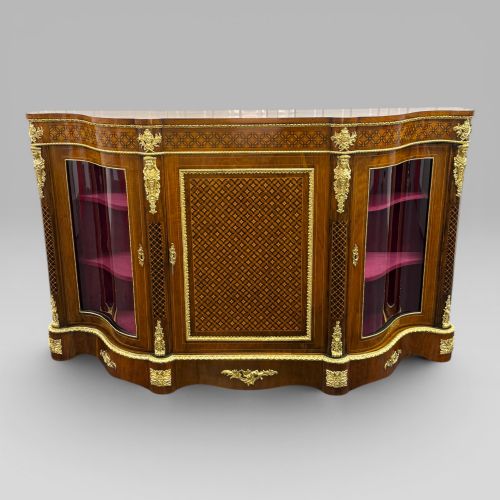


Victorian Serpentine Credenza
When you search for a Victorian serpentine credenza, you are looking at mid-nineteenth-century drawing room low cabinets with undulating fronts designed to display wealth and taste.
Victorian Serpentine Credenza
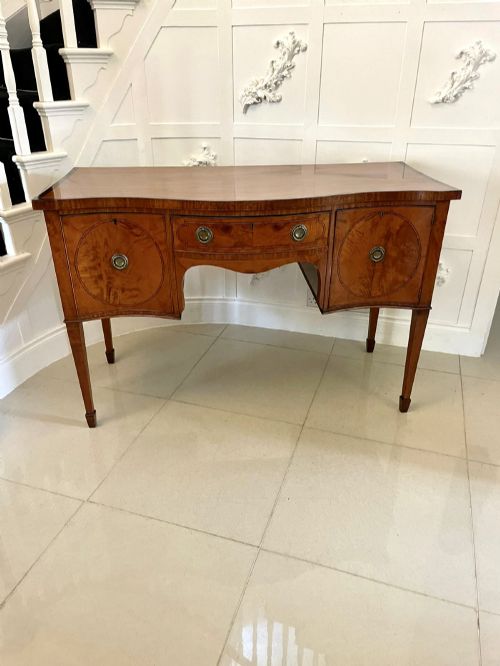
A Victorian serpentine credenza is a low, freestanding side cabinet shaped with a distinct curved, undulating front outline that sets it apart from straight-sided board furniture. Most examples encountered in these records date from the nineteenth century, spanning the Victorian period from roughly 1850 through 1880.
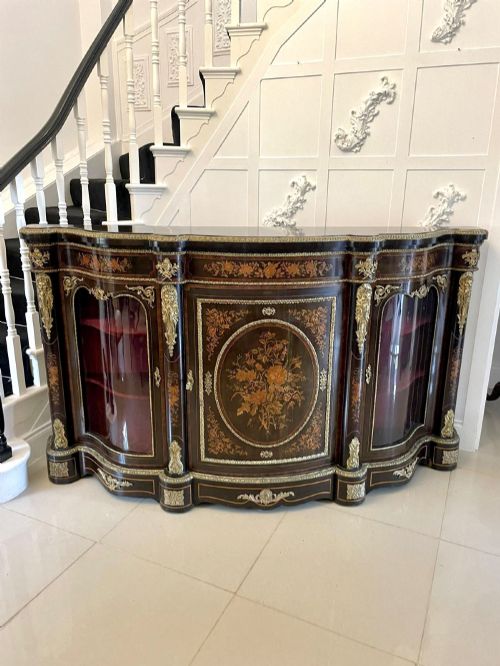
These pieces typically function as principal reception room furniture, designed to stand against a wall while displaying porcelain or ornaments on top and storing linens or books behind glazed or panelled doors. The standard form on this page uses a central door flanked by curved side compartments, often elevated on short feet or a plinth base.
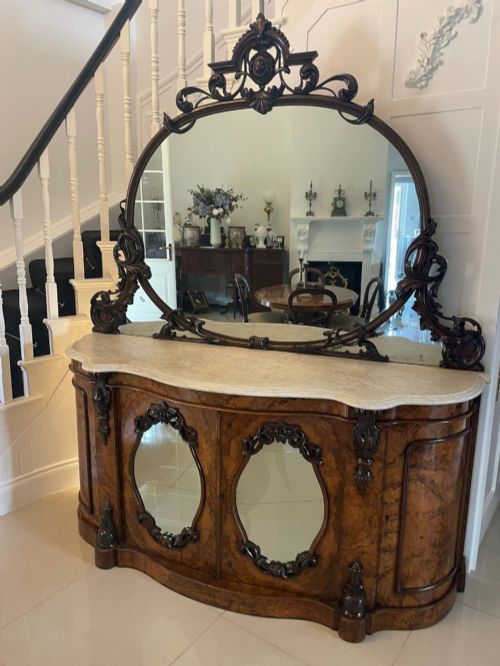
Makers of the period drew heavily on French Revival and Rococo styles, incorporating mirror backs, marble tops, and elaborate marquetry into the basic credenza framework. While some items share traits with chiffoniers or sideboards, the true credenza maintains a low profile intended for formal entertaining spaces.
How they were made
Cabinet makers constructed the foundational carcase from native softwoods or hardwoods, veneering the visible exterior surfaces in highly figured burr walnut, rosewood, or satinwood. The challenging curved serpentine profile required specialist steaming and shaping of timber to achieve the characteristic undulating lines without splitting the grain.
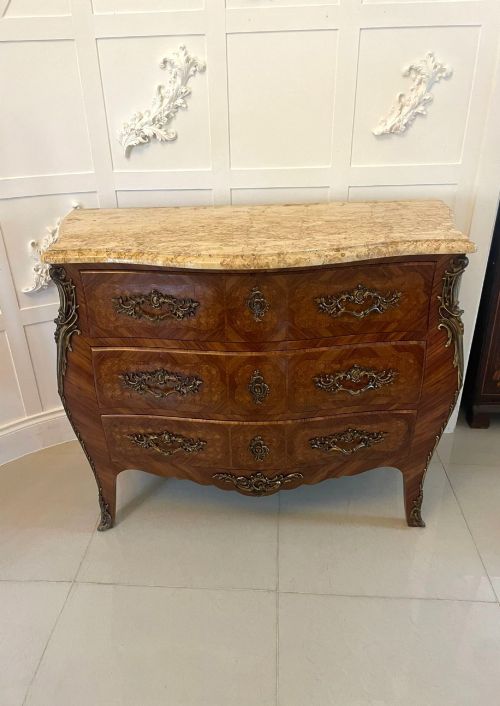
Decorative surface enrichment relied heavily on floral marquetry in contrasting woods, alongside cast or chased ormolu mounts fixed to corners, friezes, and framing borders. Many high-status variants incorporate fitted white or grey marble slabs to the upper surface, paired with internal velvet lining and mirrored back panels.
Listings demonstrate that burr walnut remains the dominant timber choice for Victorian serpentine credenzas, far outnumbering rosewood, satinwood, and ebonised finishes.
What varies in quality
The standard of timber selection marks the primary division between everyday production and top-tier workshop output, particularly in the density and figuring of the burr walnut veneer used across the front. Finer examples display symmetrical, highly figured grain patterns that wrap continuously around the complex curves of the serpentine shape.
The execution of the decorative mounts and inlay dictates the upper tier of the range, separating standard factory output from exhibition pieces bearing meticulous hand-cut marquetry and heavy, finely cast ormolu. Structural integrity also varies according to the thickness of the marble top and the precision of the door alignment within the curved framework.
Maison Gagneau·Gillows
The Victorian Serpentine Credenza Glossary
- Serpentine
- A furniture front shaped with a convex curve flanked by two concave curves, creating an undulating outline. This design requires advanced carpentry skills to fit doors and mouldings accurately.
- Credenza
- A low cabinet originating in Italy and revived in Victorian England for formal reception rooms. They typically feature cupboards enclosed by doors and lack the high upper shelving of a sideboard.
- Ormolu
- Gilded bronze mounts applied to furniture for decorative enrichment along corners and borders. The metal is cast and chased to produce crisp relief details.
- Marquetry
- Inlaid patterns formed by fitting pieces of various coloured woods and veneers into a prepared background. Floral motifs are particularly common on Victorian walnut examples.
- Burr Walnut
- Timber taken from the abnormal growth excrescences on walnut trees, yielding highly decorative swirling grain patterns. It was the favoured veneer for high-status mid-nineteenth-century cabinets.
Victorian Serpentine Credenza: Frequently Asked Questions
What is a serpentine credenza?
A serpentine credenza is a nineteenth-century low cabinet distinguished by its undulating curved front and formal reception room use. These pieces combine storage cupboards with display surfaces, often featuring glass doors or open central compartments.
Cabinet makers of the period produced them primarily in walnut and rosewood, incorporating decorative marquetry and gilt metal mounts. Their distinctive shape allows them to sit flat against a wall while offering visual movement through the room.
How were credenzas used in Victorian homes?
Victorian households utilised credenzas in drawing rooms and formal dining spaces to store fine porcelain, silver, and table linens. The top surface served as an elevated platform for displaying decorative ornaments, clocks, or bronzes.
Many versions featuring mirror backs and velvet-lined interiors were specifically intended to reflect light and showcase valuable collections during evening gatherings. They acted as status symbols that signalled the refinement of the homeowner.
How do I date a Victorian credenza?
Dating relies on examining the secondary woods, construction methods, and stylistic shifts visible across the nineteenth century. Pieces from around 1850 typically favour heavy burr walnut and robust proportions, often with carved wooden details.
By 1870 and 1880, designs frequently incorporated more extensive ormolu mounts, French Boulle marquetry, or ebonised finishes influenced by Continental revival tastes. The presence of original mirrored backs and marble tops also helps anchor pieces within the mid-Victorian era.
How do I care for a burr walnut credenza?
Burr walnut furniture requires stable indoor humidity levels and protection from direct sunlight to prevent veneer cracking or fading. Regular dusting with a dry, soft cloth maintains the finish without stripping the historical polish.
Avoid placing items with high moisture content directly onto the wooden top, and use protective felt pads under heavy decorative objects. Marble sections benefit from occasional gentle cleaning with mild soap and water followed by thorough drying.