


Victorian Ruby Glass Pair
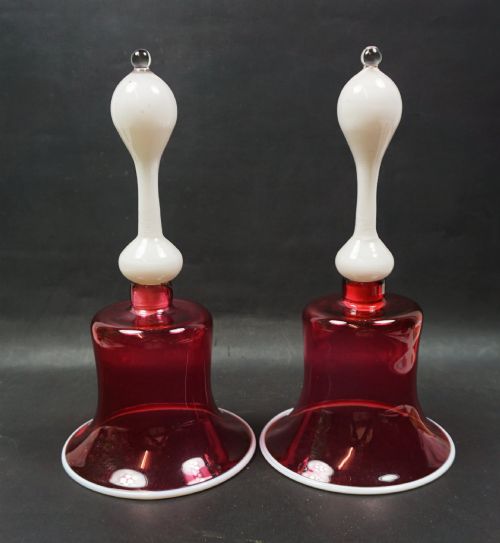
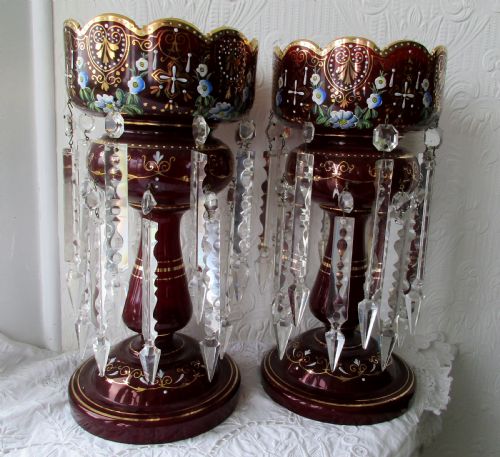
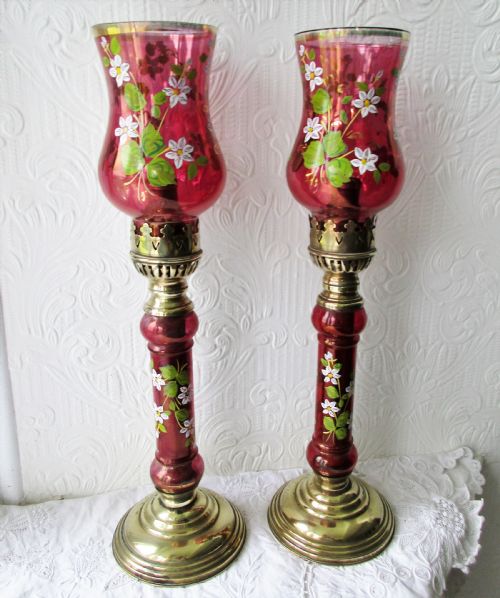
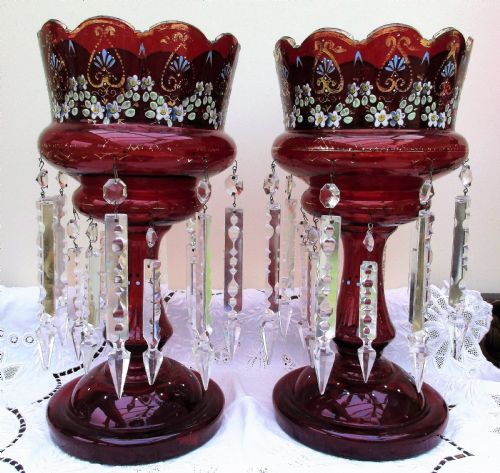
These Victorian ruby glass pair selections comprise matching dual items shaped into mantel lustres, decanters, vases, and bells that bring saturated colour to a room.
Victorian Ruby Glass Pair
A victorian ruby glass pair brings together matching dual vessels or display objects shaped as mantel lustres, decanters, vases, and bells. These items emerge predominantly from the nineteenth century, carrying origins in English and Bohemian workshops.
Mantel lustres dominate the form, featuring hanging crystal drops that catch the light around a central ruby or cranberry bowl. Alongside these stand decanters, table lamps, and drinking glasses designed as matching sets.
The objects span varied nineteenth-century decades, including specific pieces dated to eighteen eighty, eighteen seventy-five, and eighteen sixty. Makers applied rich red tones across both solid glass bodies and layered overlay configurations.
Assessing quality and finish
Quality rests in the depth of the glass colour and the crispness of the wheel-cut or engraved motifs. Superior examples display precise facet-cutting on drops and bowls alongside meticulous gilding that remains intact.
Matching symmetry between the two items defines the best pairs, ensuring balanced heights, uniform colour saturation, and corresponding drop counts on lustres. The clarity of the underlying crystal layer further separates standard items from finer works.
The object forms recorded include mantel lustres, decanters, peg lamps, champagne coupes, and engraved table glassware.
The Victorian Ruby Glass Pair Glossary
- Mantel lustre
- A decorative two-piece or multi-piece table ornament fitted with hanging glass prisms or drops designed to catch candlelight.
- Cranberry glass
- A transparent pinkish-red glass produced by adding gold chloride to the molten batch during manufacturing.
- Flash glass
- A dual-layer material formed by dipping a core of clear or white glass into a thin outer layer of coloured glass before cutting.
- Peg lamp
- An oil lamp featuring a protruding lower stem or peg designed to fit directly into a candlestick socket or base.
- Overlay glass
- A technique where a thick layer of coloured glass covers a contrasting base body, creating deep contrast when cut away.
Victorian Ruby Glass Pair: Frequently Asked Questions
What are mantel lustres used for?
Mantel lustres served as decorative garniture sets placed upon fireplace mantels or sideboards during the Victorian period. Their hanging glass prisms reflected flickering candlelight to brighten dark Victorian rooms.
Today, they function as striking decorative focal points on mantelpieces, consoles, or dining tables. Collectors appreciate them for their vibrant colour and ornamental presence.
How do I clean ruby glass safely?
Clean ruby glass items gently using lukewarm water and a mild, non-abrasive washing liquid. Avoid soaking pieces that feature delicate gold leaf gilding or enamel painted details.
Dry each item thoroughly with a soft lint-free cloth to prevent water spots. Take particular care around hanging crystal drops on lustres to avoid chipping.
How can I date a ruby glass pair?
Dating relies on examining the manufacturing techniques, pontil marks, and stylistic clues present in the glass. Nineteenth-century pieces often show rough pontil scars on the base where they were snapped from the blowing iron.
Comparing the cut-glass patterns, brass mounts, and enamel motifs against known period examples helps narrow the decade of origin. English and Bohemian pieces from this era frequently exhibit distinct regional cutting styles.