



Crystal Prism Glass Vases
Crystal prism glass vases bring sparkle and movement to a room, catching the light through hanging glass drops.
Crystal Prism Glass Vases
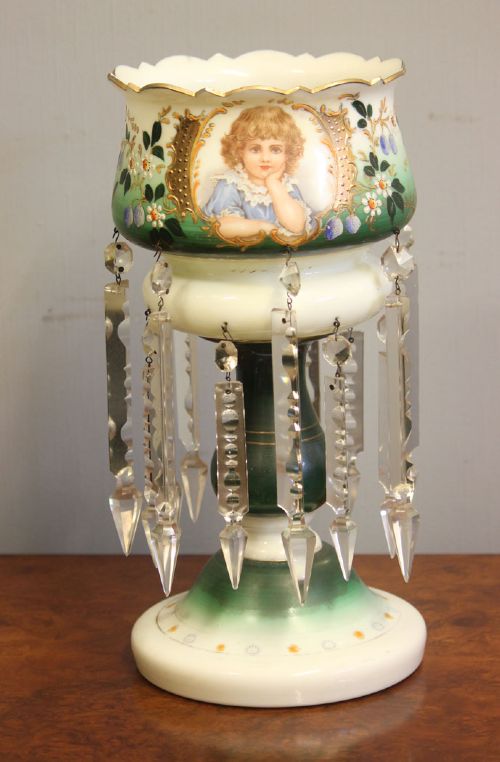
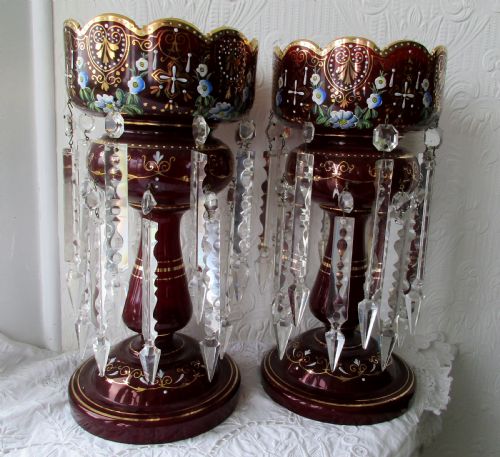
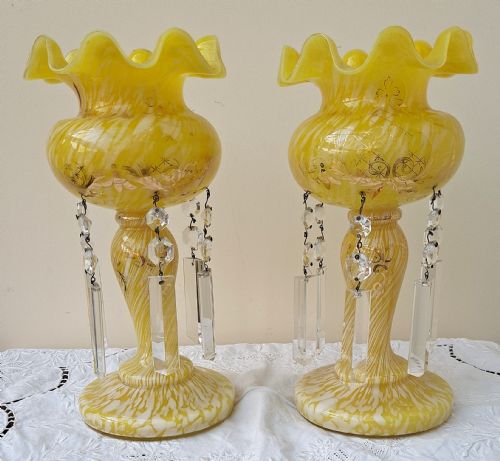
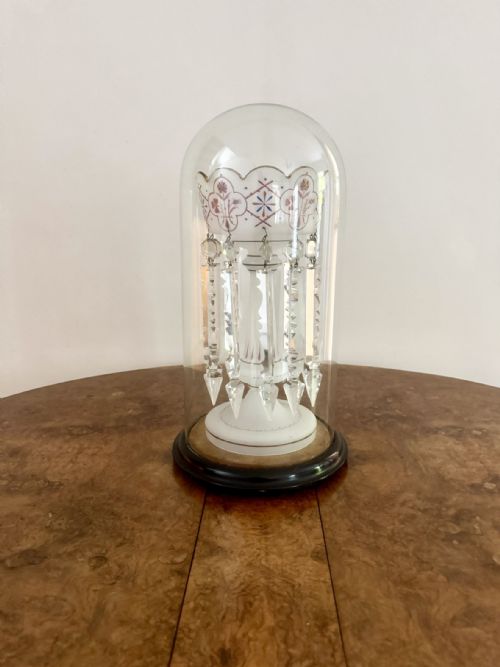
When you search for crystal prism glass vases, you encounter mantel lustres and table lustres dating from the nineteenth century. These decorative glass vessels feature hanging crystal prisms designed to refract candle or daylight.
The pieces listed on this page originate predominantly from the Victorian era, spanning decades such as eighteen eighty and eighteen ninety. You will find them in pairs as well as single examples, often used traditionally on mantelpieces.
Coloured glass forms a major part of this selection, with ruby, green, yellow, cranberry, and opaline varieties appearing alongside clear lead crystal. Bohemian overlay and flash glass techniques also feature strongly among the available objects.
Materials and construction
These items rely on heavy lead crystal and coloured glass bodies shaped by hand, often incorporating cut crystal details. Artisans applied surface decoration such as enamel and gold leaf to enrich the glass surfaces.
Prisms were individually cut and polished before being suspended from the rim using metal wires or pins. Overlay and flash glass methods involved layering different coloured glass before cutting through the top layer to reveal the contrasting hue beneath.
Listings feature nineteenth-century items including Victorian and French Chateau styles, utilising ruby glass, gold leaf, and cut crystal.
Judging quality in glass lustres
Quality rests upon the depth of the glass colour and the crispness of the cutting on both the body and the hanging prisms. Rich ruby, cranberry, and layered bohemian overlay examples demonstrate finer decorative ambition.
The completeness and matching nature of the crystal drops significantly influence the integrity of a pair. Weight, clarity, and the precision of applied enamel or gold leaf distinguish standard examples from more refined pieces.
The Crystal Prism Glass Vases Glossary
- Lustre
- A decorative vase fitted with a ring of hanging crystal prisms. These objects were popular on nineteenth-century mantelpieces.
- Prism
- A cut glass pendant suspended from the rim of a vase to refract light. They hang in numbers around the upper bowl.
- Bohemian overlay
- A technique where a layer of coloured glass is fused over clear or contrasting glass. Portions are then cut away to reveal the underlayer.
- Flash glass
- A thin layer of coloured glass applied over a colourless or contrasting glass body. This allows craftsmen to create patterns by cutting through the surface layer.
- Opaline
- An opaque, milky glass often tinted in soft shades. It provides a smooth surface for hand-painted enamel decoration.
Crystal Prism Glass Vases: Frequently Asked Questions
How were these glass vases used?
Victorian households placed them on mantelpieces and tables primarily for decorative effect and to brighten rooms by reflecting light from lamps and candles.
They also served as impressive ornamental centrepieces in period drawing rooms.
How do I date a glass lustre?
Dating relies on observing stylistic markers, manufacturing techniques, and the depth of the glass colours typical of the nineteenth century.
Victorian examples often exhibit specific forms and rich tones like ruby, cranberry, and green.
Are these glass vases usually found in pairs?
Many examples survive as balanced pairs intended for mantelpiece symmetry, though individual pieces do appear.
Pairs were standard for formal display flanking clocks or candelabras.