


Victorian Needlework Fire Screen
A victorian needlework fire screen is a handsome domestic barrier designed to deflect fireplace heat, uniting fine timber frames with intricate hand-stitched textiles.
Victorian Needlework Fire Screen
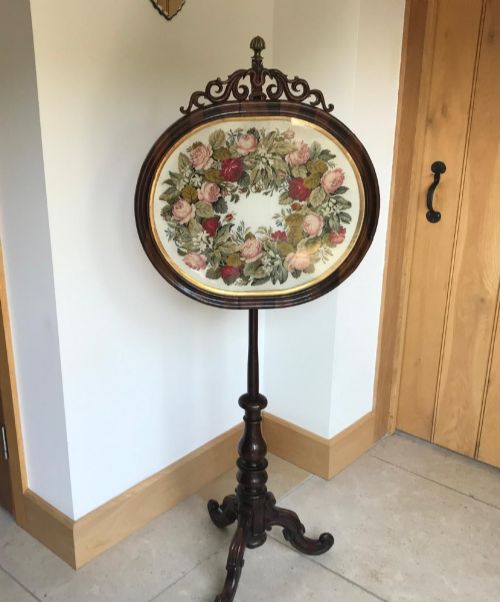
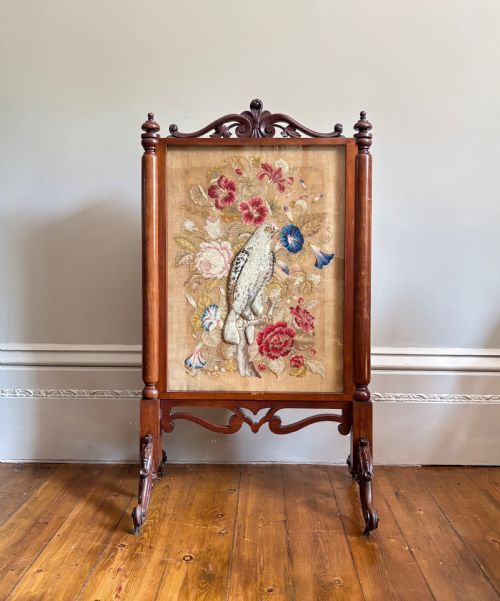
A victorian needlework fire screen encompasses both upright cheval forms and adjustable pole screens designed to protect a gentle complexion from the blaze of a hearth. These domestic furnishings appear across the nineteenth century, drawing on earlier Georgian and Regency precedents to serve both a practical function and a decorative purpose in the principal rooms of a house.
The versions most commonly met on this page belong to the Victorian period, frequently fashioned from rosewood or mahogany and fitted with intricate Berlin work, wool, or silk embroidery panels. Alongside these upright pole screens, buyers will discover table screens, framed wall art, and cheval formats that showcase needlepoint tapestry or embroidered pictures.
The structural forms vary from slender turned poles with tripod or carved bases to substantial framed screens and table face screens. Makers utilised rich timbers such as satinwood and oak alongside exotic hardwoods, mounting textile panels executed in wool, canvas, and glass.
How they were made
The frames of a victorian needlework fire screen rely on traditional cabinet-making techniques, utilising timbers such as rosewood, mahogany, satinwood, and carved oak. Artisans employed turning, such as bobbin-turned details, alongside intricate carving to shape the tripod bases, poles, and surrounds.
The textile panels inserted into these frames display a variety of needlework techniques, predominantly Berlin work, wool embroidery, silkwork, and needlepoint tapestry. These soft furnishings were often glazed for protection or mounted securely within wooden rebates to withstand the dry heat of the fireplace.
Listings demonstrate a strong preference for rosewood and mahogany frames, frequently paired with wool, silk, and Berlin work textile panels.
What varies in quality
The quality of a victorian needlework fire screen is largely determined by the harmony between the timber frame and the needlework panel. Finer examples feature dense, richly figured rosewood or mahogany with crisp, deep carving on the base, paired with densely stitched Berlin work or fine silk embroidery that retains its original colour.
Construction details also separate standard examples from superior ones, visible in the stability of the turned pole, the precision of the joinery, and the weight of the carved base. Pieces that retain their original glass protection and unaltered textile panels command greater appreciation among collectors.
The Victorian Needlework Fire Screen Glossary
- Pole screen
- A type of fire screen featuring a vertical wooden pole mounted on a tripod base, upon which an adjustable framed panel slides up and down.
- Berlin work
- A style of colourful wool needlepoint embroidery charted on squared paper that became immensely popular during the nineteenth century.
- Cheval screen
- A self-standing floor screen with a vertical frame supported by two lateral pillars or feet, allowing the panel to tilt.
- Needlepoint
- A form of canvas work embroidery stitched with a needle, often using wool or silk to create dense pictorial or geometric patterns.
- Table screen
- A smaller version of a fire screen designed to sit upon a surface rather than the floor, sometimes termed a table face screen.
Victorian Needlework Fire Screen: Frequently Asked Questions
What is a pole screen?
A pole screen is a vertical timber stand featuring a sliding panel that could be adjusted to shield the face from radiant hearth heat.
These pieces were typically positioned close to an armchair in the principal sitting rooms of nineteenth-century homes.
How were fire screens used?
They were placed strategically between seated occupants and the open fireplace to protect complexions from excessive heat and prevent makeup from melting.
Over time, as heating methods evolved, they transitioned into purely decorative furnishings that showcased fine needlework.
What is Berlin work?
Berlin work is a distinctive type of coloured wool embroidery worked on canvas from printed pattern grids.
Introduced from Germany, it dominates the textile panels found within Victorian needlework fire screens.
How do I date a screen?
Dating relies on identifying timber choices, turning styles, and the aesthetic influence of periods such as Regency, William IV, or Victorian Rococo Revival.
Heavier rosewood frames with elaborate carving typically point towards the mid-nineteenth century, while lighter satinwood or distinct tripod forms suggest earlier Regency origins.
Can I place these near heat?
Original nineteenth-century timbers and antique textiles are sensitive to dramatic temperature fluctuations and dry heat.
It is best to position these screens away from modern radiators and active fireplaces to preserve the wood and fragile needlework.