




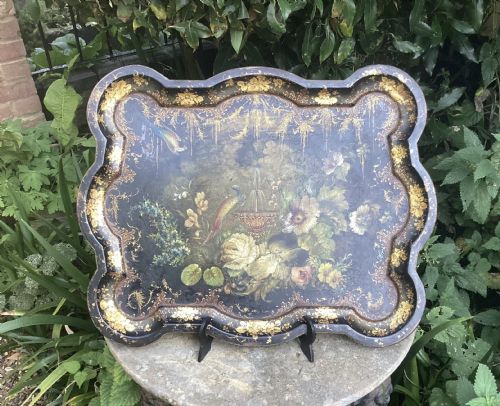
Victorian Japanned Tray
These Victorian japanned trays combine utility and ornament, bringing hand-painted lacquer and gilt detail to desks and side tables.
Victorian Japanned Tray
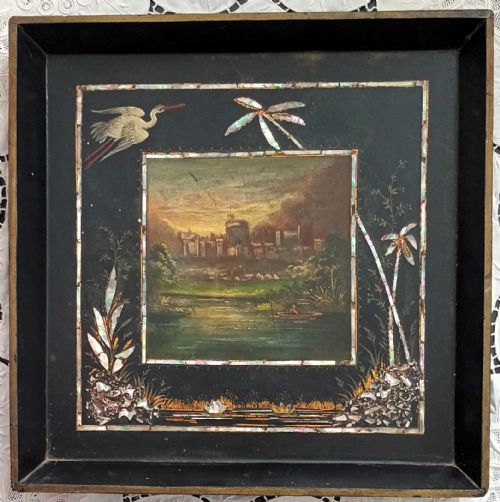
A victorian japanned tray is a serving or decorative piece constructed from papier-mâché or metal and finished with dark lacquer or paint. The selection here spans the nineteenth century, including works from the regency and victorian periods.
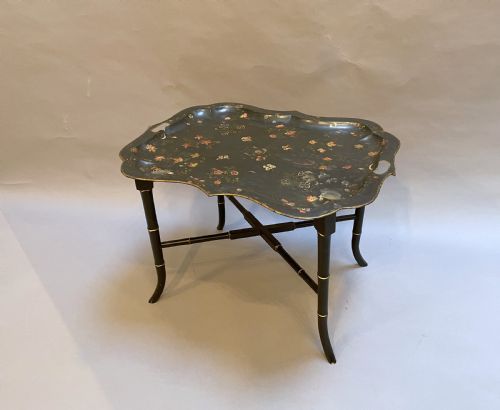
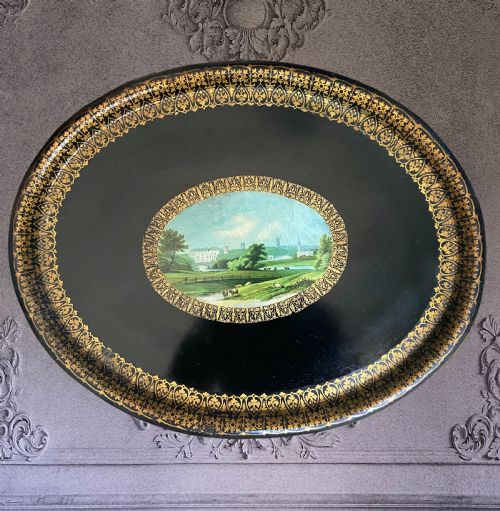
Most examples take rectangular or oval forms, while kidney shapes and occasional table conversions also appear. Makers adapted these surfaces for desk sets, letter racks, and serving duties.
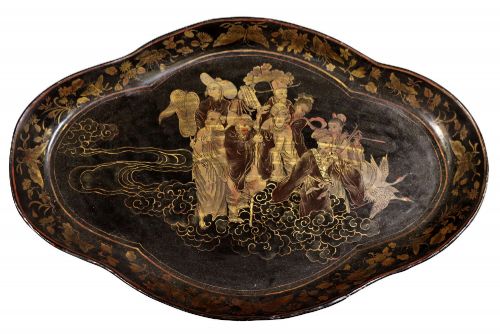
Origins include English workshops, French Napoleon III production, and Japanese export pieces. They function today as decorative centerpieces or table tops on later stands.
Materials and construction
Craftsmen built the rigid cores from compressed paper pulp known as papier-mâché, or shaped sheet metal for toleware trays. These surfaces received layers of dark lacquer or paint to create a smooth base.
Decoration relied on hand painting, gold leaf, and gilt embellishment, sometimes incorporating mother-of-pearl inlay. Chinoiserie motifs and scenic illustrations were applied before final protective varnishing.
An eighteenth-century dog once reportedly guarded a Pontypool factory, though it preferred napping on the scrap metal piles.
Assessing quality
Quality rests in the crispness of the hand-painted details and the stability of the underlying papier-mâché or metal. Superior examples exhibit precise gilding and well-preserved lacquer without excessive surface craquelure.
The sophistication of the pictorial subject, from simple gilded borders to detailed hunting scenes or historical narratives, distinguishes standard production from masterworks.
Jennens and Bettridge·H. Meeson
The Victorian Japanned Tray Glossary
- Japanned
- European imitation of East Asian lacquerwork, created by applying dark varnishes and painted decoration to metal or papier-mâché. This finish provided a durable and glossy surface.
- Papier-mâché
- A composite material made from paper pulp or layers of paper bound with glue, pressed into moulds, and baked hard. It formed a lightweight yet sturdy base for trays.
- Toleware
- Painted or lacquered sheet metalware produced in Britain and Europe during the eighteenth and nineteenth centuries. Pontypool was an early centre for this production.
- Chinoiserie
- European artistic style reflecting Chinese motifs and landscapes, popular on lacquer and painted trays. Artists used whimsical pavilions, figures, and flora.
- Gilt
- Application of gold leaf or gold powder to decorate the borders and surfaces of trays. It highlights the dark background lacquer.
Victorian Japanned Tray: Frequently Asked Questions
Can these trays still be used for serving?
Most antique pieces function better as decorative display items or stationary trays due to age and surface wear.
Using them for wet drinks or heavy items risks scratching the original lacquer and gilt borders.
What is the difference between toleware and papier-mâché?
Toleware utilises a sheet metal base, while papier-mâché is formed from compressed paper pulp and binding agents.
Metal trays tend to feel heavier and show different types of edge wear compared to the fibrous paper cores.
Why are some trays mounted on stands?
Larger trays were frequently converted into occasional or coffee tables by adding wooden legs during the nineteenth or twentieth centuries.
This adaptation allowed fragile decorative surfaces to serve practical roles in domestic interiors.