
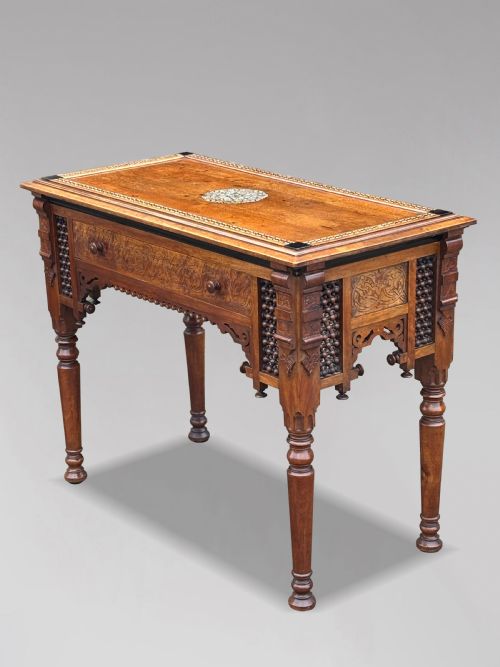
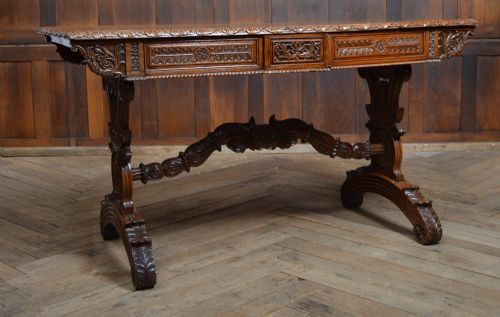


Victorian Indian Desk
These Victorian Indian desks combine heavy local timbers with intricate carving made during the height of the British colonial period.

Victorian Indian Desk
A Victorian Indian desk encompasses a variety of writing furniture produced during the nineteenth century under Anglo-Indian and colonial influences. Pieces matching this search phrase range from solid ebony writing boxes and sloping correspondence chests to partners desks and Davenport writing desks.
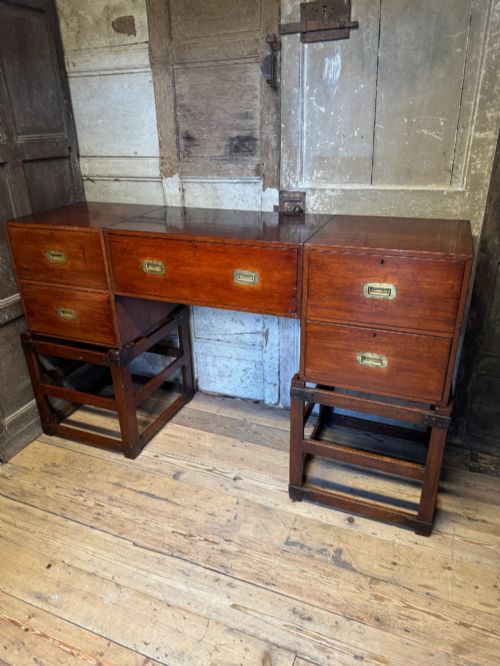
The versions most commonly met on this page include portable campaign writing slopes and larger pedestal desks rendered in dense tropical hardwoods. Many incorporate folding mechanisms, secret drawers, and brass mounts suited for colonial administration.
Materials and Construction
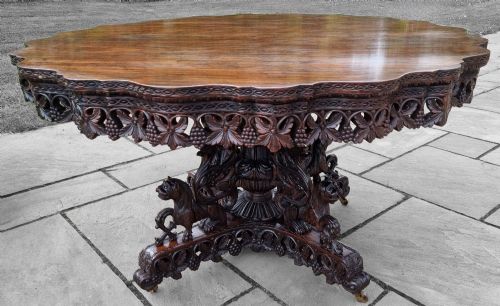
Carpenters utilised dark, heavy timbers such as padauk, teak, rosewood, and ebony, which were chosen for their durability and capacity to hold deep relief carving. These woods were frequently combined with contrasting bone, ivory, or subtle brass stringing for decorative effect.
Construction techniques often reflected campaign requirements, producing sectional furniture that could be easily dismantled for transport, alongside stationary library pieces featuring elaborate floral or geometric scrollwork.
Current listings demonstrate a strong presence of nineteenth-century ebony writing boxes alongside padauk tables and teak campaign chests.
Assessing Quality and Execution
Quality rests upon the crispness of the hand-carving and the density of the chosen timber, with solid ebony and figured padauk sitting at the upper end of the range. The depth and undercut of floral scrolls or figural elements distinguish master workshops from routine production.
Internal secondary fittings, such as secret compartments, fitted pigeonholes, and original brass hardware, separate superior examples from simpler utilitarian pieces.
The Victorian Indian Desk Glossary
- Writing Slope
- A portable slant-topped box designed to hold stationery and provide a firm surface for writing letters. When opened, it reveals a folding leather-lined writing surface and compartments for inkwells.
- Campaign Desk
- Dismountable military or travel furniture fitted with brass carrying handles, flush hardware, and reinforced corners designed for colonial journeys. These pieces separate into modular sections for ease of transport.
- Padauk
- A dense, heavy reddish-brown tropical hardwood native to Southeast Asia and India, prized for stability and deep natural lustre. It provides a robust ground for intricate nineteenth-century relief carving.
- Vizagapatam
- A coastal Indian centre renowned for luxury boxes and desk accessories decorated with intricate bone and ivory inlay. Pieces originating here typically display meticulous geometric micro-mosaics.
- Davenport Desk
- A compact Victorian writing desk featuring a sloped, hinged writing surface above a set of side drawers. The interior usually conceals small pigeonholes and letter compartments.
Victorian Indian Desk: Frequently Asked Questions
What is an Anglo-Indian desk?
An Anglo-Indian desk is a piece of nineteenth-century furniture made in India by local craftsmen using traditional regional carving techniques combined with European furniture forms demanded by the British administration.
These desks range from portable campaign boxes with brass mounts to substantial padauk partners desks and Davenport models intended for colonial studies.
How do I identify campaign furniture?
Campaign furniture is characterised by modular construction, recessed brass handles, reinforced brass corners, and folding mechanisms designed to facilitate transport during the colonial era.
Many examples separate into two or more distinct sections, allowing officers and administrators to pack their desks securely for long journeys.
What woods were used for these desks?
Maker workshops utilised dense tropical timbers such as teak, padauk, rosewood, and ebony, which withstood humid climates and provided a stable base for deep carving.
Lighter woods like beech or elm occasionally appear, while decorative details frequently incorporate bone or ivory inlay.
How do I care for a Victorian hardwood desk?
These dense hardwoods require minimal intervention; dusting with a dry cloth and avoiding direct sunlight or sudden humidity changes preserves the finish.
Applying a traditional wax polish occasionally maintains the natural lustre of the timber without building up heavy residues.