
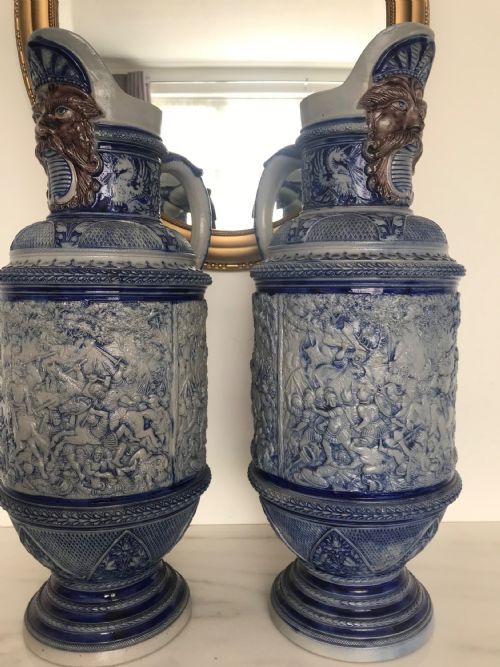
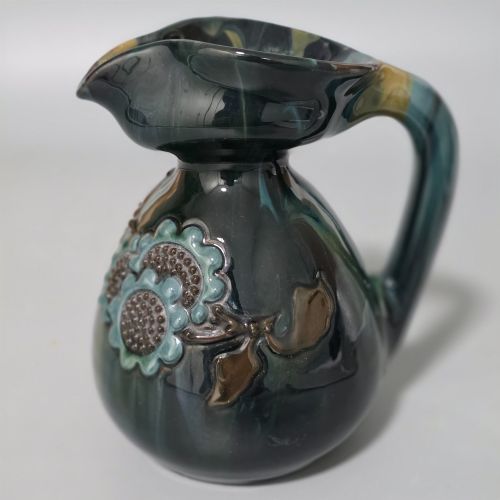


Victorian Glazed Stoneware Pitcher
A victorian glazed stoneware pitcher brings heavy utility and fine studio craft to the table, forged from robust clay and salt-fired finishes.
Victorian Glazed Stoneware Pitcher
A victorian glazed stoneware pitcher encompasses heavy ceramic vessels made primarily during the nineteenth century, ranging from simple tavern service to ambitious studio art pottery. These utilitarian objects span everyday pouring tasks and commemorative pieces marked by royal jubilees, political figures, or sporting scenes.
You will encounter pieces from large industrial potteries alongside distinctive studio works, often styled in Victorian Arts and Crafts, Art Nouveau, or traditional folk art traditions. The selection leans heavily toward robust salt-glazed bodies and rich cobalt blue ornamentation designed for enduring service.
Materials and construction
Makers utilised dense clay bodies fired at high temperatures to achieve impermeability, frequently applying salt during the kiln process to produce a characteristic pitted, orange-peel texture. This dense vitrified material resists liquids naturally without requiring internal lead linings.
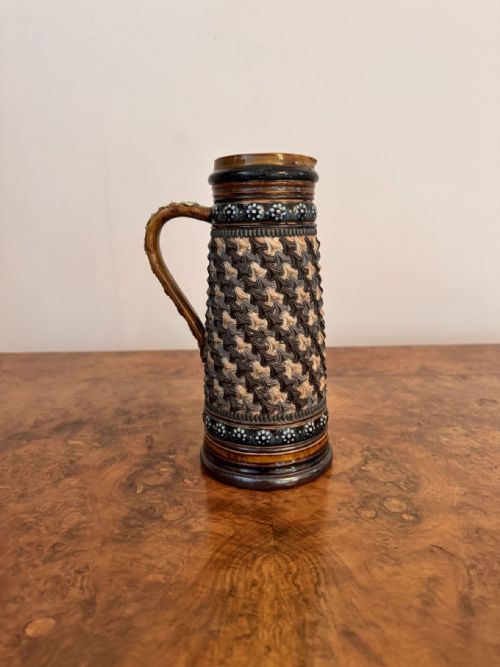
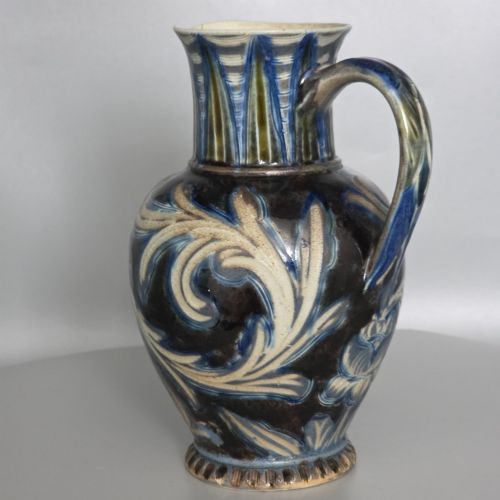
Surface decoration relies on incised patterns, relief moulding, and slip trailing rather than fragile overglaze painting. Cobalt blue oxide pigments provide deep contrast against grey or cream grounds, while specialised finishes like Doulton Slater's patent incorporate lace textures pressed directly into the damp clay.
Puzzle jugs invite bemused guests to solve hidden liquid pathways while avoiding unexpected spills down their waistcoats.
Evaluating craftsmanship and execution
Quality rests upon the crispness of the modelled relief work and the deliberate control of the salt glaze across complex geometric or floral motifs. Superior examples display sharply defined incisions and balanced proportions without kiln distortion or sagging.
The distinction between standard tavern vessels and top-tier studio pottery lies in the artistic ambition of the maker and the finesse of individual hand-finishing. Pieces bearing named studio artists or specific commemorative commission details command greater attention through their artistic provenance.
Doulton Lambeth·Simon Peter Gerz·Sir Edmund Elton·Emma Shute·Minton
The Victorian Glazed Stoneware Pitcher Glossary
- Salt glaze
- A finish achieved by throwing common salt into the hot kiln during firing, creating a durable glossy surface with a characteristic textured orange-peel feel.
- Relief moulded
- A decorative technique where designs are pressed or cast in raised form directly onto the body of the vessel before firing.
- Harvest jug
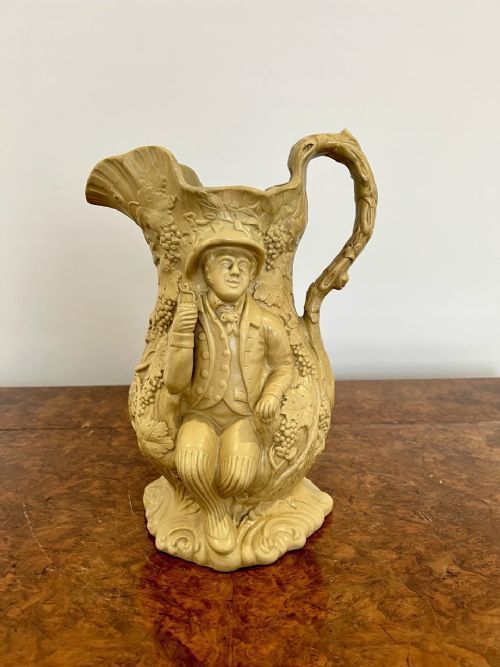
- A traditional large drinking vessel typically decorated with applied sprigged scenes of rural sports, farming, and hunting motifs.
- Puzzle jug
- An ingenious drinking vessel featuring a perforated neck that forces the drinker to use a concealed spout system to avoid spilling.
- Sprigged
- A method where separately moulded clay ornaments are applied to the surface of a damp vessel using liquid slip as an adhesive.
Victorian Glazed Stoneware Pitcher: Frequently Asked Questions
How were these pitchers actually used?
These vessels served everyday domestic needs such as pouring water, ale, or cider at table and in public taverns. Larger pieces functioned as storage jugs for liquids in busy Victorian kitchens.
Commemorative and exhibition examples often celebrated national events or political figures, sometimes sitting on display rather than joining active service.
Can I still use my pitcher for pouring liquids?
Most pieces remain entirely watertight due to the vitrified nature of high-fired stoneware and salt glaze finishes. However, valuable studio art pottery or pieces with delicate applied handles warrant careful handling during use.
Hand washing in warm water preserves the historic surface better than mechanical dishwashing.
How do I distinguish salt glaze from standard glazes?
Salt glaze exhibits a distinct dimpled texture resembling the skin of an orange, caused by the chemical reaction between vaporised salt and silica in the hot clay body. Standard liquid glazes sit in a smooth, glass-like layer across the surface.
You can feel the subtle pitting of a genuine salt-fired surface by running your fingers gently across the body.
What defines the Arts and Crafts style on these jugs?
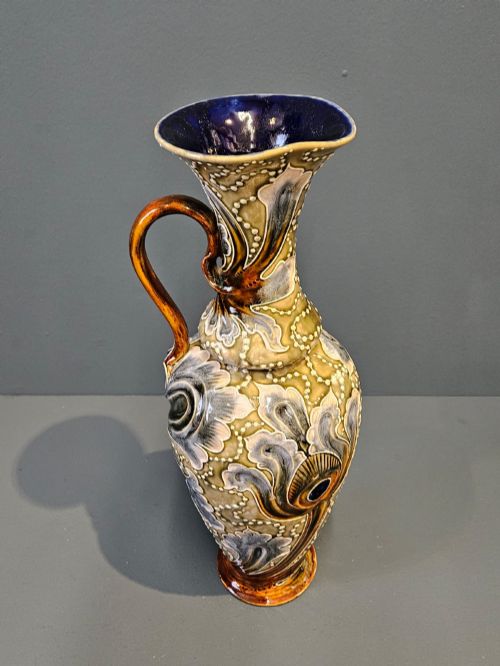
Arts and Crafts examples emphasise natural materials, visible handcrafting techniques, and stylized floral or botanical motifs. Makers focused on honest construction and individual artistic expression rather than mass-produced uniformity.
These pieces often feature incised plant forms and earthy tones that highlight the natural qualities of the clay.