


Victorian Demi Lune Furniture
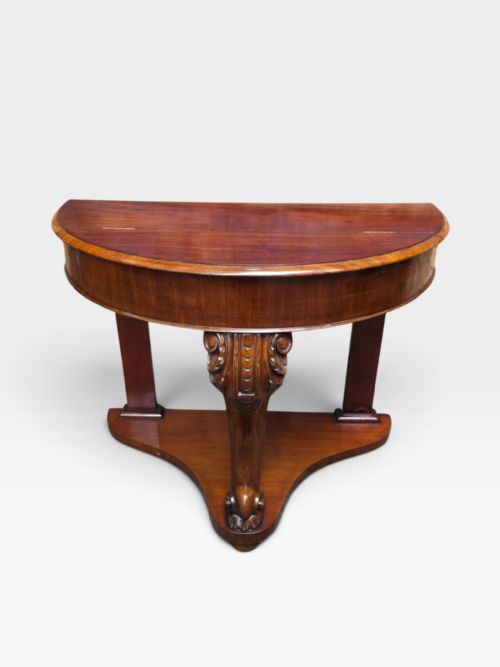
Victorian demi lune furniture comprises half-round tables, cabinets and stands shaped to fit flat against a wall, bringing curved elegance and compact utility to narrow spaces.
Victorian Demi Lune Furniture
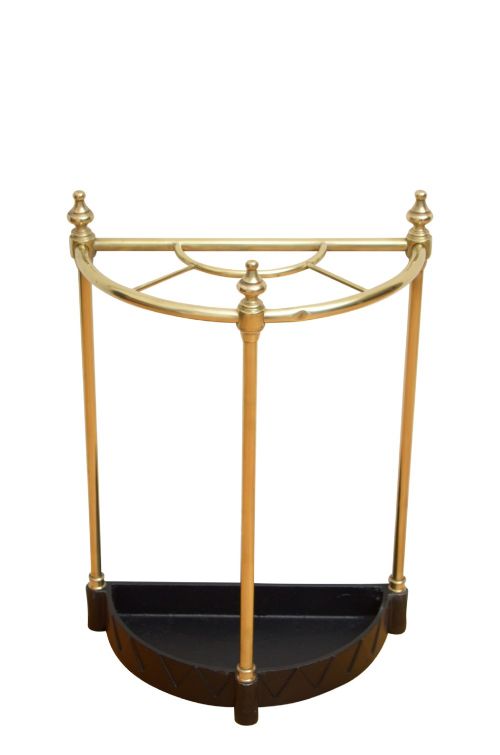
Victorian demi lune furniture takes the form of half-moon consoles, card tables, display cabinets, whatnots, dressing tables and umbrella stands designed to occupy minimal floor space in hallways and reception rooms. These pieces appear primarily from the nineteenth century alongside related Edwardian examples.
The selection on this page demonstrates the wide variety of uses for the half-round footprint, spanning folding tables for games, cabinets with painted panels, and multi-tiered whatnots. Timbers such as mahogany, burr walnut, satinwood and oak define the physical character of these items.
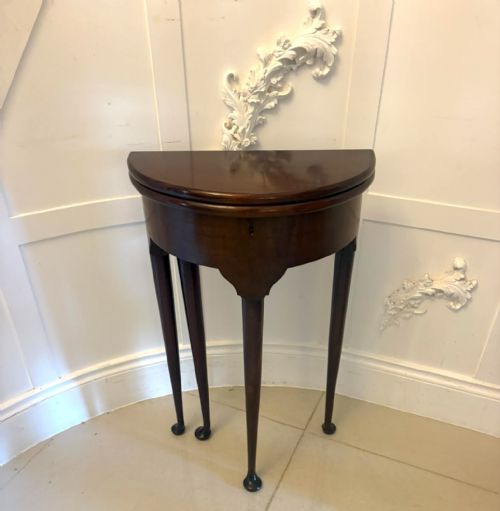
Makers adapted the semicircular shape to serve specialised domestic functions, producing card tables with concealed storage, hall stands with lift-up lids, and display consoles with glass doors. The styles range from standard Victorian production to Sheraton Revival, Georgian Revival and Queen Anne interpretations.
How they were made
Cabinet makers utilised dense native and imported timbers, applying figured veneers such as burr walnut and satinwood over stable carcase woods to create rich decorative surfaces on curved panels. Inlaid borders and painted details frequently embellish the main body of the furniture.
Folding mechanisms on card and tea tables rely on hinged tops and clever framing to reveal concealed storage compartments or green baize playing surfaces when opened. Structural support comes from slender turned or tapering legs tailored to the weight of the piece.
Listings feature nineteenth-century and Edwardian examples utilising mahogany, burr walnut, satinwood, oak, and pitch pine across tables, cabinets, and stands.
What varies in quality
The grade of timber selection and the precision of the veneer matching across the curved front set individual pieces apart, with highly figured burr walnut and delicate satinwood representing the finer end of the scale. Painted panels and inlaid stringing display varying levels of artistic skill and hand execution.
The Victorian Demi Lune Furniture Glossary
- Demi-lune
- French for half-moon, describing furniture with a flat back and a semicircular front designed to stand against a wall. This profile maximises floor space in narrow hallways and smaller rooms.
- Whatnot
- An open set of freestanding or console shelves used for displaying ornaments and small objects. These tiered structures often follow a semicircular footprint to match surrounding corner or wall furniture.
- Sheraton Revival
- A late nineteenth and early twentieth century design movement that reinterpreted the lighter, neoclassical styles associated with George Sheraton. Pieces from this revival feature delicate marquetry, satinwood, and tapered legs.
- Card Table
- A specialised folding table equipped with a hinged top that opens to reveal a baize-lined surface for playing games. Many nineteenth-century examples incorporate hidden compartments beneath the folding top.
- Veneer
- A thin layer of highly figured wood applied over a secondary timber carcase to provide a decorative exterior. Burr walnut and satinwood veneers are typical of finer Victorian cabinet work.
Victorian Demi Lune Furniture: Frequently Asked Questions
What is a demi lune table?
A demi lune table is a half-moon shaped piece of furniture with a flat straight edge designed to sit directly against a wall. This format saves floor space while providing a functional surface or display area.
In the nineteenth century, these pieces evolved into specialised forms such as card tables, console cabinets and hall stands.
Where should I place a half round cabinet?
These items suit narrow hallways, landings and alcoves where a full rectangular table would obstruct movement. Their curved front softens the geometric lines of a room.
They also function effectively as console or display surfaces in living rooms and dining spaces.
How do I identify a Sheraton Revival piece?
Sheraton Revival furniture from the late nineteenth or early twentieth century mimics the lighter aesthetic of the eighteenth century. Look for satinwood timbers, painted panel details, and delicate inlaid stringing.
These pieces often feature slender tapering legs rather than the heavier proportions of early Victorian designs.
What were whatnots used for?
Whatnots served as tiered display furniture for ornaments, ceramics and small collected items in Victorian drawing rooms. Semicircular variants fit neatly into corners or against flat walls.
Their open shelving allowed decorative objects to be easily viewed from multiple angles.
Are these tables good for small spaces?
The flat back allows the furniture to push flush against a wall, projecting outward by only a modest distance. This makes them practical for compact rooms and narrow entrance halls.
Folding variants provide an expandable surface for games or dining without dominating the room permanently.