





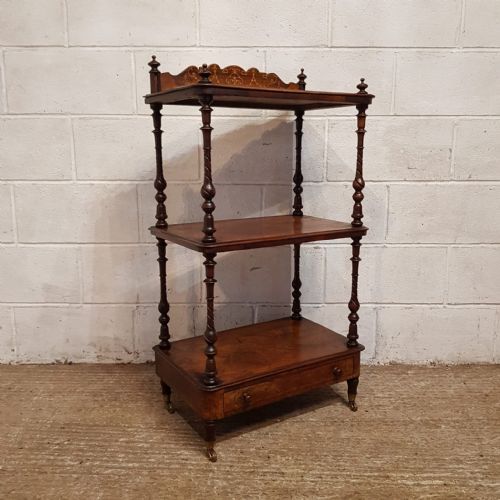


Victorian Burr Walnut Whatnot
These tiered display pieces bring rich timber figures into nineteenth-century rooms for books and ornaments.
Victorian Burr Walnut Whatnot
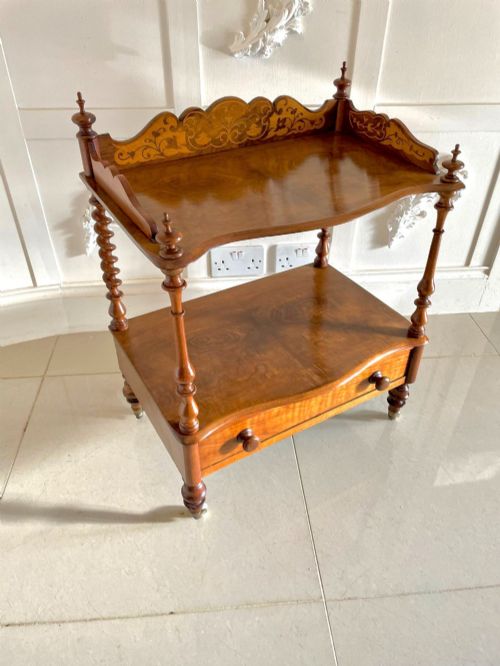
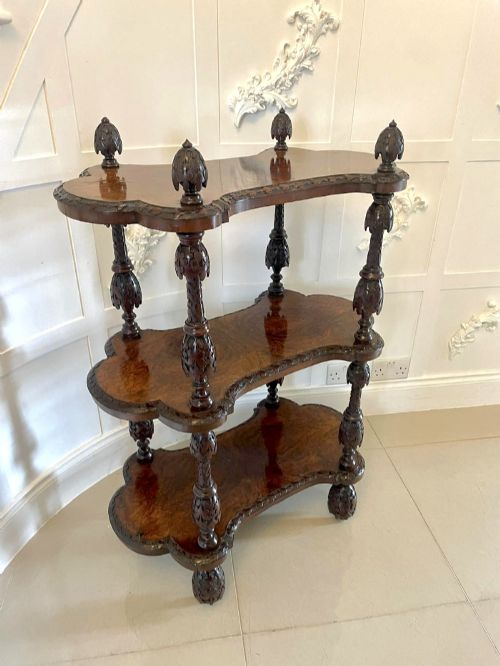
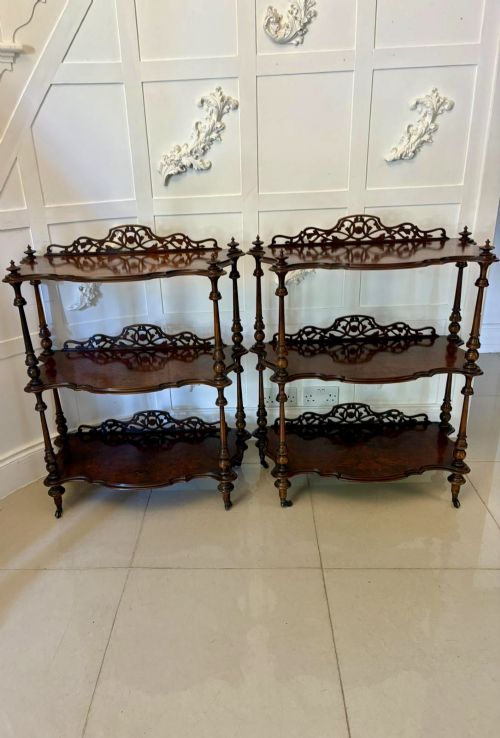
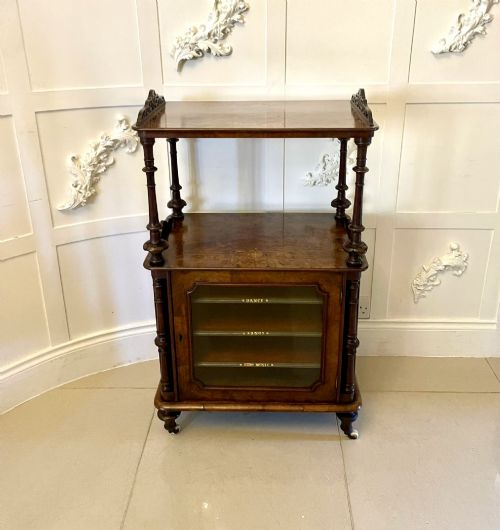
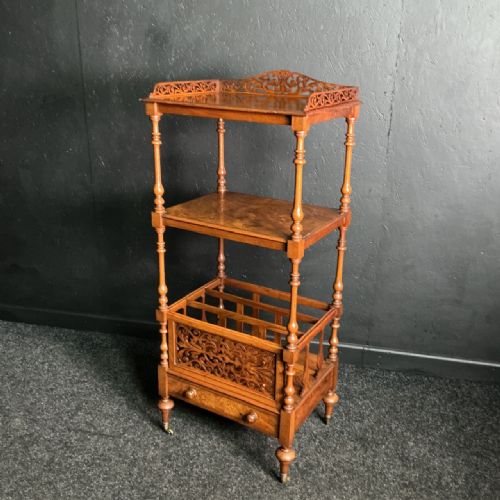
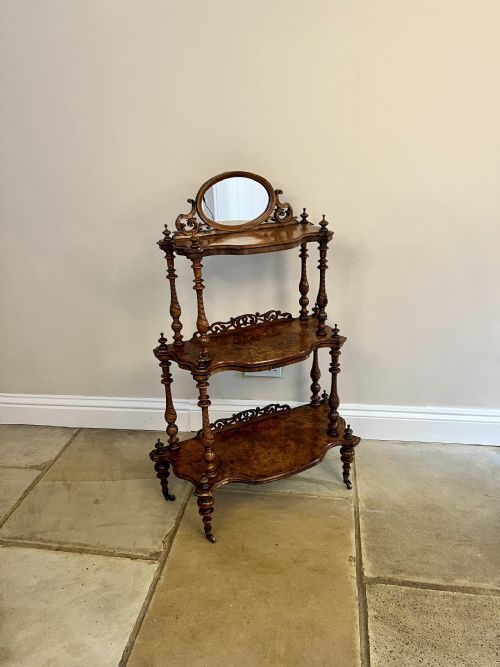
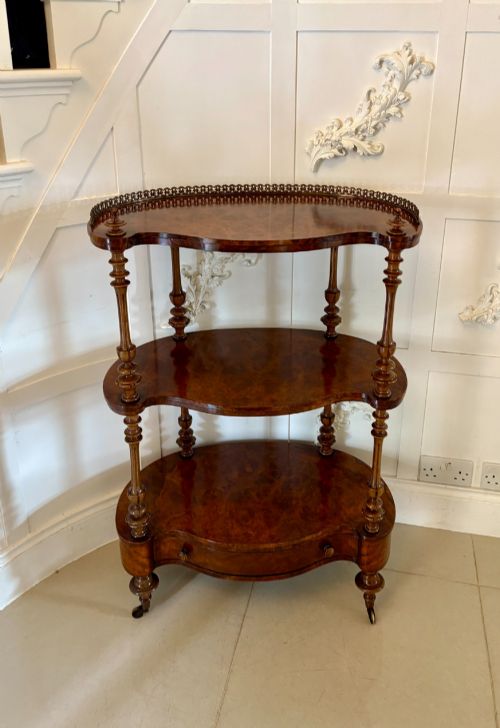
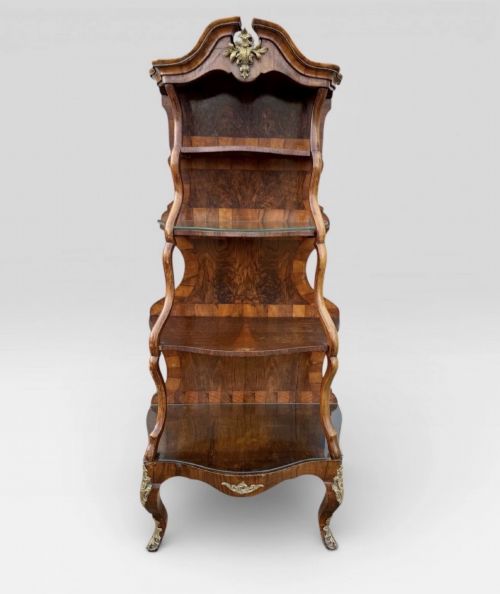
A victorian burr walnut whatnot is a multi-tiered piece of nineteenth-century furniture designed for displaying ornaments, holding books, or supporting lamps in formal rooms. The pieces appearing here span the mid to late nineteenth century, predominantly taking the form of tiered open shelves, corner stands, or fitted combinations incorporating lower compartments.
Makers of the period adapted these stands into various specialised forms, including canterburys with partitioned slots for sheet music, demi-lune console tables, and freestanding serpentine units. Most examples rely on three or four graduated platforms supported by turned columns or upright posts.
Originating largely within Victorian parlours and drawing rooms, these items served both decorative and practical functions. Their tiered construction allowed collectors to exhibit small ceramics and glassware without cluttering main tabletops.
How they were made
Cabinetmakers constructed these pieces using solid pine or secondary timbers as a core, onto which they applied finely figured burr walnut veneer. This specialised wood slicing technique produced swirling, knotty grain patterns across the primary display surfaces.
Makers integrated decorative detailing through contrasting stringing, marquetry inlay, and gilt metal mounts or brass accents. Structural stability came from turned wooden supports and, in certain multi-tier iterations, secure corner joints designed to bear the weight of heavy books.
Victorian Burr Walnut Whatnot Retail Price Guide 2026
Typical asking prices for victorian burr walnut whatnot among the pieces listed under this phrase on Sellingantiques today, from the lower quarter to the upper quarter. They describe what is for sale here now, not the wider market.
Surfaces frequently incorporate marquetry inlay, brass accents, ceramic components, and mirror glass alongside burr walnut veneer.
What varies in quality
The visual impact of a piece depends heavily on the symmetry and density of the burr walnut figuring selected for the main tiers. Strong, unbroken grain patterns and meticulous book-matching distinguish finer examples from standard production.
Execution of secondary details, such as delicate marquetry inlay, turned gallery spindles, and integrated drawers or partitions, separates basic utility items from exhibition-grade furniture. The crispness of carved elements and the integrity of the joinery across multiple tiers further define the upper tier of craftsmanship.
T Wilson of London
The Victorian Burr Walnut Whatnot Glossary
- Whatnot
- A piece of furniture consisting of a set of open shelves for small objects and ornaments. These typically feature three to four tiers supported by slender uprights.
- Burr walnut
- A veneer sliced from the gnarled wart or burl of a walnut tree, prized for its intricate and chaotic grain patterns. It provides a highly decorative surface for Victorian cabinetwork.
- Canterbury
- A low stand fitted with partitions for holding music sheets, books, or portfolios, frequently combined with whatnot shelving above. This form appears often in mid-nineteenth-century drawing rooms.
- Étagère
- A French term for a piece of furniture with open shelves for displaying ornaments, synonymous with the English whatnot. These items emphasise vertical display capacity.
- Serpentine
- A curved shape characterised by a convex centre flanked by concave ends, creating a flowing wave-like outline. This contour appears on the shelves and edges of finer nineteenth-century tables.
Victorian Burr Walnut Whatnot: Frequently Asked Questions
What are victorian burr walnut whatnots used for?
These tiered pieces were originally designed for displaying decorative objects, holding books, or supporting table lamps in nineteenth-century drawing rooms and parlours. Their open shelves allowed owners to exhibit collections of ceramics and glassware.
Today, they serve a similar purpose in modern interiors, functioning as corner display units, bedside stands, or occasional tables for books and small items.
How do I identify a nineteenth-century model?
Authentic nineteenth-century examples display traditional construction methods, such as hand-cut dovetails on drawers, turned wooden supports, and authentic walnut veneers applied over secondary timbers. Examining the underside and joints reveals period hand-tool marks.
Stylistic cues like Rococo Revival curves or Victorian marquetry inlay also help date the piece alongside the specific figuring of the burr walnut timber.
Where should I place a whatnot in my home?
Corner models fit naturally into unused angles of a room, maximising display space without obstructing walkways. Freestanding rectangular or serpentine versions work well against walls or beside seating furniture.
Because these pieces feature open shelves on multiple levels, keeping them away from direct heat sources helps protect the delicate walnut veneer from drying out.
What is the difference between a whatnot and a canterbury?
A standard whatnot consists purely of open shelves stacked vertically for displaying ornaments and books. A canterbury incorporates partitioned vertical slots at the base specifically designed for holding sheet music or portfolios.
Many nineteenth-century examples combine both forms, featuring music slots below and open display shelves on the upper tiers.