


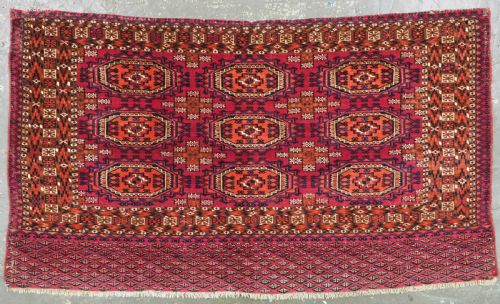


Turkmen Camel Bag
These pieces are turkmen camel bag examples, woven by nomadic tribes to carry possessions and prized for their tribal designs and rich natural dyes.
Turkmen Camel Bag
A turkmen camel bag is a tribal textile woven in Central Asia during the eighteenth and nineteenth centuries, encompassing forms such as torbas and chuvals. These woven objects served practical functions for nomadic life, draped across the flanks of camels to transport belongings during migration.
The pieces appearing on this page span several decades from the mid-nineteenth century up to the early twentieth century, reflecting the output of various tribal groups. Buyers frequently encounter formats like chuval faces and complete torbas featuring characteristic guls and flatweave details.
Classification of these weavings draws upon tribal attributions linked to specific groups in Turkmenistan and broader Central Asia. The material record demonstrates distinct stylistic traditions preserved across generations of nomadic weavers.
Materials and Construction
The construction of a turkmen camel bag relies primarily on hand-spun wool, often combined with cotton foundations and occasional silk highlights. Natural dyes provide the enduring palette observed across these tribal weavings.
Listings feature periods spanning from the mid-eighteenth century to the early twentieth century, executed in wool, cotton, silk, and natural dyes.
Factors of Quality
Quality in these textiles rests upon the fineness of the weave, the clarity of the tribal guls, and the depth of the natural dyes. Pieces retaining original elements such as backs, tassels, and complete borders command greater interest from collectors.
The complexity of the design layout, whether featuring multiple rows of guls or intricate ikat and banded flatweave patterns, distinguishes standard examples from exceptional ones. Condition and structural integrity also influence how a weaving is regarded.
Ersari·Salor·Teke·Yomut·Saryk
The Turkmen Camel Bag Glossary
- Torba
- A small Turkmen bag used for storage inside a tent or for transport on an animal. These smaller utilitarian weavings often display horizontal formats and detailed tribal motifs.
- Chuval
- A large Turkmen storage bag traditionally carried on the flank of a camel. They frequently showcase prominent rows of guls and robust pile construction.
- Gul
- A repeating medallion or principal motif characteristic of Turkmen tribal carpets and bags. Each tribal group utilised distinct gul patterns to signal identity and heritage.
- Flatweave
- A textile constructed without pile by interweaving warp and weft threads, also known as tapestry weave. This technique appears in banded designs and secondary areas of bags.
- Natural Dyes
- Colourants derived from plants, insects, and minerals used before the introduction of synthetic alternatives. They impart the characteristic varied tones seen in nineteenth-century wool.
Turkmen Camel Bag: Frequently Asked Questions
What is a turkmen camel bag used for?
These bags served practical functions in nomadic communities, primarily as storage containers mounted on the flanks of camels during migrations. Inside the dwelling, they stored household possessions and blankets.
Today, collectors appreciate them as wall hangings or decorative textiles that bring rich tribal history into modern interiors.
How do I identify a torba from a chuval?
A torba is generally smaller and wider in format, designed for smaller storage tasks or tent use. A chuval is significantly larger and functioned as a primary pack bag on animal flanks.
Both forms share characteristic tribal motifs, but their proportions and primary gul counts usually distinguish one from the other.
How can I tell which tribe made the bag?
Tribal attribution relies heavily on the specific shape and drawing of the guls, alongside the choice of secondary motifs and border designs. Groups such as the Teke, Yomut, Ersari, and Saryk each maintained distinct visual vocabularies.
Palette choices and structural details like flatweave techniques also offer clues to the originating weavers.
Are these pieces complete with backs?
Some listings feature complete bags with their original plain weave or flatwoven backs intact, while others consist solely of the decorative face. Bags with backs often retain additional structural elements like hanging loops or tassels.
Both complete pieces and surviving faces hold distinct places within the study of tribal textiles.
How do I care for a tribal textile?
Protect these wool and cotton weavings from direct sunlight to prevent fading of the natural dyes. Gentle vacuuming through a mesh screen helps remove dust without damaging the pile or flatweave structure.
Professional textile conservation is recommended if cleaning or mounting support becomes necessary.