
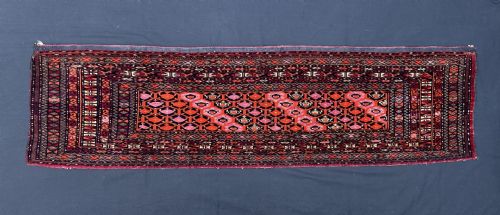


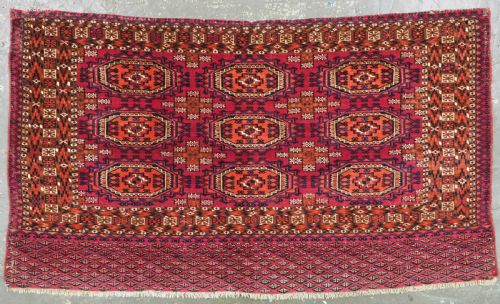


Traditional Turkmen Rug Face
These traditional turkmen rug face pieces are woven tribal trappings carrying centuries of nomadic history into modern interiors.
Traditional Turkmen Rug Face
Most examples originate from the late nineteenth century, spanning decades from eighteen sixty through nineteen hundred. Collectors encounter distinct tribal attributions such as Tekke, Saryk, Yomut, and Ersari within these offerings.
Materials and construction methods
Makers utilised durable wool combined with natural dyes to construct these traditional turkmen rug face textiles. The resulting surfaces exhibit rich tones derived from traditional botanical and mineral colouring agents.
Weavers employed tight knotting techniques, creating very fine weaves designed to withstand the rigours of nomadic life. These dense structures preserve the intricate geometric patterns across generations.
Listings feature pieces dated from 1850 through 1900, originating from tribes including Tekke, Saryk, Yomut, and Ersari.
Distinctions in craftsmanship
The density of the weave and the precision of the guls separate standard examples from finer works. Superior pieces display crisp secondary motifs and well-balanced border proportions.
The clarity of the natural dyes and the preservation of the original elem designs influence the overall integrity of the textile. Distinct tribal attributions and complex patterns enhance the visual depth of individual pieces.
The Traditional Turkmen Rug Face Glossary
- Torba
- A small tent bag used for storage by nomadic tribes. These pieces typically feature wide rectangular formats.
- Chuval
- A large storage bag face produced by Turkmen weavers. They frequently display multiple rows of guls.
- Gul
- A medallion motif repeated across Turkmen carpets and trappings. Each tribal group utilises distinct variations of this pattern.
- Elem
- The decorated lower panel of a Turkmen bag face or main carpet. This section often contains separate geometric or floral motifs.
- Jollar
- A Turkmen tent bag face used primarily for camel transport. They share similar construction to torbas but vary in proportion.
Traditional Turkmen Rug Face: Frequently Asked Questions
What is a traditional turkmen rug face used for today?
These textiles serve as decorative wall hangings or small display rugs in contemporary interiors. Their compact formats allow them to fit into spaces where larger carpets cannot.
Collectors often mount them to protect the wool structure while displaying the tribal patterns clearly on residential walls.
How do I identify a Tekke from a Yomut piece?
Attribution relies on examining the specific gul motifs and overall colour palette used in the weave. Tekke items often feature crisp octagonal guls, whereas Yomut pieces display alternative tribal forms.
Secondary borders and elem designs also provide vital clues for distinguishing between the various tribal origins represented here.
Are natural dyes used in all these textiles?
The listings on this page record wool and natural dyes as the foundational materials for these nineteenth-century works. These traditional colour sources yield stable, deep tones that age gracefully over decades.
Close inspection of the wool pile reveals the subtle tonal variations characteristic of botanical and mineral dyeing processes.
How should I care for an antique tribal textile?
Keep these pieces away from direct sunlight to protect the natural wool fibres and dye integrity. Gentle vacuuming without a rotating brush helps remove dust accumulation safely.
Professional textile conservators should handle any cleaning or restoration requirements to preserve the historic structure of the weave.