
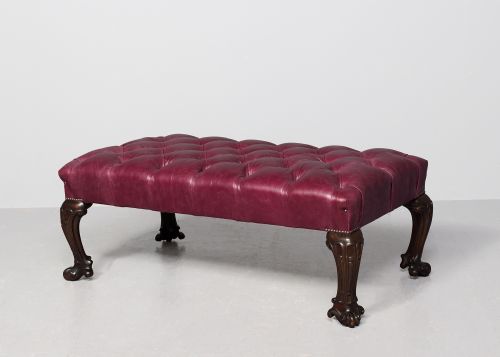


Traditional Red Ottoman
A traditional red ottoman brings deep crimson warmth and practical low seating into a room, spanning tactile footstools, carved wooden frames and hand-knotted Anatolian carpets.
Traditional Red Ottoman
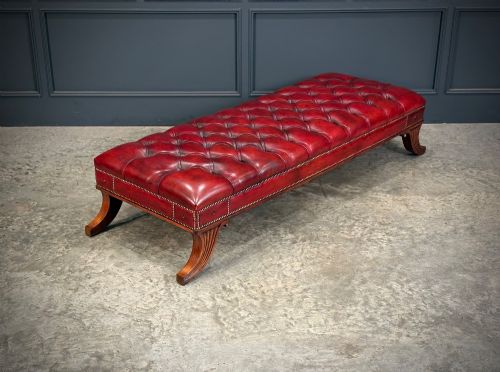
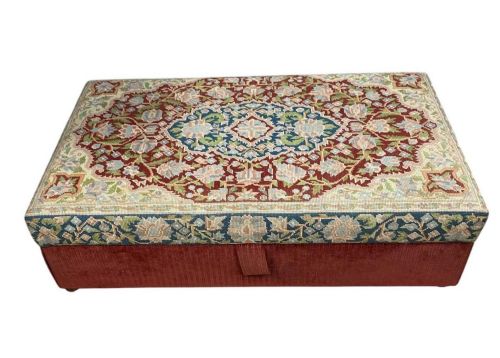
A traditional red ottoman encompasses several distinct forms on this page, ranging from buttoned leather footstools and mahogany centre stools to antique prayer rugs and flatweave kilims. Buyers encounter large nineteenth-century footstools alongside woven Ushak carpets and Turkish village rugs that share a dominant crimson palette.
The objects bridge functional domestic seating and textile art, uniting wooden frames from the Georgian and Victorian eras with wool and silk floor coverings. Many pieces originate from Anatolian weaving traditions, while others reflect British cabinet-making styles in mahogany and oak.
Selecting the right piece involves choosing between sturdy upholstered footstools designed for resting feet or coffee tables, and historical floor textiles that anchor a room with rich madder red dyes. Each form brings a distinct texture, whether smooth hide, carved wood or pile wool.
Materials and Construction
Makers constructed the rigid frames of these pieces using dense hardwoods such as mahogany and oak, often shaping them in Georgian, Victorian or Queen Anne styles with brass castors or carved cabriole legs. Upholstered variants rely on deep buttoning through red leather, hide or velvet secured over robust internal padding.
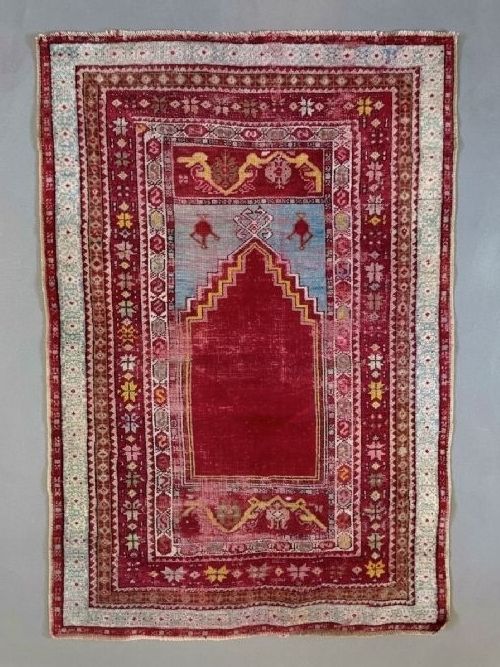
Woven textile examples employ hand-spun wool, cotton and silk fibres, knotted or flatwoven into intricate geometric and floral prayer rug designs. Natural dyes, notably rich madder reds, impart the characteristic colour variations seen across Ushak, Ladik and Milas carpets.
Listings feature traditional red ottomans spanning the eighteenth, nineteenth and early twentieth centuries, constructed in wood, wool, silk and leather.
Assessing Quality and Execution
For textile pieces, quality emerges through the complexity of the weave, the clarity of the central mihrab or floral motifs, and the depth of the natural dye palette. Superior examples maintain balanced proportions and robust structural foundations that withstand active domestic use.
Howard & Sons
The Traditional Red Ottoman Glossary
- Ushak carpet
- A large knotted rug originating from the town of Usak in western Anatolia, known for large-scale floral designs and warm red or terracotta tones. These carpets frequently anchor grand room schemes.
- Prayer rug
- A small woven mat featuring a distinctive niche or arch design at one end, known as a mihrab, which worshippers point towards Mecca. Collectors prize them for symbolic geometry and compact artistry.
- Kilim
- A flatwoven textile produced without a pile across the Balkan and Anatolian regions, prized for crisp geometric patterns and lightweight versatility. They serve as decorative floor coverings or wall hangings.
- Centre stool
- A large upholstered footstool or low table designed to stand in the middle of a room rather than against a wall. They often feature mahogany frames and leather tops.
- Buttoning
- An upholstery technique where twine pulls the fabric or leather deep into the padding to secure symmetrical tufts. This method adds both structural tension and tactile depth to footstools.
Traditional Red Ottoman: Frequently Asked Questions
How do I use an ottoman as a coffee table?
Select a large, firm, leather-upholstered footstool with a flat surface that can stably support trays, books and decorative objects.
Ensure the height matches your surrounding seating so it functions comfortably as both a resting place for feet and a central surface.
Where should I place a prayer rug?
Position these smaller woven pieces in low-traffic areas such as hallways, bedside spaces or beneath small accent tables where their detailed borders remain visible.
Their rich red hues work well to add concentrated warmth and historical texture to compact corners of a room.
How do I care for antique leather upholstery?
Maintain the hide by keeping it away from direct heat sources and applying specialised leather balms periodically to preserve suppleness.
Gentle dusting with a dry cloth prevents dirt from settling into the deep button folds and seams of the leather.
What distinguishes an Ushak carpet?
Ushak carpets are defined by their luminous wool, distinctive large-scale floral medallions, and characteristic madder red or terracotta colour foundations.
They carry a softer, more relaxed aesthetic compared to precise Persian carpets, making them versatile for historic and modern interiors.