


Floral Needlepoint Bench
These floral needlepoint bench selections offer practical seating and footrests worked in wool tapestry across various historic styles.
Floral Needlepoint Bench
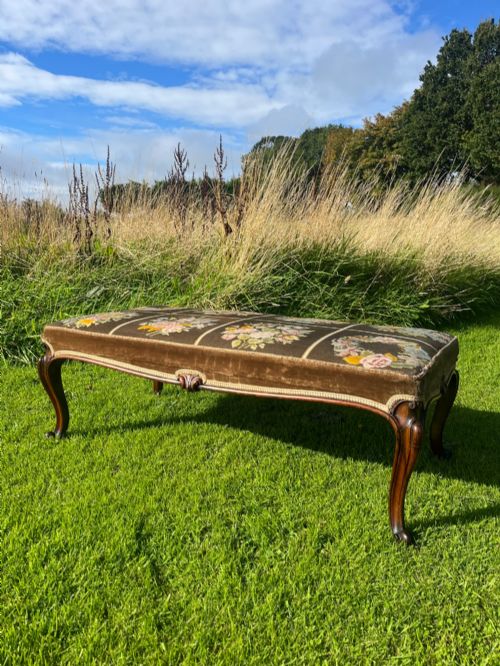
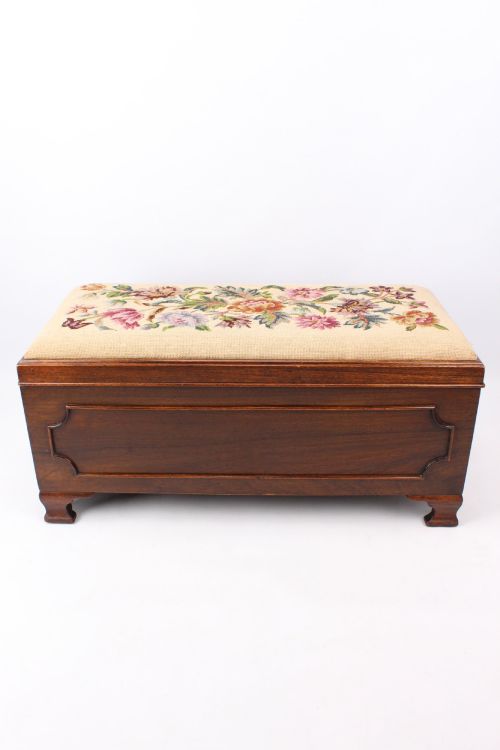
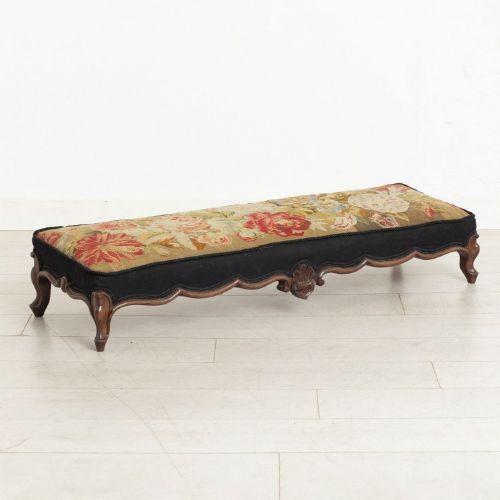
A floral needlepoint bench brings together low seating and footrest forms ornamented with textile work. Buyers seeking a floral needlepoint bench will encounter forms ranging from compact footstools to dressing stools and larger ottomans or settees.
The pieces span periods including the Victorian era, the nineteenth century, and the early twentieth century up to nineteen twenty. Frames take inspiration from Queen Anne, Swedish Empire, French Provincial, Italian Neoclassical, and Georgian styles.
Origins represented in these listings stretch across English, French, Italian, and Swedish workshops. Forms include centre stools, dressing table stools, and long footstools alongside occasional low footstools.
Materials and construction
Frames are constructed from timbers such as mahogany, walnut, birch, and various painted woods, sometimes accented with brass details. Joinery supports the weight of seated occupants while accommodating upholstered upper sections.
Upholstery relies upon wool tapestry and textile needlework, occasionally retaining original fabric coverings. Velvet also appears as a secondary textile material on certain seating items.
Listings feature frames in mahogany, walnut, birch, and painted wood paired with wool tapestry, textile, and velvet upholstery.
Factors of quality
Quality rests upon the execution of the timber frame and the complexity of the needlework design. Finer pieces demonstrate careful carving on cabriole legs and sturdy construction in woods like mahogany or walnut.
The integrity and detail of the wool tapestry seating surface distinguish finer examples from simpler upholstered variants. Original fabric preservation and painted finishes further differentiate pieces across the range.
Whytock and Reid
The Floral Needlepoint Bench Glossary
- Needlepoint
- A type of canvas work embroidery executed with wool yarn to create detailed pictorial or floral patterns. It provides a durable surface suitable for seating upholstery.
- Cabriole leg
- A furniture leg featuring a double curve, typically bowing outward at the knee and tapering inward toward the foot. This form draws on classical and eighteenth century design traditions.
- Centre stool
- A freestanding stool designed to be viewed from all sides, often placed in the middle of a room rather than against a wall. These pieces function as movable seats or rests.
- Tapestry
- A thick textile woven or worked with decorative designs, frequently featuring floral motifs in these pieces. It forms the primary decorative upholstery for the seats.
Floral Needlepoint Bench: Frequently Asked Questions
What is a floral needlepoint bench used for?
These pieces serve as footstools, dressing table seats, or occasional low seating in living spaces and bedrooms. Their upholstered tops provide a cushioned surface for resting feet or sitting.
Larger variants such as ottomans and settees accommodate multiple users or longer lounging arrangements. They integrate decorative textile elements into functional room layouts.
How do I identify a Victorian stool?
Victorian examples often feature walnut frames, dark polished finishes, and traditional cabriole legs supporting upholstered needlework seats. Construction methods from this era reflect mid to late nineteenth century cabinetmaking standards.
Stylistic cues link them directly to the Victorian period mentioned in their descriptions, distinguishing them from earlier Georgian styles or later twentieth century pieces.
Are these benches suitable for daily use?
Most pieces are built with solid timber frames in mahogany, walnut, or painted wood to support regular sitting. Wool tapestry upholstery provides a hardwearing surface for daily footrest or seating duties.
Consider the age and original fabric condition of specific items when planning heavy daily deployment. Gentle placement helps preserve antique textiles over time.
What styles are common among these benches?
Frames reflect a wide geographical and historical range, including Queen Anne, Georgian, Swedish Empire, and French Provincial designs. Painted Italian and Chinoiserie variants also appear among the offerings.
This stylistic diversity allows buyers to match seating to specific period interiors or eclectic room schemes.