


Traditional Persian Living Room Carpet
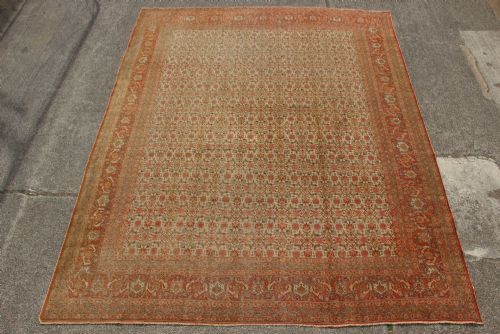
A traditional persian living room carpet grounds a large space with dense floral or geometric weaving brought down from the late nineteenth century and early decades of the twentieth.
Traditional Persian Living Room Carpet
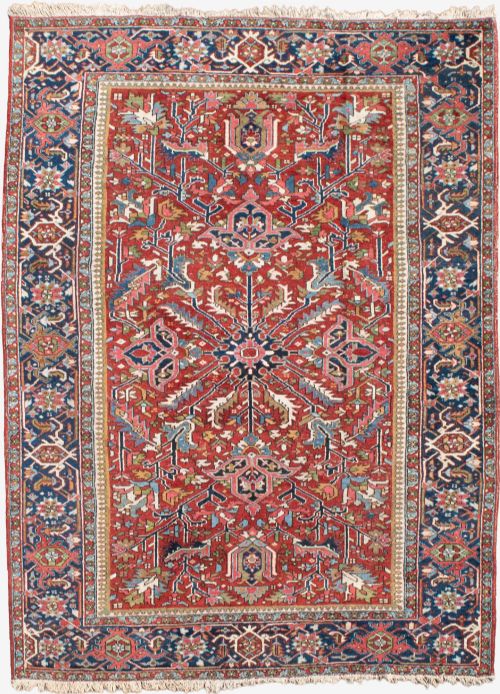
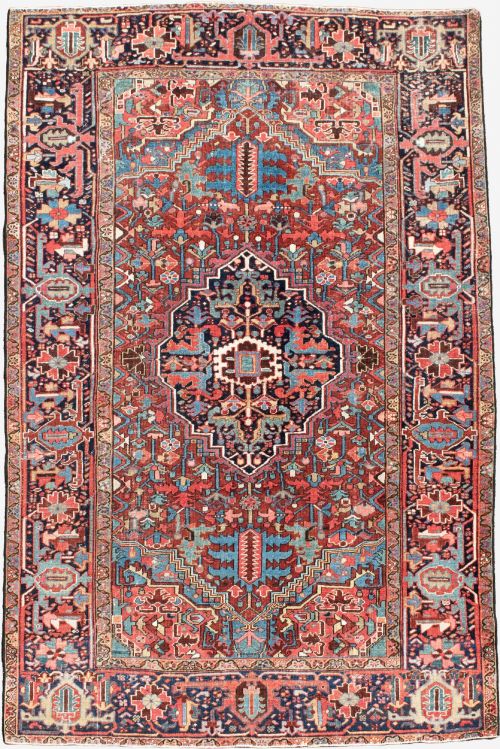
A traditional persian living room carpet encompasses large room-size formats and substantial area pieces woven across various regional centres. Buyers seeking this type of floor covering will encounter named origins such as Heriz, Tabriz, Kirman, and Mahal.
The selections span the late nineteenth century into the 1930s and 1940s, providing room-sized examples suitable for anchoring sitting rooms. Forms range from geometric village weaves to finely detailed city productions.
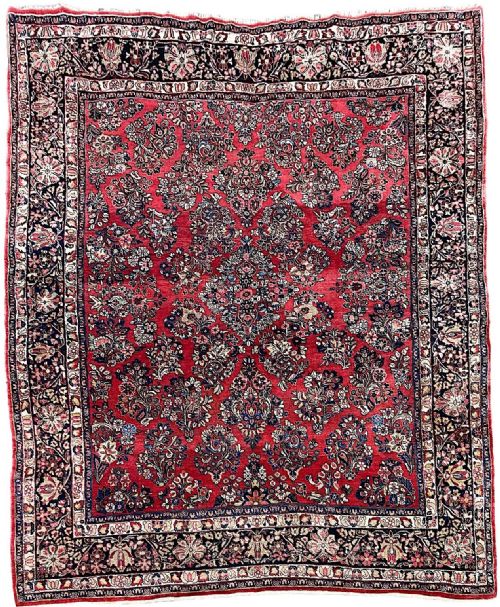
Many items arrive labelled under specific regional styles like Sarouk, Qum, and Sultanabad, alongside broader designations including Persian Tribal and traditional Persian.
What varies in quality
Knot density and the precision of the drawing dictate the fineness of the work, separating city carpets with intricate floral curves from coarser village productions. Materials also play a role, as pure wool constructions or the inclusion of silk elements elevate certain pieces above standard wool-and-cotton mixes.
Condition and scale create further distinctions, particularly in large country house carpets where retaining structural integrity across expansive room-sized dimensions demands superior original weaving.
The listings span woven objects from 1870 through 1940, utilising wool, cotton, and silk.
The Traditional Persian Living Room Carpet Glossary
- Heriz
- A style originating from north-west Persia known for bold geometric medallions and robust structural resilience. These pieces often feature large-scale corner spandrels.
- Sarouk
- A Persian weaving type celebrated for supple wool and floral sprays, frequently utilising soft colours. Production centres in the central region of Iran.
- Tabriz
- A major city style noted for finely executed classical medallion layouts and pictorial or intricate floral designs. Weavers here achieved high knot counts.
- Boteh
- A stylised almond or paisley motif representing a cypress tree or flower, commonly found repeated across field designs. This ancient symbol appears frequently in traditional village rugs.
- Kashan
- A historic centre for fine pile carpets, sometimes incorporating silk alongside wool to achieve delicate surface details. These pieces typically display sophisticated curvilinear floral patterns.
Traditional Persian Living Room Carpet: Frequently Asked Questions
How do I choose the right size room carpet?
Measure your seating area to ensure the front legs of furniture sit comfortably upon the textile while leaving a border of exposed flooring around the edges.
Room-size options here often exceed three metres in length, making them suitable for substantial living spaces and principal reception rooms.
What is the difference between Heriz and Tabriz carpets?
Heriz carpets generally display bold geometric centerpieces and sturdy structural weaves originating from mountain villages. Tabriz pieces tend towards finer, curvilinear floral compositions produced in urban workshops.
Both styles date across the same late nineteenth and early twentieth-century periods represented in the listings.
How do I care for an antique wool carpet?
Vacuum gently without a beater bar and keep the textile out of direct sunlight to protect the natural dyes. Professional cleaning should be undertaken periodically by specialists familiar with antique Persian pile.
Placing an appropriate underlay beneath the rug prevents slipping and reduces friction against hard floors.
Can I date these carpets accurately?
Dating relies on stylistic analysis, material composition, and structural characteristics typical of periods such as the 1910s or 1930s. Exact years are often estimated within a decade based on known workshop outputs and regional designs.
Examinations of the knotting technique and foundation threads help confirm the era of production.