
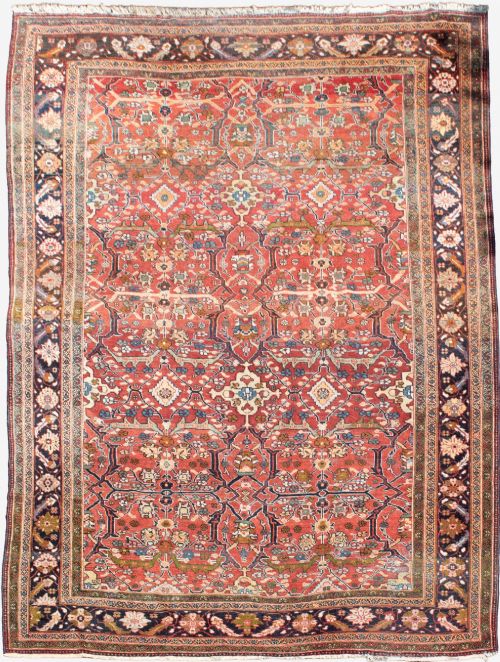


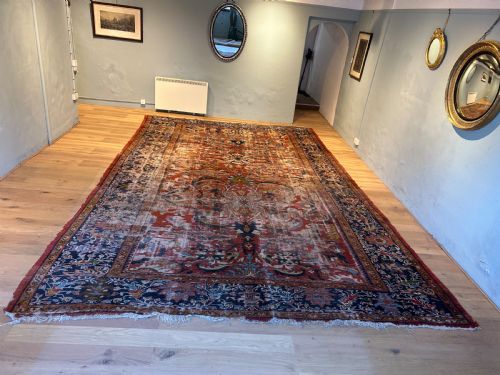


Red Ziegler Mahal Rug
These red ziegler mahal rug pieces bring stately Persian presence to a room, offering grand scale and subtle coloration.
Red Ziegler Mahal Rug
A red ziegler mahal rug represents large-scale Persian weaving designed primarily for Western export houses during the late nineteenth century. You are most likely to encounter room-sized and country house carpets bearing the characteristic Ziegler and Mahal designations from this era.
The format covers substantial floor coverings, with dimensions stretching from over three metres to past five metres in length. These pieces function as anchor elements in substantial interiors, bringing traditional Persian patterns executed with a distinct aesthetic sensibility.
How they were made
The construction relies on a wool pile knotted onto a foundational cotton warp and weft structure. This combination provides both the necessary surface depth for intricate patterns and the structural stability required for large room-sized formats.
Weavers utilised hand-spun wool and natural dye sources to achieve the subdued palette characteristic of the type. The resulting textiles combine robust durability with a refined handling of tone across expansive fields.
Some country house carpets in this group measure over five metres long, requiring more floor space than a modern dining table.
What varies in quality
Quality rests in the handling of scale and the balance of the overall design across large fields. Stronger examples maintain harmony between the expansive background and the secondary motifs without appearing monotonous.
The handling of the wool and the integrity of the weave also dictate the standing of an individual piece. Finer knotting and well-preserved structural foundations separate standard commercial output from superior workshop production.
The Red Ziegler Mahal Rug Glossary
- Ziegler
- A designation originating from the Swiss firm that commissioned carpets in nineteenth-century Persia for the European market. These pieces typically feature muted palettes and larger floral motifs.
- Mahal
- A term associated with rugs and carpets produced in the Mahallat region of Persia. They are known for accessible interpretations of classical Persian designs suited to Western interiors.
- Warp
- The stationary vertical threads stretched upon the loom before weaving begins. The cotton warp provides the primary structural skeleton for these large carpets.
- Weft
- The horizontal threads passed through the warp to secure the knots in place. In these nineteenth-century carpets, the weft works alongside the warp to maintain structural integrity.
Red Ziegler Mahal Rug: Frequently Asked Questions
What is a red ziegler mahal rug?
These pieces are large Persian carpets produced during the nineteenth century for export, featuring wool pile on cotton foundations.
They are defined by expansive dimensions and traditional patterns adapted for Western tastes.
How do I date a ziegler carpet?
Dating relies on materials, structure, and stylistic markers pointing to the nineteenth century, specifically around the 1880s to 1900.
Examinations of the weave and wool characteristics help narrow the period of origin.
Where were these carpets made?
Production took place in Persia, specifically within workshops influenced by European export firms operating in regions like Mahallat.
These centres combined local weaving traditions with specific design commissions from abroad.
How do I care for a large antique carpet?
Large room-sized carpets require gentle vacuuming without rotating brush heads and professional cleaning when necessary.
Placing them away from direct sunlight preserves the natural dyes in the wool pile.