
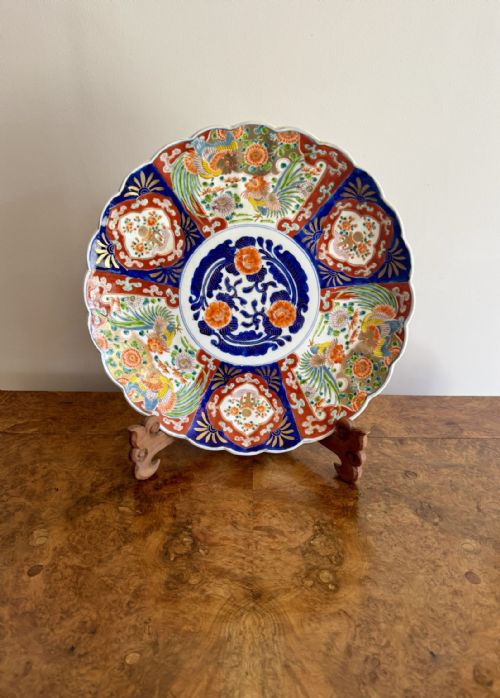
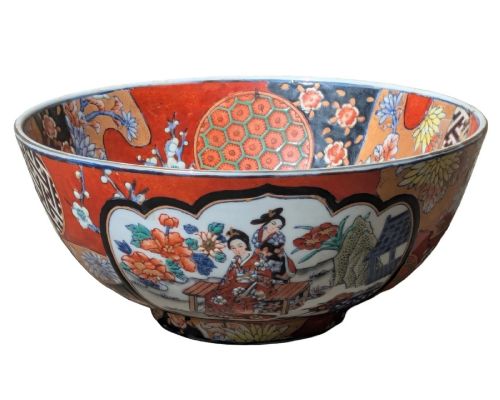

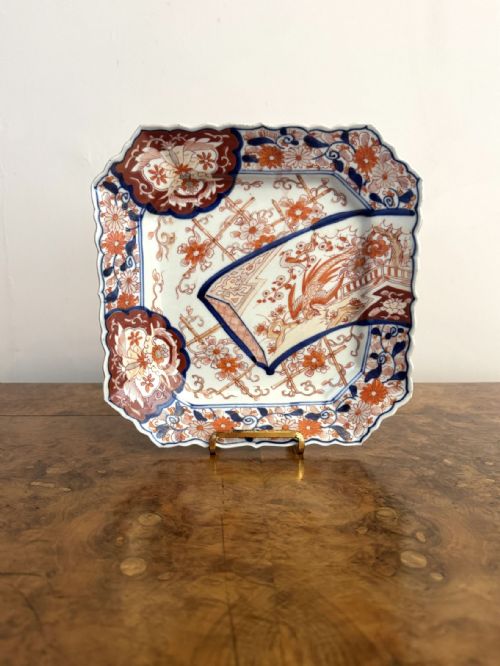
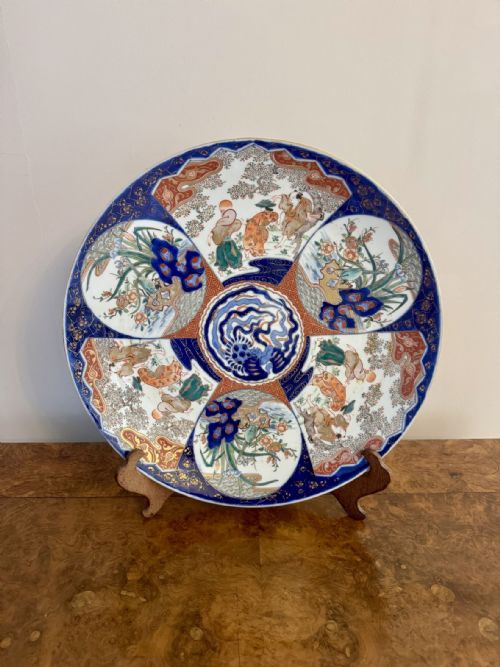
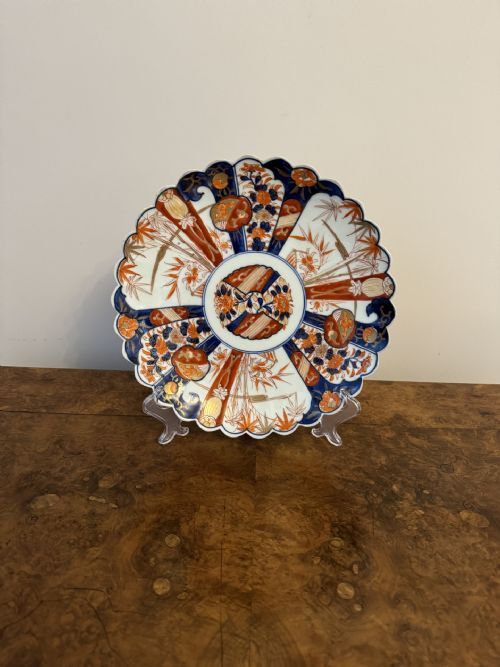
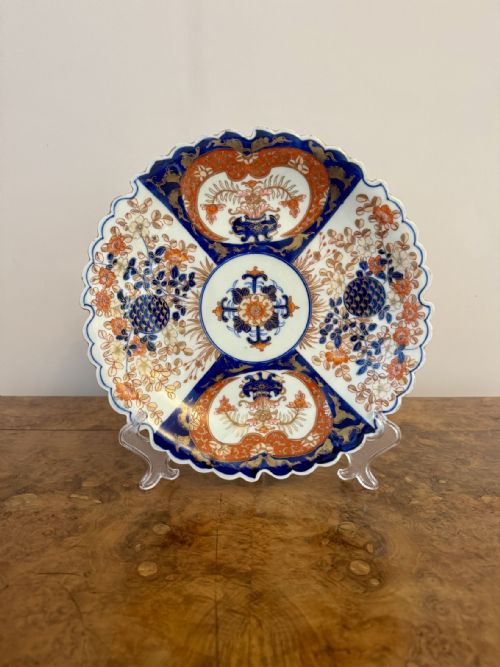


Traditional Japanese Porcelain Charger
These traditional japanese porcelain charger selections bring rich Imari palettes and large scale forms to domestic display.
Traditional Japanese Porcelain Charger
A traditional japanese porcelain charger forms a wide, shallow display dish created for visual impact rather than dining use. The versions most commonly met on this page span the 19th century and the 1900 period, encompassing both Meiji and Victorian era imports.
Makers shaped these items into circular chargers, square shaped plates, scalloped edge dishes, and large platters. They frequently appear individually or in matched pairs and small collections.
Materials and construction methods
Artisans built each traditional japanese porcelain charger from white ceramic paste, applying cobalt underglaze details beneath transparent coats. Enamel colours and gold leaf highlights were then added over the glaze to build up complex decorative schemes.
The firing process bonded the mineral pigments to the porcelain body under high heat. Subsequent low-temperature firings fixed the surface gilding and enamel pigments securely onto the ceramic.
Several plates arrive complete with old collection labels stuck to the reverse, hinting at decades spent inside Victorian drawing rooms.
Distinctions in craftsmanship and design
The fineness of the hand painted brushwork dictates the visual weight of the surface patterns. Crisp cobalt underglaze lines and precise enamel placement separate standard production from more ambitious output.
The richness of the gilding and the complexity of the geometric or floral panels determine the overall decorative presence. Heavier porcelain bodies and well-balanced square or scalloped edges show greater ambition in the forming stage.
The Traditional Japanese Porcelain Charger Glossary
- Imari
- A style of Japanese porcelain featuring distinctive blue, red and gold decoration. It originated in Hizen province and was shipped through the port of Imari.
- Charger
- A large decorative plate or platter used primarily for display rather than serving food. These pieces measure larger than standard dining plates.
- Cobalt Underglaze
- A blue pigment applied to the raw ceramic body before glazing and firing. This technique protects the blue colour beneath a glassy protective layer.
- Meiji Period
- The era in Japanese history spanning from 1868 to 1912. Many decorative items exported to Western markets date from this time.
- Aka-e
- Japanese red-painted decoration used in polychrome porcelain designs. Artisans combined this red pigment with gold leaf and cobalt.
Traditional Japanese Porcelain Charger: Frequently Asked Questions
What is a traditional japanese porcelain charger?
A traditional japanese porcelain charger is a large decorative dish produced in Japan for export and display. These items showcase intricate painted designs using cobalt, enamel, and gold.
They function primarily as ornamental table centrepieces or wall-hanging items rather than utilitarian tableware. Their substantial diameter allows for complex multi-panel pictorial compositions.
How do I display a charger safely?
Display chargers securely using sturdy wall brackets designed for heavy ceramics or dedicated plate stands on flat surfaces. Keep them away from direct sunlight to protect the surface enamels.
Ensure the mounting hardware takes the full weight of the ceramic body. Position them where accidental knocks from passing foot traffic cannot cause a fall.
How do I date these pieces?
Dating relies on stylistic markers, historical periods such as the Meiji era, and material characteristics. Blue underglaze tones and enamel combinations shift across the nineteenth and early twentieth centuries.
Examining the foot ring and the texture of the ceramic body provides further clues to age. Comparing edge profiles like scalloped or square shapes helps narrow down the production decade.