

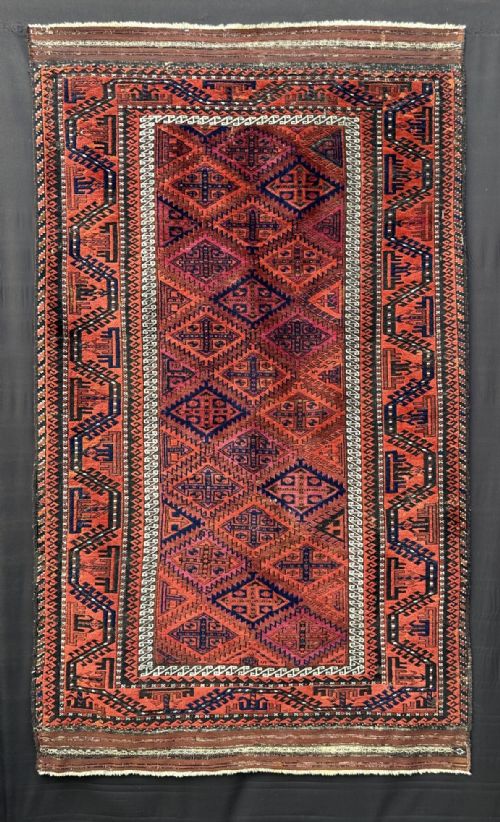
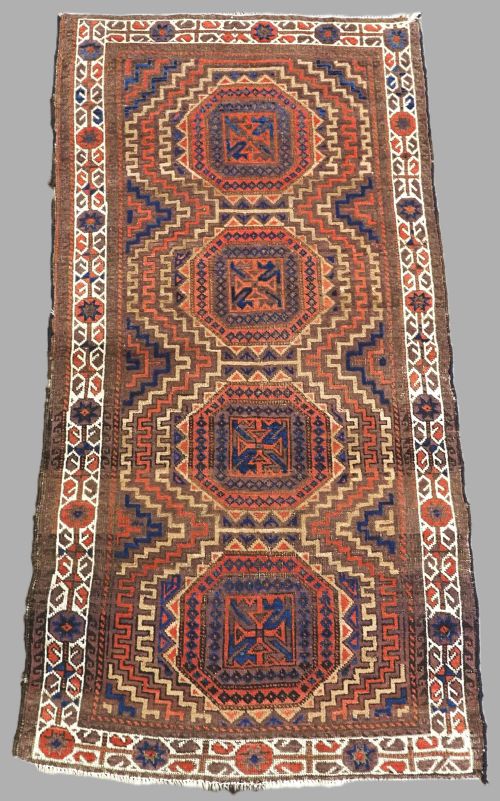
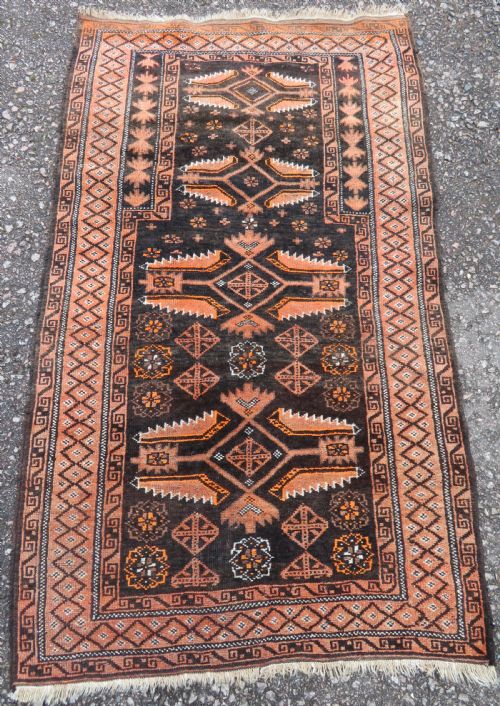


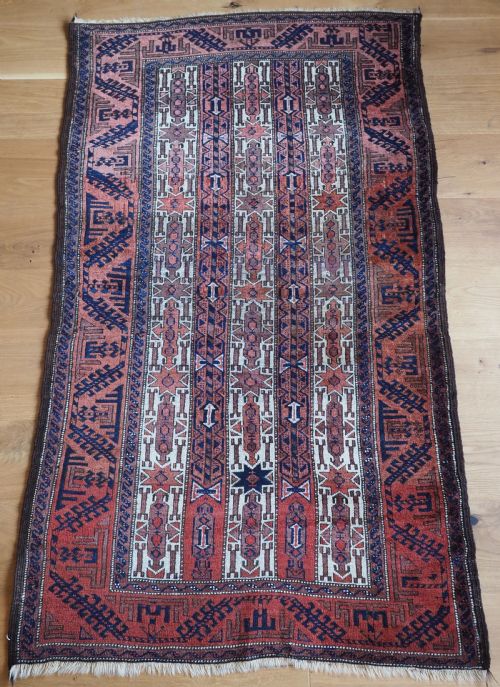


Terracotta Baluch Runner Rug
These tribal carpets woven by nomadic groups offer rich geometric motifs and deep earthy tones.
Terracotta Baluch Runner Rug
A terracotta baluch runner rug brings dense tribal character to a floor through traditional motifs like guls, lattice patterns and tree designs. Pieces emerge from nineteenth-century and early twentieth-century weaving traditions associated with Baluch, Timuri and related tribal groups across regions of Afghanistan, Persia and Khorasan.
Runners and smaller formats dominate the available selection, often presenting elongated proportions suited to hallways and narrow spaces. Tribal weavers utilised regional motifs including the Kalam Donneh pencil box pattern, Herati layouts and Mina Khani variants within these formats.
The aesthetic relies heavily on rich saturated grounds, frequently incorporating terracotta and warm earthy palettes alongside dark wool contrasts. Surviving examples reflect nomadic and village workshops operating across the borderlands of Central Asia and Persia.
Materials and construction
Weavers relied primarily on hand-spun wool for the pile, supplemented by cotton foundations and occasional use of goat hair or camel hair for durability in the selvages and ends. Natural dyes provided the characteristic deep colour spectrum found across these tribal carpets.
Nomadic vertical or horizontal looms accommodated the narrow formats, producing tight knotting and robust structures designed to withstand daily foot traffic. Weftwork decoration and kilim end finishes frequently secured the extremities of the rugs.
Terracotta Baluch Runner Rug Retail Price Guide 2026
Typical asking prices for terracotta baluch runner rug among the pieces listed under this phrase on Sellingantiques today, from the lower quarter to the upper quarter. They describe what is for sale here now, not the wider market.
Materials across these listings span wool, cotton, camel hair, goat hair and natural dyes.
Evaluating quality and execution
Quality rests upon the fineness of the knotting and the crispness of the geometric detailing executed across the field. Tighter structures maintain structural integrity and allow intricate motifs like the Mina Khani variant or large guls to retain sharp definition.
The depth and permanence of the natural dyes influence visual success, with certain pieces displaying remarkable saturation that deepens with age. Variations in wool quality from soft hand-spun fleece to coarser animal hair affect the tactile weight and handle of the textile.
The Terracotta Baluch Runner Rug Glossary
- Gul
- A primary octagonal or gabled medallion motif repeated in rows across tribal carpets. These motifs often identify specific weaving groups.
- Kalam Donneh
- A repeating pattern resembling a stylized pencil box or leaf shape. It appears frequently in nineteenth-century Baluch and Timuri weaving.
- Pushti
- A small mat or rug format intended for seating or face placement. These compact pieces share the design vocabulary of larger floor carpets.
- Kilim
- A flat-woven textile structure often utilised at the ends of pile rugs for reinforcement and decorative bands. This technique involves interlocking horizontal and vertical threads without a pile.
Terracotta Baluch Runner Rug: Frequently Asked Questions
How do I care for my rug?
Vacuum gently without rotating brush bars to protect the hand-spun wool pile and delicate flat-woven ends. Keep the textile away from direct, prolonged sunlight to preserve the natural dye colours.
Professional cleaning tailored to antique tribal carpets maintains the structural integrity of the foundation. Avoid excessive moisture and address spills immediately with gentle blotting.
Where were these pieces made?
Nomadic and village groups in the borderlands of Persia, Afghanistan and the Khorasan region produced these textiles. Weavers operated within specific tribal traditions such as the Mahdad Khani, Bahluli and Timuri.
Production centres spanned diverse regional landscapes rather than fixed urban workshops. The resulting rugs combine distinct local motifs with shared nomadic aesthetics.
What defines tribal design?
Geometric abstraction, repeating medallions and symbolic motifs drawn from daily nomadic life characterise this aesthetic. Weavers relied on memory and traditional regional patterns rather than printed cartoons.
Asymmetrical placements and spontaneous colour shifts frequently occur within these hand-knotted compositions. Each piece reflects the specific visual heritage of the maker's tribe.