
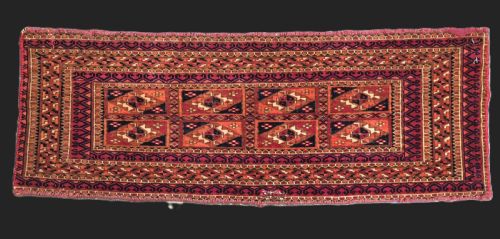
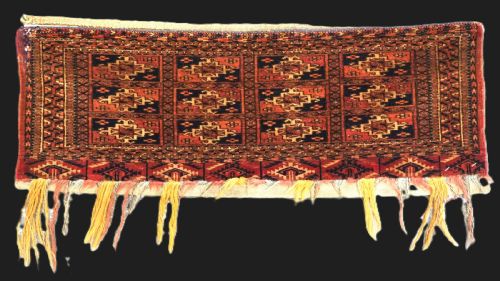


Tekke Turkmen Trapping
A tekke turkmen trapping offers the rich geometry of Central Asian nomadic weaving, prized for dense wool and deep red dye palettes.
Tekke Turkmen Trapping
A tekke turkmen trapping is a tribal textile woven in Central Asia during the late nineteenth century. These pieces primarily take the form of torba faces, complete torbas with original backs, and chuval faces.
Buyers meeting these tribal rugs and textiles will find examples featuring characteristic guls, ivory grounds, and curled leaf designs. They represent dowry weaving and nomadic household goods from the eighteen-seventies and eighteen-eighties.
How they were made
These trappings are constructed from wool dyed with natural dyes, yielding deep tribal colour palettes. The weaving utilises fine knotting techniques, resulting in dense structures suited to nomadic utility and display.
Weavers produced these tribal textiles on portable looms, incorporating distinct motifs such as the aina gul and the salor gul into the wool foundation.
Object forms on this page include torba faces, complete torbas with backs, and chuval faces.
What varies in quality
Quality in a tekke turkmen trapping is visible in the density of the weave and the clarity of the design motifs. Finer knotting allows intricate patterns like the curled leaf or multiple guls to appear sharp and well-defined.
The presence of original backs and smaller, scarce dimensions also distinguish certain examples. The depth of the natural dyes and the precision of the tribal designs govern the visual strength of each piece.
The Tekke Turkmen Trapping Glossary
- Torba
- A small storage bag or trapping used in nomadic tents. These pieces were often hung against tent walls or used for dowry possessions.
- Chuval
- A larger tent bag utilised for household storage by Turkmen tribes. They typically display a greater number of guls than smaller torbas.
- Gul
- A primary medallion motif repeated across Turkmen carpets and trappings. Different tribal groups developed their own distinct gul variations.
- Mafrash
- A rectangular storage bag or trapping associated with nomadic bedding and possessions. They frequently share structural similarities with torbas.
- Dowry weaving
- Textiles produced by women as part of a bride's household property before marriage. These items often display the finest workmanship of the tribe.
Tekke Turkmen Trapping: Frequently Asked Questions
What is a torba?
A torba is a small tribal trapping used for storage inside a nomad tent. These pieces were suspended from walls or used to hold personal belongings.
They represent traditional Central Asian nomadic craftsmanship from the nineteenth century.
How were these trappings used?
Nomadic families utilised these woven bags within the yurt for storage and domestic organisation. They held bedding, clothing, and valuable dowry items.
Over time, many of these functional objects survived as decorative wall hangings and textile fragments.
What does gul mean?
A gul is a repeated octagonal medallion motif central to Turkmen textile design. Each tribal subgroup utilised specific gul patterns to signify identity and heritage.
On these trappings, they form the primary visual rhythm across the wool ground.
How do I date these textiles?
Dating relies on examining the wool quality, natural dye palettes, and structural characteristics typical of nineteenth-century nomadic weaving. Pieces from this era generally date from the eighteen-seventies and eighteen-eighties.
Tribal structures and traditional design motifs further confirm their period of origin.