




Swedish Grey Commode
A swedish grey commode brings calm restraint to a room, offering practical storage wrapped in pale, painted elegance.
Swedish Grey Commode
When you search for a swedish grey commode, you are looking at substantial storage pieces primarily built as chests of drawers or cupboards originating from Scandinavian traditions. These items span periods from the eighteenth century through to the nineteenth century, including specific expressions like Gustavian neoclassicism, Baroque revival and Scandinavian country styles.
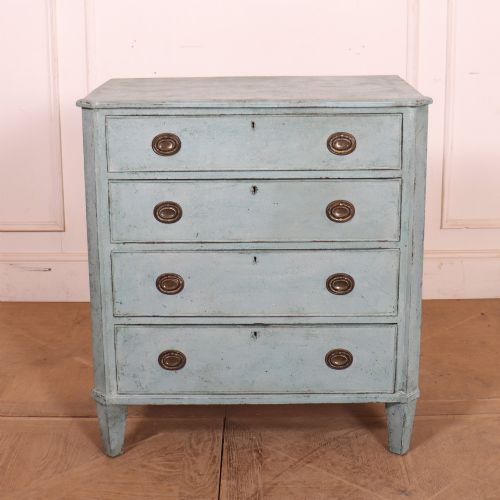
The examples you meet on this page lean heavily on nineteenth-century craftsmanship alongside earlier eighteenth-century forms such as the c.1770 neoclassical commode. You will find both single chests and matching pairs, offering either serpentine fronts or straight facades equipped with multiple drawers.
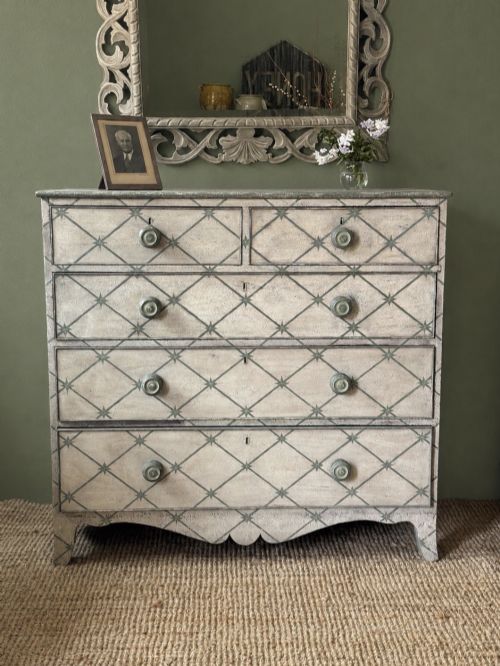
Beyond standard chests of drawers, the selection incorporates painted cupboards and two-drawer commodes. These pieces display finishes ranging from original scraped paint surfaces to hand-applied grey colour transformations on woods like ash and pine.
Materials and Construction
Makers constructed these commodes using accessible regional timbers, predominantly pine and softwood, though solid ash also appears alongside iron and brass hardware details. Pine provided a stable, workable substrate ideal for receiving layered paint finishes.
Surface decoration defines the visual impact of these items, utilising paint as the primary medium to create the characteristic muted tones. Artisans applied soft grey palettes, sometimes complemented by faux marble tops that mimic more expensive stone surfaces using clever paint techniques.
The documented periods span from 1750 through the nineteenth century, encompassing Gustavian neoclassicism and Victorian country utilitarianism.
Factors That Separate Examples
The distinction between ordinary and exceptional pieces rests upon the integrity of the surface finish and the depth of period character. Original scraped paint surfaces carrying decades of authentic weathering hold distinct appeal compared to later or heavier redecorations.
Proportion and stylistic detailing dictate the visual strength of each commode. Refined Gustavian fluting or clean neoclassical lines demand greater joinery skill than simple country utility chests, elevating the piece within its period.
The Swedish Grey Commode Glossary
- Commode
- A low chest of drawers or cabinet, typically ornate in its joinery and finish. In Scandinavian usage, these serve both functional bedside or hallway storage and decorative purposes.
- Gustavian
- The Swedish neoclassical style spanning the late eighteenth century, known for restraint, symmetry and lighter classical motifs. It draws inspiration from French Louis XVI design but adapts it with Nordic sobriety.
- Serpentine Front
- A furniture facade featuring a convex centre flanked by concave curves, creating an undulating movement across the drawer fronts. This shape requires advanced woodworking precision.
- Scraped Paint
- A finish where layers of historic paint are carefully revealed by scraping back newer overcoats to expose the original coloration. Collectors prize this technique for its genuine historical patina.
- Baroque Revival
- A nineteenth-century historical revival style drawing on seventeenth-century Baroque exuberance, featuring heavier proportions and pronounced architectural detailing.
Swedish Grey Commode: Frequently Asked Questions
How do I clean a painted commode?
Dust the surface regularly with a soft, dry cloth to prevent dirt accumulation on the painted finish. Avoid harsh chemical cleaners or excessive water, which can damage historic paint layers.
For stubborn marks, use a slightly damp cloth with mild soap, drying the area immediately afterwards. Test any cleaning method on a hidden spot first.
Are these commodes suitable for modern bedrooms?
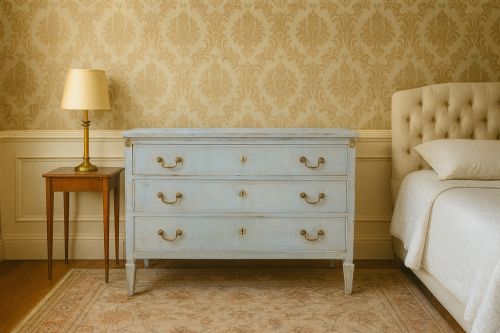
These chests offer generous drawer capacity and a neutral grey palette that integrates easily into contemporary interior schemes. Their understated proportions work well against plain walls or alongside modern furnishings.
They provide functional bedside or clothing storage while adding historic character to a room. The flat tops also serve well for lamps and display items.
What is faux marble?
Faux marble is a decorative painting technique designed to imitate the veining and appearance of real stone on a wooden surface. Artisans use glazes and brushes to replicate marble textures.
This method offered an affordable alternative to solid stone tops while keeping the commode lighter and easier to transport.
How can I tell a Gustavian piece from a Victorian one?
Gustavian pieces typically date from the late eighteenth century and exhibit refined neoclassical symmetry, often with subtle carved fluting or restrained paneling. They reflect a lighter, airy aesthetic inspired by French design.
Victorian pieces originate from the nineteenth century and generally feature heavier construction or simpler country vernacular forms. They may also display later revivals of earlier styles.