




Standing Tapestry Screen
A standing tapestry screen blocks hearth heat while framing intricate needlework.
Standing Tapestry Screen
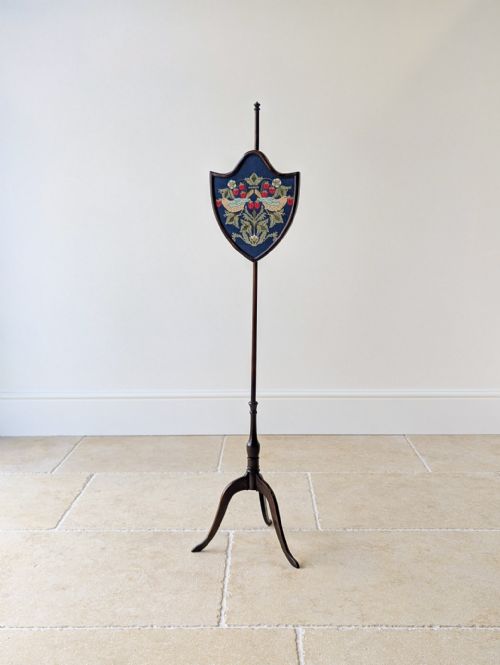
A standing tapestry screen serves as a decorative room divider and a practical guard against open fire heat. The pieces found here span Georgian, Regency, and Victorian eras, often taking the form of pole screens with adjustable panels mounted on tripod or pedestal bases.
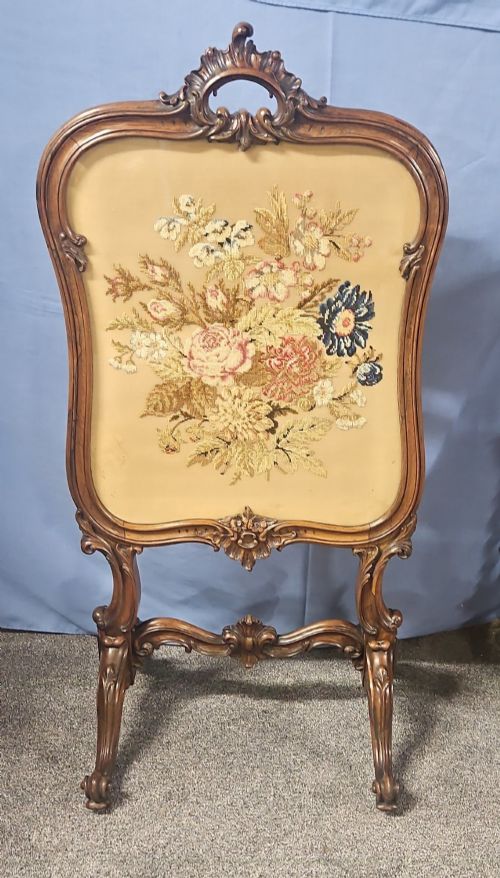
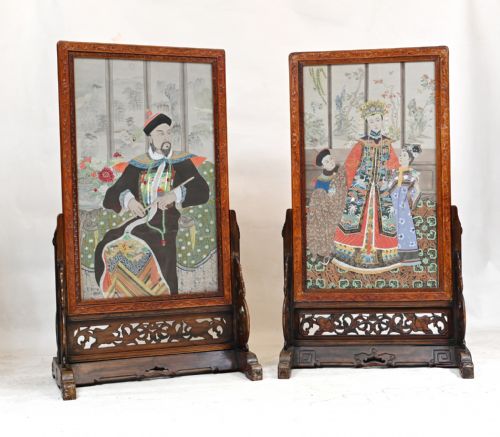
Makers constructed these items using timber frames to support panels of wool, silk, needlepoint, or embroidery. The designs range from carved mahogany and rosewood pole screens to larger cheval formats and Chinese hardwood pairs.
Buyers will encounter various incarnations, from early Georgian Chippendale tripod designs to ornate Victorian Rococo Revival and Black Forest examples. Each version reflects the interior domestic habits of its period.
Materials and construction
Carpenters worked primarily in solid hardwoods such as mahogany, rosewood, walnut, satinwood, and oak to turn the slender poles and carve the heavy tripod bases. Brass mechanisms frequently allowed the textile panels to slide vertically and lock at the desired height.
The decorative panels themselves rely on textiles worked by hand, utilising wool, silk, and glass beads to create needlepoint, tapestry, and embroidery pictures. These panels were stretched securely within wooden frames to hang or tilt upon the upright supports.
The inventory records various object forms, including tripod pole screens, cheval frames, table screens, and Chinese hardwood pairs.
Assessing quality and craftsmanship
The distinction between tiers rests upon the depth of the carving on the wooden base and the tightness of the timber joints. Superior examples display crisp foliage carving on mahogany or rosewood, whilst simpler ones rely on plain turned posts.
The needlework panel dictates much of the visual merit, where fine, even stitches in silk and wool outrank coarser wool needlepoint. The stability of the adjustable sliding mechanism also marks the difference between standard production and finer workshop output.
The Standing Tapestry Screen Glossary
- Pole screen
- A freestanding wooden stand with a vertical shaft that holds an adjustable needlework panel designed to shield a person's face from a fireplace.
- Tripod base
- A three-legged support structure commonly found beneath the upright posts of Georgian and Victorian pole screens.
- Needlepoint
- A type of canvas work embroidery stitched with wool or silk threads, frequently seen on the panels of these screens.
- Cheval screen
- A large standing frame that swings upon two vertical side pillars rather than sliding on a single central pole.
- Palisander
- A dense, dark tropical timber related to rosewood, utilised for cabinet work and decorative frames during the Regency period.
Standing Tapestry Screen: Frequently Asked Questions
How do you use a standing tapestry screen?
These screens were traditionally placed between a seating area and an open hearth to shield the occupants' faces from the intense radiant heat of the fire.
Today, they function as decorative room accents or freestanding panels that introduce colour and historical textile work into a modern interior space.
How do you adjust the panel height?
Most pole screens utilise a small brass collar or friction mechanism hidden behind the textile panel that grips the central wooden shaft.
By loosening this catch, the panel slides vertically to the preferred position before being tightened again to hold it steady.
What woods were used for these screens?
Cabinet makers predominantly selected dense hardwoods such as mahogany, rosewood, walnut, and oak to provide stability for the slender standing poles and carved tripod feet.
Lighter timbers like satinwood appear in specific Victorian pieces, while Chinese examples often employ exotic hardwoods.
How do I identify a Georgian screen?
Georgian and Regency screens typically feature cleaner classical lines, tripod bases with claw and ball or spade feet, and restrained mahogany or rosewood framing.
Later Victorian iterations tend towards heavier carving, rosewood or walnut construction, and more elaborate Rococo Revival or Black Forest ornamentation.