


Rosewood Pole Screen
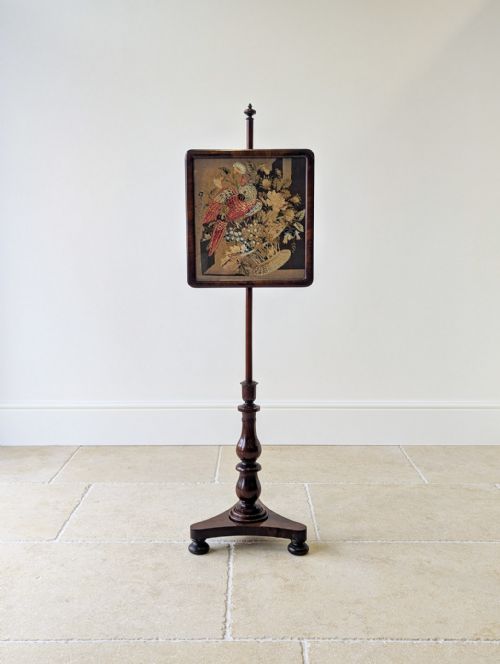
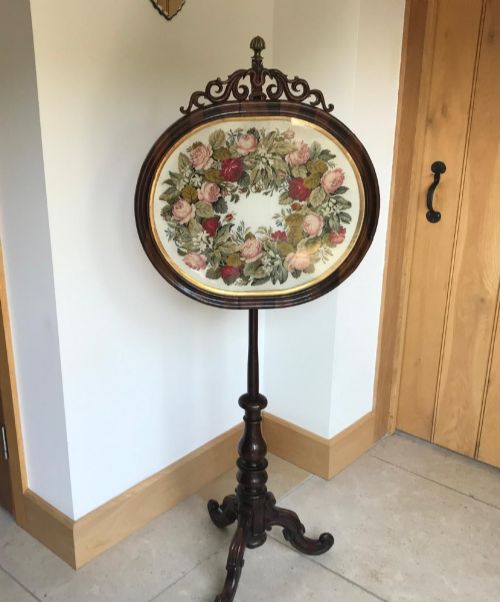
A rosewood pole screen stands ready to block the direct heat of an open fire while serving as a fine focal point in a period room.
What a rosewood pole screen is
A rosewood pole screen consists of a vertical wooden shaft mounted on a weighted base, carrying a sliding panel designed to shield the face from a hearth fire. These pieces emerge primarily from the Regency, Georgian, William IV, and Victorian periods.
The form relies on a clever sliding mechanism that allows the user to raise or lower the central panel along the pole as the fire's intensity shifts throughout the evening. Most examples found here combine dark timber standards with textile panels worked by hand.
You will encounter single screens and matched pairs spanning the early nineteenth century. The typical design pairs a stout turned or carved pillar with a tripod base, topped by a rectangular or shield-shaped needlework screen.
Materials and construction
Makers shaped dense rosewood into slender upright poles and stable tripod feet, sometimes incorporating brass inlay or poker work detail into the timber. The turning lathe shaped the central pillars into baluster and column forms.
The vertical panels use textile inserts such as needlepoint, tapestry, crewelwork, Berlin woolwork, and embroidered silk and wool. These panels sit within timber frames that slide freely on the central pole via a concealed internal collar or thumb screw.
Retail Price Guide 2026
Typical UK retail prices for rosewood pole screen, calculated from the Sellingantiques database of over a million retail prices indexed since 2003. This retail price guide relies exclusively on Sellingantiques data; no external sources or auction records are used, so the figures do not describe the wider market.
These screens saved nineteenth-century complexions from melting their wax-based makeup too close to the fire.
Distinctions in quality
Quality rests in the crispness of the timber carving on the base and the weight of the rosewood utilised for the standard. Superior examples show refined proportions and secure sliding mechanisms that hold the panel firmly at any height.
The needlework panel dictates much of the visual merit, distinguishing between standard woolwork and finely executed petit point tapestry with intricate shading. Original untouched surfaces and matching pairs carry distinct advantages over altered or single items.
Gillows
The Rosewood Pole Screen Glossary
- Pole screen
- A freestanding domestic furniture piece with an adjustable vertical screen mounted on a slender shaft and base, used originally to protect the complexion from open hearth heat.
- Needlepoint
- A type of canvas work embroidery stitched with wool or silk threads, frequently forming the pictorial or floral panels mounted within these screens.
- Regency
- A British design period spanning the early nineteenth century, characterised by classical restraint, architectural lines, and occasional brass ornamentation.
- William IV
- A transitional decorative style from the 1830s that favours heavier proportions, robust scrolling, and rich dark timbers.
- Berlin woolwork
- A colourful method of canvas embroidery popular during the Victorian era, worked from gridded pattern charts using brightly dyed Berlin wools.
Frequently Asked Questions
How do you adjust the panel height?
The inner collar or friction mechanism allows the panel to glide up and down the vertical wooden shaft smoothly.
Users simply slide the frame to the desired position to block radiant heat from the hearth.
Where were these placed in a room?
They sat between the seating area and the fireplace to shield the face from intense radiant heat.
Positioned carefully, they also served to display intricate needlework when the hearth was not lit.
How can I tell a Regency screen from a Victorian one?
Regency models generally exhibit classical restraint with slender proportions and sometimes brass inlay on the rosewood.
Victorian examples often display heavier carving on the pillar and tripod base alongside Berlin woolwork panels.
Are the textile panels original?
Many retain their period needlepoint, tapestry, or crewelwork panels worked in wool and silk.
Careful inspection of the stitching and the rear of the frame reveals how the textile is secured.