
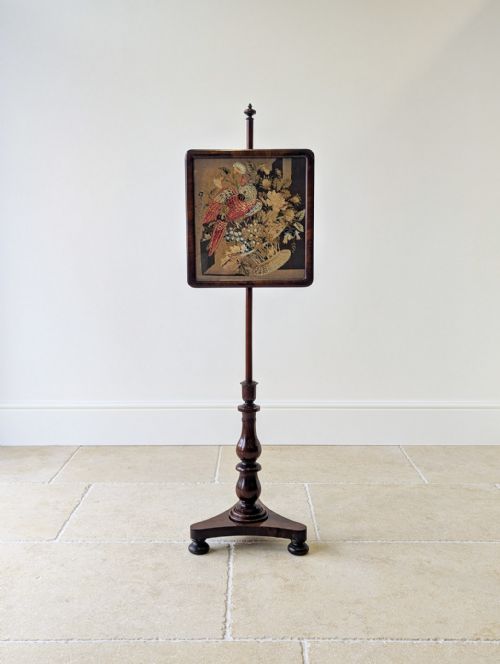
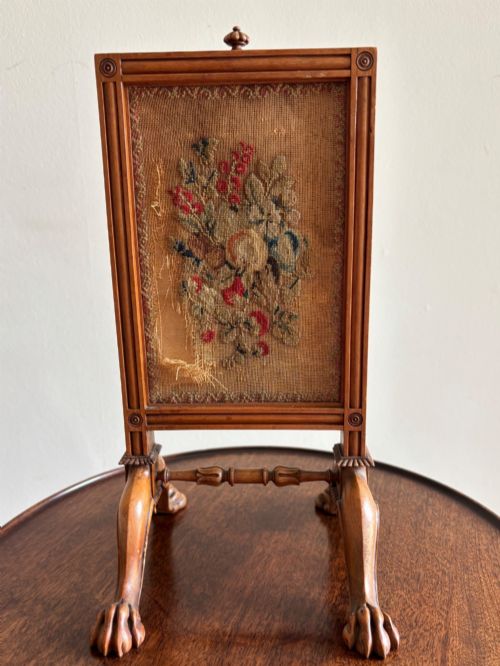


19th Century Pole Screen
These 19th century pole screen pieces are elegant adjustable hearth accessories designed to shield faces from open fires, bringing refined textile panels into a room.
19th Century Pole Screen
A 19th century pole screen is a vertical floor-standing piece consisting of a slender upright standard, a heavy supporting base, and a sliding panel that adjusts to block radiant heat. The selection focuses heavily on Regency and William IV examples, alongside Victorian iterations and occasional Georgian pieces.
Most pieces feature textile panels such as needlepoint, tapestry, or embroidery, though glass reflectors and poker work panels also appear. The forms range from single screens to matched pairs in mahogany, rosewood, and giltwood.
Materials and construction methods
Cabinetmakers constructed the main standards and bases from dense hardwoods like mahogany and rosewood, frequently incorporating turned shaping and carved details. Giltwood and brass components appear regularly, providing structural support and mechanical adjustment for the sliding panels.
Needlework panels utilise wool and textile threads worked by hand into intricate tapestries and embroidery. These textiles are then mounted into wooden or gilt frames designed to slide smoothly along the vertical brass or wooden pole.
19th Century Pole Screen Retail Price Guide 2026
Typical asking prices for 19th century pole screen among the pieces listed under this phrase on Sellingantiques today, from the lower quarter to the upper quarter. They describe what is for sale here now, not the wider market.
Period attribution across the inventory extends from Georgian and Regency eras through to William IV and Victorian designs.
Distinctions in execution and condition
Quality rests in the sculptural depth of the carved wooden bases, the stability of the adjustable mechanism, and the integrity of the timber. Dense rosewood and finely figured mahogany denote superior workshop output.
The needlework panel represents a major quality marker, where dense stitching, well-preserved wools, and intricate pictorial designs elevate the piece above simpler domestic work.
The 19th Century Pole Screen Glossary
- Pole screen
- A vertical standard supporting an adjustable sliding panel used near a fireplace. It protects the face from the intense heat of an open coal fire.
- Needlepoint
- Embroidery stitched onto a stiff open-weave canvas ground. It forms the decorative pictorial or floral panels seen on these screens.
- Giltwood
- Timber coated with a thin layer of gold leaf. This finish adds bright reflective highlights to the carved frames.
- Poker work
- Pyrography created by burning designs into a wooden panel. This technique occasionally replaces textile panels in surviving examples.
- Goncalo Alves
- A dense exotic hardwood with striking figuring. Cabinetmakers utilised this timber for high-status Regency furniture.
19th Century Pole Screen: Frequently Asked Questions
How did people use a pole screen?
These screens stood beside the fireplace to shield a lady's face from the intense radiant heat of an open fire, which could otherwise melt heavy makeup or damage the complexion.
Users adjusted the height of the central panel along the vertical pole to suit their seated position in the room.
How do I date a pole screen?
Dating relies on the prevailing style of the wooden base, such as the chunky scrolled feet of the William IV period or the lighter reeded standards of the Regency era.
Needlework styles and mounting techniques also help narrow down the period of manufacture.
Can I adjust the screen height safely?
Most surviving examples retain their original brass or wooden friction mechanisms inside the sliding collar.
Gentle handling ensures the internal mechanism continues to hold the panel securely at the desired height.
Are these pieces usually found as pairs?
While many survive as single items meant for individual placement near a hearth, matched pairs occasionally appear in the record.
Pairs generally command strong interest from collectors seeking symmetry in larger reception rooms.