
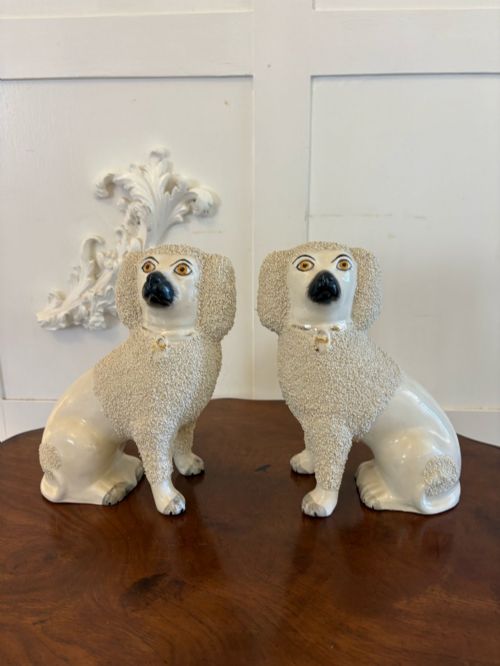
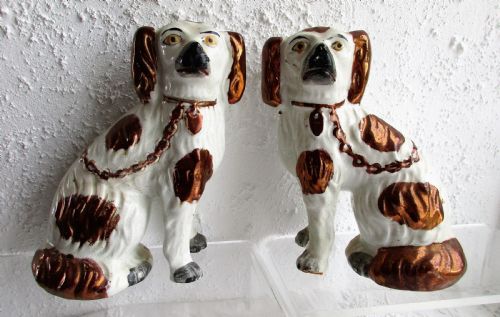


Staffordshire Fireplace Dogs
These Staffordshire fireplace dogs bring quiet Victorian character to a mantelpiece, offering traditional ceramic companionship from the nineteenth century.
Staffordshire Fireplace Dogs
When you search for Staffordshire fireplace dogs, you find ceramic figures made to sit in pairs guarding hearths during the nineteenth century. These decorative objects take the form of spaniels, poodles, greyhounds, pugs, and hunting dogs with hares.
The pieces on this page are most commonly Victorian pairs, spanning decades from eighteen fifty to nineteen hundred. They appear in collections of four or five pieces as well as traditional pairs meant to flank a fireplace.
Makers shaped these pottery figurines as decorative objects to sit upon mantelpieces across British homes. The selection ranges from white and gilt models to black and white or copper lustre variants.
Clay, glaze, and hand painting
Potters shaped these earthenware figures using ceramic techniques typical of Victorian country pottery. Artisans applied lead glaze and enamel over the pottery bodies to create smooth surfaces.
Makers added details using gold leaf and copper lustre finishes. Certain pieces received hand-painted touches and glass eyes to give the ceramic figures realistic expressions.
Some nineteenth-century spaniels peer out with glass eyes, watching the room with an attentive gaze from the mantelpiece.
Refining the pottery standard
Quality in these ceramic figures rests on the crispness of the moulding and the care taken with hand-painted details. Superior pieces show precise brushwork on the faces and coats.
The application of copper lustre or gold leaf separates standard pairs from finer examples. Uniformity in the glaze and intact glass eyes elevate the presence of the ceramic pair on a mantel.
The Staffordshire Fireplace Dogs Glossary
- Earthenware
- Porous pottery fired at lower temperatures. It forms the primary ceramic body for these nineteenth-century figures.
- Copper Lustre
- A metallic glaze finish reflecting coppery tones. It appears on specific Victorian Staffordshire dog pairs.
- Comforter Spaniels
- Popular Victorian pottery dog figures placed on mantelpieces. They represent the spaniels kept by royalty and the public alike.
- Lead Glaze
- A glossy coating applied to ceramic ware before firing. It creates a smooth, shiny surface across the earthenware body.
Staffordshire Fireplace Dogs: Frequently Asked Questions
Where did Staffordshire dogs sit?
These ceramic figures sat in pairs on mantelpieces above fireplaces in nineteenth-century homes. People arranged them facing inward toward the hearth as decorative companions.
Today, collectors place them in similar settings on mantelpieces, side tables, or shelves to bring Victorian character into a room.
What breeds do these figures represent?
The listings include spaniels, poodles, greyhounds, pugs, and hunting dogs with hares. Spaniels remain the most common breed encountered among the pairs.
Each breed reflects popular nineteenth-century tastes in household pets and sporting animals, modelled in earthenware by pottery makers.
How do I date a Staffordshire dog?
Dating relies on stylistic clues, glazing techniques, and recorded periods spanning from eighteen fifty to nineteen hundred. Nineteenth-century examples often feature hand-painted enamel or copper lustre details.
Examining the earthenware body and the presence of glass eyes helps distinguish pieces made across the Victorian era.
Are they sold as pairs?
Most Staffordshire fireplace dogs appear as matching pairs intended to flank a fireplace or centrepiece. Some collections consist of four or five pieces together.
Pairs show a left and right orientation so the dogs face one another when placed on a mantel.