




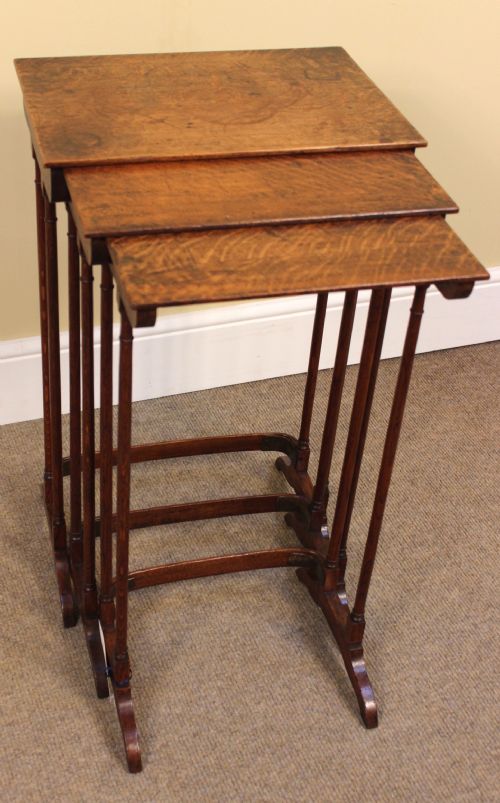

Stacking Accent Tables
Stacking accent tables offer practical multi-tiered surfaces that slide together neatly when floor space matters.
Stacking Accent Tables
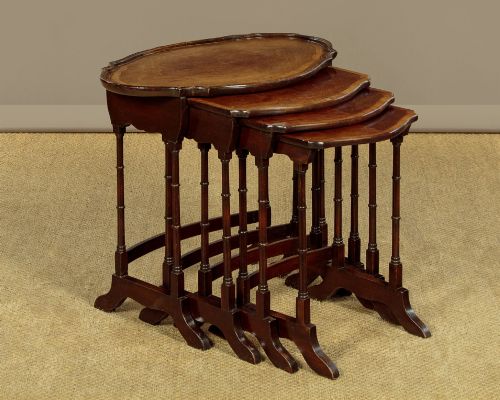
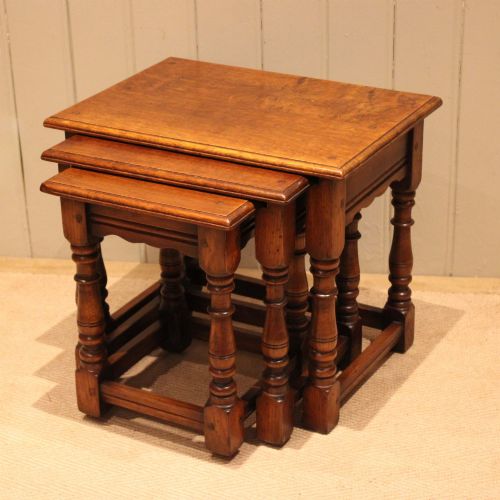
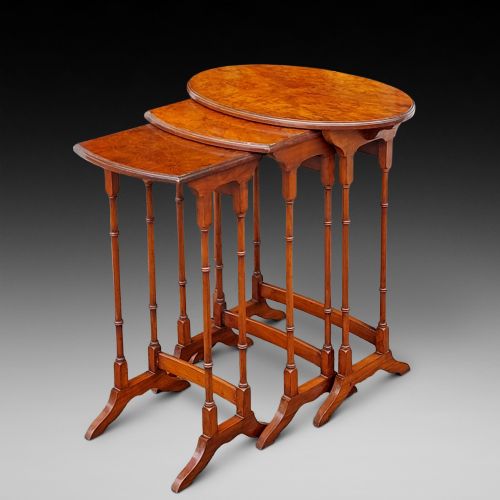
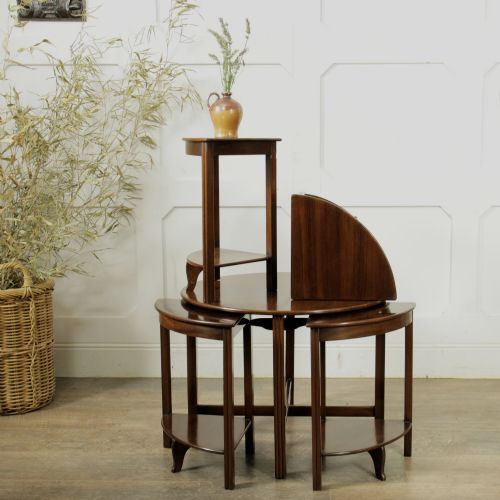
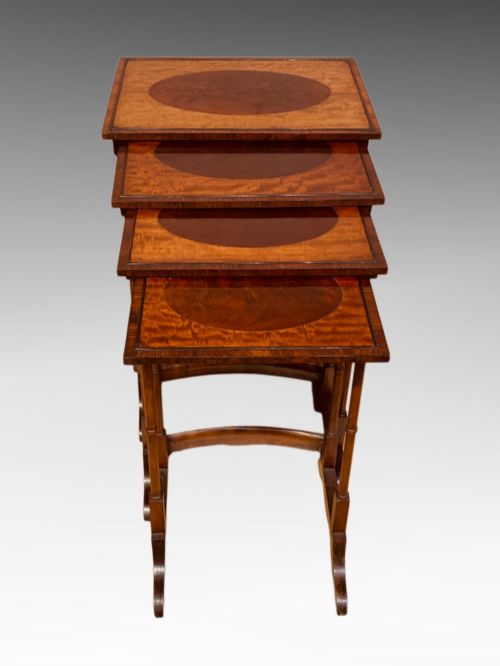
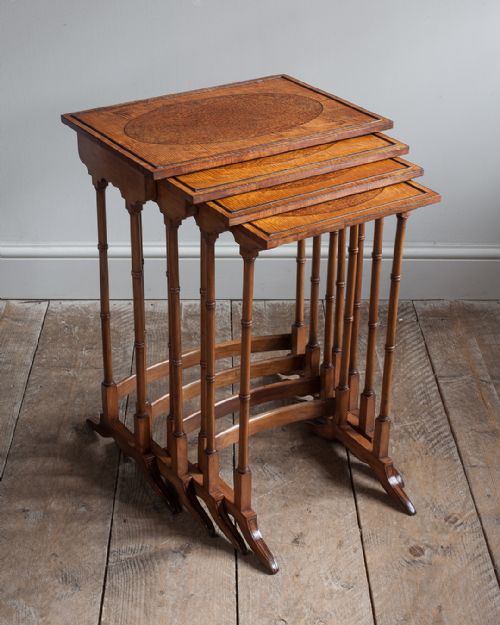
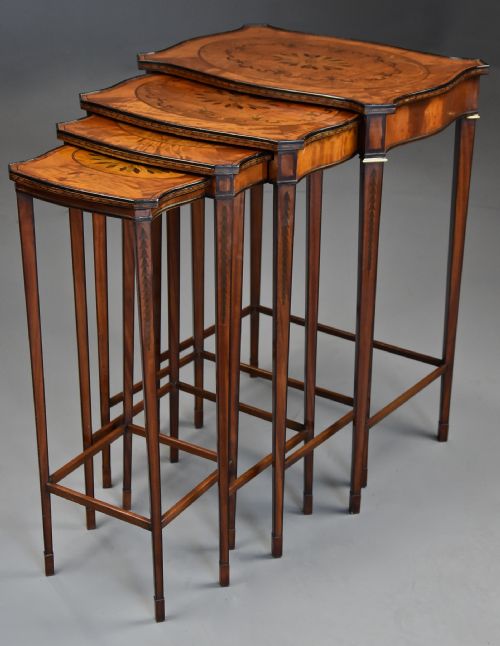
Stacking accent tables appear across this selection as nests of three, four, or five graduated surfaces designed to slide beneath one another. These space-saving pieces emerge frequently in Edwardian and nineteenth-century formats, ranging from simple oak versions to elaborate inlaid designs.
Makers produced these tiered sets in various configurations, including circular, oval, kidney-shaped, and serpentine forms. The pieces function primarily as movable tea tables or occasional surfaces that deploy instantly when guests arrive.
Materials and construction
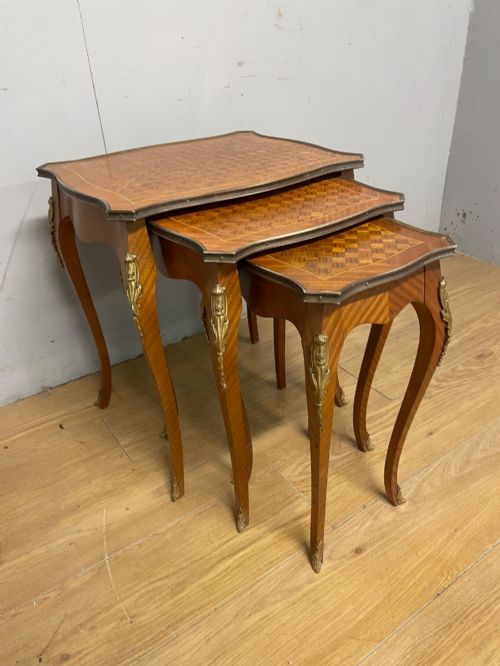
Cabinetmakers utilised dense timbers such as mahogany, walnut, oak, rosewood, and satinwood, often applying burr veneers or parquetry to the main surfaces. Workshops integrated fine inlay work using contrasting woods to decorate the tops of individual tables.
Oriental examples employ dense hardwoods, whilst French pieces frequently display floral marquetry, boulle-work, and black lacquer finishes. Individual frames rely on slender turned legs or vertical supports scaled to allow each smaller table to slide into the next.
Listings demonstrate that mahogany and oak form the most common structural timbers across nineteenth-century and Edwardian stacking tables.
Quality and craftsmanship
Construction standards reveal themselves in the precision of the joints and the smoothness with which the graduated tables nest together without binding. Superior examples maintain structural rigidity across all tiers despite the slender proportions required for stacking.
Decorative ambition separates standard utility pieces from high-end workshop productions, particularly in the complexity of parquetry, hand-cut inlay, and specific wood selections like burr walnut or figured satinwood.
Émile Gallé
The Stacking Accent Tables Glossary
- Quartetto
- A set of four stacking tables designed to nest together. The term appears frequently in nineteenth-century and Edwardian cataloguing.
- Parquetry
- Geometric mosaic woodwork formed by small fitted pieces of veneer. Makers applied this technique to tabletop surfaces for decorative pattern.
- Boulle-work
- Elaborate inlay work utilising brass, tortoiseshell, or other materials set into a dark ground. It appears on French decorative pieces.
- Serpentine
- A gently undulating curved line forming the edge of a tabletop. This profile demands precise woodworking skill to execute cleanly.
- Satinwood
- A durable tropical timber with a lustrous yellowish grain. Cabinetmakers utilised it extensively for light-coloured stringing and fine veneer panels.
Stacking Accent Tables: Frequently Asked Questions
What is a quartetto nest?
A quartetto nest refers specifically to a set of four tables designed to slide neatly beneath the largest member of the group.
This term appears frequently in Edwardian and nineteenth-century trade descriptions for matching stacking tables.
How were stacking tables used?
These pieces served historically as tea tables or occasional surfaces that occupants could deploy around a room as needed.
When not in use, the smaller tiers slid away underneath the main table to conserve floor space.
How do I identify Edwardian examples?
Edwardian stacking tables often feature lighter timbers such as satinwood or mahogany enhanced with delicate stringing and inlay.
Makers of this period favoured refined proportions and frequently produced sets of three or five graduated tables.
What are Chinese nesting tables?
Chinese nesting tables typically consist of four heavy hardwood surfaces carved with traditional oriental motifs or clean geometric lines.
These pieces rely on solid construction rather than applied veneers to achieve their durable structure.