
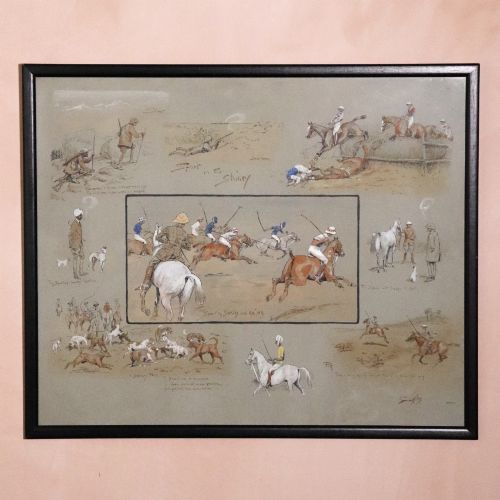


Snaffles Equestrian Art
Snaffles equestrian art captures the spirit of the hunting field and military life through distinct prints and watercolours.
Snaffles Equestrian Art
Snaffles equestrian art comprises original prints and watercolours spanning the early twentieth century, focusing on hunting, military subjects, and country pursuits. These works reflect British sporting art traditions from the nineteen hundreds through to the nineteen forties, often framed in wood or oak.
Buyers commonly encounter framed prints and original watercolour paintings on paper, sometimes enhanced with gouache. The subjects range from fox hunting scenes and point-to-points to military garrison life and canine studies.
Pieces from this category bring a distinct Edwardian and British country house aesthetic to an interior. They record a specific era of sporting culture through the recognisable hand of the artist.
How they were made
Works in this category utilise paper as the primary medium for both printed editions and hand-painted watercolours and gouache. Prints often receive hand-colouring to enrich the printed line before framing.
Framing materials rely on wood, frequently employing oak and gilt mouldings protected by glass. These traditional framing methods secure the delicate works on paper for display.
Listings span the decades from nineteen hundred to nineteen forty, using paper, watercolour, gouache, oak, and glass.
What varies in quality
Quality rests upon the distinction between an original watercolour painting and a published print. Watercolours offer unique brushwork and pigment depth, whereas prints rely on the crispness of the original impression and the precision of any subsequent hand-colouring.
The condition of the paper and the integrity of the original framing, such as oak frames and glass, influence the overall character of the piece. Stronger impressions and well-preserved pigments distinguish the finer examples within the range.
Charles Johnson Payne Snaffles
The Snaffles Equestrian Art Glossary
- Watercolour painting
- A work executed with water-soluble pigments on paper. This medium allows for transparent washes and fine detail in early twentieth-century sporting scenes.
- Gouache
- An opaque water-based paint used to add highlights and solid colour to works on paper. It provides rich opacity alongside watercolour washes.
- Framed print
- An impression on paper set behind glass within a wooden moulding. This presentation protects works from environmental damage while allowing clear display.
- Oak frame
- A heavy wooden housing constructed from oak to support and protect prints and paintings. It forms a traditional border common in British sporting art.
- Gilt
- A thin layer of gold leaf or metallic finish applied to frames. This treatment adds a reflective edge to the wooden moulding.
Snaffles Equestrian Art: Frequently Asked Questions
Are these works original?
The selection includes both original watercolour paintings and original prints created during the early twentieth century. Each piece reflects the distinct hand or printing technique of the period.
Buyers should examine the title of each listing to distinguish between a unique watercolour painting and an original print edition.
How should I frame these pieces?
Many examples arrive in period frames made of wood, oak, or gilt under glass. Preserving these historic housings maintains the character of the artwork.
When framing, ensure the paper remains protected behind glass away from direct sunlight to prevent fading of the pigments.
What subjects do these artworks depict?
The works primarily illustrate British sporting art, Edwardian hunting scenes, and military garrison life. Common themes include point-to-point races, huntsmen, and canine studies.
Scenes range from British colonial contexts to traditional country house pursuits recorded between nineteen hundred and nineteen forty.
What materials are used in these pieces?
Artworks are executed on paper using watercolour, gouache, and printmaking techniques. These are typically mounted behind glass within wooden or oak frames.
Gilt finishes frequently appear on the mouldings, adding traditional decorative detail to the framing.