


Charles Johnson Payne Print
A charles johnson payne print captures the spirited character of British sporting art through vivid hand-coloured prints, watercolours, and gouache works.
Charles Johnson Payne Print
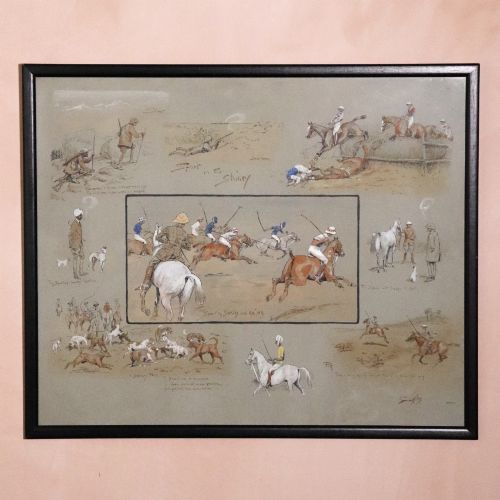
A charles johnson payne print brings the dynamic world of British sporting art into domestic spaces, capturing fox hunting, horse racing, and military life with distinct personality. These works span the early twentieth century, reflecting Edwardian traditions and country house aesthetics through humorous and observant vignettes.
Buyers will most frequently encounter framed prints alongside original watercolours and gouache paintings. These framed artworks often retain their original wood and oak frames, preserving the complete period presentation.
The subjects range from hunting sequences and military sketches to coastal scenes and canine portraits. Each piece documents a vanished era of equestrian and social pursuits with characteristic charm.
How they were made
The works rely upon paper as the primary medium for both printed editions and original painted compositions. Artists and publishers utilised watercolour and gouache to apply vibrant colour washes over the underlying printed lines.
Framing materials typically consist of wood and oak, enclosing the paper behind protective glass. These traditional enclosures secure the delicate works while maintaining the visual style of the period.
Charles Johnson Payne Print Retail Price Guide 2026
Typical asking prices for charles johnson payne print among the pieces listed under this phrase on Sellingantiques today, from the lower quarter to the upper quarter. They describe what is for sale here now, not the wider market.
Listings span the Edwardian period through the mid-twentieth century, utilising paper, watercolour, gouache, wood, and oak.
What varies in quality
Quality rests upon the strength of the original composition and the vibrancy of the hand-applied pigments. Works featuring distinct watercolour or gouache additions demonstrate superior artistic engagement compared to standard monochrome impressions.
The preservation of the paper surface and the integrity of the original wood or oak frame dictate the overall desirability of the piece. Clean margins, clear signatures, and stable framing elevate individual examples within the genre.
Charles Johnson Payne Snaffles
The Charles Johnson Payne Print Glossary
- Gouache
- An opaque water-based paint that provides solid areas of colour and dense highlights. This medium frequently appears alongside watercolour in original works.
- Watercolour
- A transparent paint medium applied to paper to create luminous washes. It forms the basis of many original equestrian and sporting compositions.
- Framed Print
- An image produced on paper from an original plate, secured behind glass within a protective border. These items form the majority of available artworks.
- British Sporting Art
- A genre focusing on horses, hounds, hunting, and rural pastimes. The style defines the visual culture of country houses and garrison towns.
- Edwardian Sporting Art
- Visual works produced during the early twentieth century under Edwardian cultural influences. This classification marks the chronological beginning of the listed period.
Charles Johnson Payne Print: Frequently Asked Questions
What subjects do these prints show?
The works predominantly depict traditional equestrian pursuits, including fox hunting, horse racing, and point-to-point events. Military life and canine studies also feature prominently across the available selection.
Scenes range from humorous military anecdotes to dramatic field moments, capturing the social atmosphere of early twentieth-century Britain.
Are these works original or reproductions?
The selection includes both original painted works in watercolour and gouache, as well as period printed editions. Many prints feature hand-coloured details applied directly to the paper surface.
Each listing specifies whether the piece is an original painting or a printed artwork from the period.
How should I display a framed print?
These pieces require placement away from direct sunlight to protect the paper and watercolour pigments from fading. Maintaining stable indoor humidity prevents warping in the wood and oak frames.
Displaying them at eye level in traditional interiors allows the detailed narrative elements of the sporting scenes to be fully appreciated.
How do I date an early twentieth-century artwork?
Dating relies upon the recorded period of production, which spans from the Edwardian era through the mid-century decades. Stylistic markers and framing materials often provide contextual clues to the exact decade.
Many compositions bear specific publication dates or stylistic traits characteristic of work produced between nineteen-hundred and nineteen-fifty.