
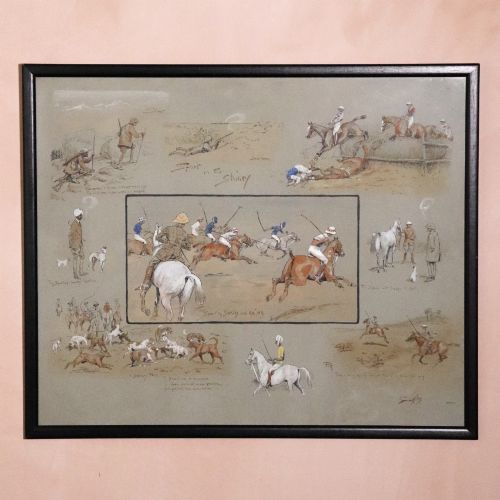


Snaffles Original Print
Snaffles original print selections capture Edwardian sporting life with humour and verve, offering collectors a tangible piece of British military and hunting heritage.
Snaffles Original Print
A snaffles original print brings the distinct equestrian, military and sporting subjects of the artist Charles Johnson Payne into domestic spaces. Collectors searching for a snaffles original print will frequently encounter framed works depicting point-to-point racing, military garrison life and British colonial scenes from the early twentieth century.
The material record spans Edwardian sporting art through to mid-century printed cards and Christmas greetings. These framed pieces carry the recognizable titles and hand-finished details characteristic of the artist's output across several decades.
Materials and technique
The physical objects rely on paper mounted within wooden surrounds, frequently utilising oak frames and glass protection. Many examples incorporate watercolour washes applied over printed lines, giving individual character to published editions.
Production methods combine standard printmaking processes with manual touches that distinguish contemporary workshop output. The physical weight of the oak frame and the texture of the aged paper ground each surviving piece firmly in its period.
Current listings feature paper, glass, wood, watercolour and oak frames spanning the Edwardian period to the nineteen-fifties.
Assessing quality and preservation
Distinction across the range rests upon the vibrancy of the remaining colour and the preservation of the paper support. Examples retaining crisp plate marks and strong hand-coloured pigments command greater attention from discerning collectors.
The integrity of the original framing and the clarity of the printed title inscription contribute significantly to the overall presence of the piece. Conservation of the paper against light degradation maintains the visual impact intended by the artist.
The Snaffles Original Print Glossary
- Original Print
- An impression pulled from a plate etched, engraved or lithographed under the artist's direction. These works form the core of published sporting series.
- Watercolour
- A paint medium utilising water-soluble pigments on paper. The artist often applied this by hand to enhance monochrome print editions.
- Oak Frame
- A protective wooden enclosure constructed from durable oak timber. Such surrounds frequently define the domestic presentation of early twentieth-century British art.
- Printed Card
- A smaller format card stock used for greetings, invitations or seasonal messages. These often carry miniature reproductions of popular sporting subjects.
- Sporting Art
- Genre art depicting equestrian pursuits, hunting, shooting and canine subjects. This tradition forms the primary context for the artist's entire creative output.
Snaffles Original Print: Frequently Asked Questions
What subjects do these prints show?
The imagery focuses heavily on horses, military life, fox hunting and colonial garrison scenes. Subjects range from point-to-point racing to humorous anecdotes from the field.
Characters in uniform and mounted riders dominate the compositions, reflecting the sporting culture of the British country house and regiment.
How should I hang these framed works?
Selecting a spot away from direct sunlight protects the delicate paper and watercolour pigments from fading over time. Stable indoor humidity prevents warping in the wooden frames.
Grouping several pieces together creates a traditional gallery wall reminiscent of a British country house interior.
Are these works hand-coloured?
Many examples feature hand-applied watercolour over a printed base, a technique characteristic of the artist's production method. This touch adds individual variation to published editions.
Close inspection often reveals the brushstrokes that animate the printed horses, uniforms and landscapes.
What periods do these pieces date from?
The available selection spans the early twentieth century, specifically from the Edwardian era through the 1950s. Production clustered heavily around the decades preceding and following the First World War.
Printed cards and greetings extend into later decades, documenting the enduring popularity of the artist's military and sporting themes.