


Framed Snaffles Print
A framed snaffles print brings the spirited world of early twentieth century British sporting art directly to your walls.
Framed Snaffles Print
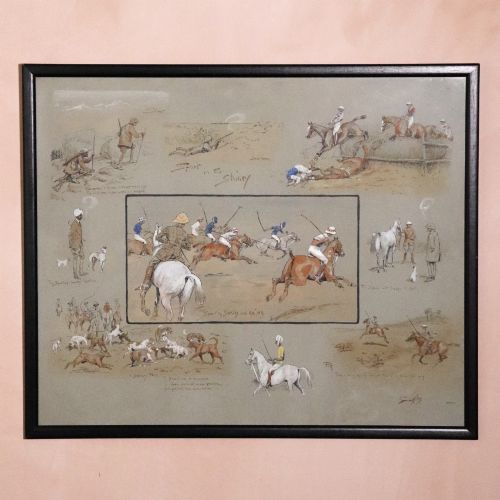
A framed snaffles print captures the distinctive equestrian and military subjects created by the artist Charles Johnson Payne, widely known as Snaffles. These works span from the Edwardian era through the mid twentieth century, recording hunting scenes, military life and rural pursuits with characteristic humour and precision.
Buyers seeking a framed snaffles print will most commonly encounter original prints on paper, often complemented by gouache or watercolour highlights, housed within traditional wooden or oak frames protected by glass. The subjects range from classic fox hunting moments to regimental scenes and canine portraits.
The aesthetic is deeply rooted in British country house tradition and British sporting art, reflecting an era of military service and field sports. Each piece offers a window into early twentieth century British culture through the distinctive hand and eye of a celebrated sporting illustrator.
Materials and construction
These works rely on paper as the primary medium for the printed image, frequently enhanced with watercolour or gouache applied by hand to add colour and depth. The prints are mounted behind glass to protect the delicate paper surface and pigments from environmental damage.
The surrounding framework typically utilises wood or solid oak, forming a robust barrier that preserves the artwork. These traditional framing materials reflect the standard workshop practices of the early twentieth century, ensuring the piece remains stable over decades.
One cheerful card captures the seasonal spirit with the exclamation Forrard Forrard Forrid!
Elements of quality
Quality in these works rests upon the crispness of the original printed line and the vibrancy of any hand applied watercolour or gouache. Examples where the artist has added significant hand finishing stand apart from standard mass produced impressions.
The integrity of the framing materials also influences the overall standard, with period oak frames providing a more fitting context than modern replacements. Preservation of the paper without excessive fading or discoloration distinguishes the finer specimens from the more worn.
Charles Johnson Payne Snaffles
The Framed Snaffles Print Glossary
- Snaffles
- The professional pseudonym of Charles Johnson Payne, an influential British artist renowned for his sporting and military watercolours and prints. His work defined the visual style of early twentieth century military and hunting life.
- Gouache
- An opaque watercolour medium used by the artist to add solid highlights and rich colour to prints and paintings. It provides a heavier, more vivid finish than transparent watercolour alone.
- Point-to-point
- An amateur steeplechase horse race held over natural hunting country, frequently featured as a subject in the artist's hunting scenes. This theme captures the core of British rural sporting tradition.
- Watercolour
- A paint consisting of pigment suspended in a water-based solution, utilised both independently and to embellish printed works. It offers transparent washes that define light and atmosphere in sporting compositions.
- Edwardian sporting art
- The genre of painting and illustration depicting field sports and equestrian subjects during the reign of King Edward VII and the subsequent decades. This period produced some of the most sought after works by military and hunting artists.
Framed Snaffles Print: Frequently Asked Questions
What subjects do these prints show?
The artworks primarily depict hunting scenes, military life, regimental characters and rural canine subjects. They capture specific moments from British sporting and military culture between the Edwardian era and the mid twentieth century.
Many compositions incorporate humorous captions or distinct local references that reflect the lifestyle of the British garrison and country house.
Are these prints hand coloured?
Many examples feature hand applied watercolour or gouache over the printed base. This added pigment gives individual character and depth to the imagery.
Not every piece includes hand colouring, as some exist purely as monochrome or standard printed impressions issued during the artist's active decades.
How should I frame and display them?
Display the artwork away from direct sunlight to prevent the paper and any watercolour pigments from fading over time. Maintaining a stable indoor environment protects both the paper and the original wooden frame.
Keeping the glass clean and ensuring the backing remains sealed will preserve the condition of the paper for years to come.
How can I tell the period of a print?
Dating relies on the recorded production eras, which range from the early 1900s through the 1950s. The style of the paper, the framing materials and the specific regiment or hunting subject often point to a particular decade.
Certain titles correspond to known publication dates or specific historical periods in the artist's working life.