
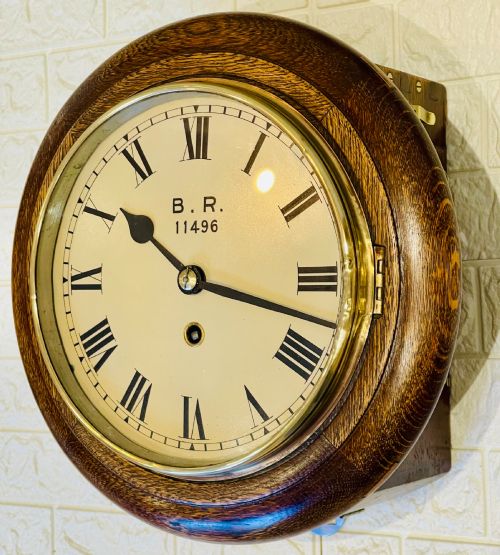
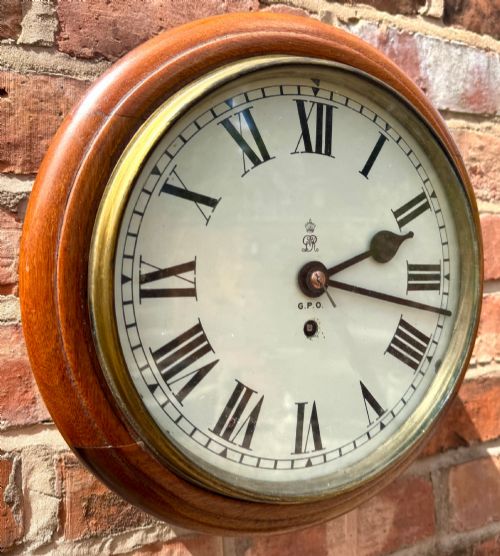


Single Fusee Movement
A single fusee movement drives a reliable clock mechanism, offering steady power delivery from a spring or weight via a conical pulley.
Single Fusee Movement
When you search for a single fusee movement, you encounter clocks designed to maintain even force as the mainspring unwinds. These mechanisms appear inside wall clocks, mantel clocks, library timepieces, and drop dial London wall clocks.
The pieces listed on this page span the 19th Century, Regency, Victorian, Edwardian, and 1950 periods. You will frequently find railway wall clocks alongside elegant mahogany and gilt ormolu mantel pieces.
How they were made
Clockmakers constructed these movements using brass, iron, and glass housed within wooden cases of mahogany, oak, and satinwood inlay. Gilt bronze and patinated bronze finishes appear on decorative mantel clocks, while railway and drop dial wall clocks utilise sturdy timber surrounds.
The single chain fusee mechanism connects to the barrel via a cord or chain, ensuring the drive force remains constant as the spring tension drops. Makers also incorporated specialised components like year-going movements and miniature balloon cases.
Single Fusee Movement Retail Price Guide 2026
Typical asking prices for single fusee movement among the pieces listed under this phrase on Sellingantiques today, from the lower quarter to the upper quarter. They describe what is for sale here now, not the wider market.
Some railway clocks kept passengers on time while smelling faintly of coal smoke and decades of station tea.
What varies in quality
Quality separates standard utilitarian timepieces from finer decorative examples through the precision of the brass mechanism and the choice of case materials. Finer items feature signed dials, ormolu mounts, and detailed inlay work rather than plain utilitarian timber.
The execution of the dial and the refinement of the cabinetwork determine the standing of each clock. Signed London makers and specialised library clocks represent a higher tier of craftsmanship compared to standard railway office timepieces.
W. Burton·Phillips Brothers·Hay London·JOHN WALKER·SLY WEYMOUTH·Henry Berkeley Square London·John Massey
The Single Fusee Movement Glossary
- Fusee
- A conical pulley used in a clock to maintain even power as the mainspring unwinds. This device compensates for the decreasing tension of the spring.
- Mantel clock
- A clock designed to sit on a shelf or fireplace mantel. These often feature decorative cases in mahogany or gilt bronze.
- Drop dial
- A wall clock featuring an extended case below the dial to accommodate a pendulum. This form is common in railway and office environments.
- Ormolu
- Gilded bronze used for decorative mounts on furniture and clock cases. It adds a bright metallic finish to period pieces.
Single Fusee Movement: Frequently Asked Questions
What is a single fusee movement?
A single fusee movement uses a conical pulley and a chain or cord to equalise the power delivered by the mainspring. This ensures the clock maintains consistent timekeeping as the spring unwinds.
Such mechanisms are found in various 19th Century and Edwardian timepieces, ranging from railway wall clocks to ornate mantel pieces.
How do I wind a fusee clock?
Winding requires a key inserted into the dial face to turn the fusee arbor. Care must be taken not to overwind the mechanism.
These clocks typically run for eight days or longer depending on the specific gear train and movement design.
Where were these clocks used?
They served practical and decorative roles in diverse settings, including railway stations, offices, libraries, and domestic drawing rooms. Railway companies utilised robust oak wall clocks for precise timetabling.
Library and table clocks provided quiet service in private studies and formal rooms.
How do I identify the period?
Dating relies on the style of the case, the timber used, and the signature of the maker inscribed on the dial or movement. Regency and Victorian pieces often display distinct decorative motifs.
Later examples from the Edwardian period or mid-20th Century reflect simpler lines or specific institutional use.